
MEDDIC sales methodology: A practical guide to qualifying deals

Table of Contents:
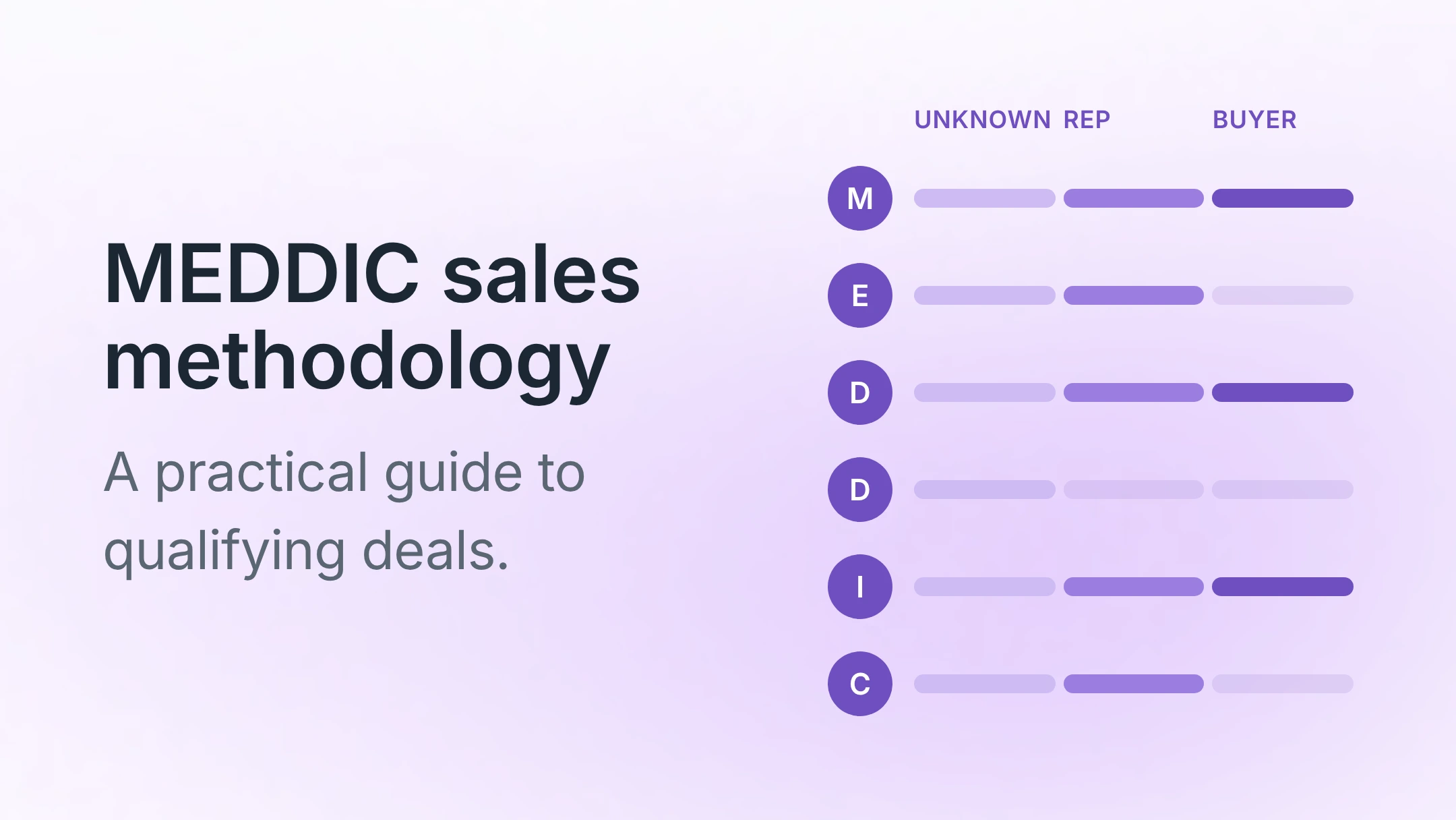
MEDDIC is a six-part qualification framework B2B sales teams use to test whether a deal can close: Metrics, Economic Buyer, Decision Criteria, Decision Process, Identify Pain, and Champion.
If you manage a pipeline, MEDDIC matters most on the deals that look healthy. A complete CRM record, an engaged contact and a close date this quarter can still hide an economic buyer nobody on your team has met.
This guide shows you how to qualify each criterion with evidence the buyer has confirmed, and how to use that evidence in deal reviews and forecast calls. It starts with the definition and the six criteria, then covers discovery questions, a worked example, a checklist and the MEDDIC evidence ladder, a three-level scale for grading how much you know about each deal.
TL;DR
- MEDDIC qualifies a deal on six criteria: Metrics, Economic Buyer, Decision Criteria, Decision Process, Identify Pain and Champion.
- A criterion counts once the buyer confirms it. The MEDDIC evidence ladder grades each one as Unknown, Rep-reported or Buyer-confirmed.
- You get discovery questions for every criterion, a worked deal example and a qualification checklist for your next pipeline review.
- Managers use MEDDIC evidence to inspect deals and challenge forecast categories. It informs their judgment and doesn't guarantee forecast accuracy.
- MEDDICC adds Competition. MEDDPICC adds Paper Process and Competition for longer, procurement-heavy cycles.
What is the MEDDIC sales methodology?
The MEDDIC sales methodology is a B2B qualification framework that checks whether an opportunity has a quantified business case, an engaged economic buyer, known decision criteria and process, a confirmed pain, and an internal champion. Sales teams use it to decide which deals deserve time and which carry hidden risk.
MEDDIC is a popular sales methodology designed to help teams qualify and prioritize leads.
Three traits define how it works in practice:
- It's a qualification framework. Reps can uncover the six criteria in any order and at any stage of the deal.
- It fits deals with several stakeholders, a business case and a formal approval process, which describes most mid-market and enterprise B2B sales.
- It measures evidence. A criterion counts once the buyer has confirmed it, a higher bar than a rep having asked the question.
Each letter in the acronym stands for one thing you need to learn about the deal, covered next.
What does MEDDIC stand for?
MEDDIC is an abbreviation that stands for:
- Metrics
- Economic Buyer
- Decision Criteria
- Decision Process
- Identify Pain
- Champion
Each criterion below follows the same pattern: a definition, what to establish, discovery questions, credible evidence and a warning sign.
1. Metrics
Metrics represent the economic value or impact your prospect aspires to generate from using your product or service. You can identify these metrics important to your buyers by asking them questions related to increasing revenue, cutting down costs, improving team efficiency, or any other measurable KPI that your solution aims to solve. Once you understand their priorities, you can point to the capabilities of your product that address their business goals.
- What to establish: The KPI the buyer will measure, its current baseline, the target and the cost of doing nothing.
- Questions: "Which KPI would this project move, and where is it today?" "What does a 10% change in that number mean in revenue or cost?"
- Credible evidence: The buyer states the baseline and target in their own words, or shares a document that does.
- Warning sign: The only metric in the deal record came from your ROI calculator, and the buyer has never repeated it.
2. Economic Buyer
The economic buyer is an individual or multiple stakeholders with the authority to make the purchasing decision on behalf of the organization. You want to identify and engage with the decision-makers from early on to make sure you're spending your time and energy on the right people who have the power to move the deal forward.
- What to establish: Who owns the budget, whether they know about the evaluation, and what they need to see to approve it.
- Questions: "Who signs off on a purchase of this size?" "Has that person seen the business case yet?"
- Credible evidence: You've met or emailed the economic buyer, or the champion relays a specific approval condition from them.
- Warning sign: The CRM lists a job title such as "CFO", but nobody on your team has met that person or heard their priorities.
3. Decision Criteria
What factors do prospects consider when making a purchase decision? These could be anything ranging from budget to ease of implementation, compatibility with the existing tech stack, and product capabilities. Find out what criteria are important to your prospects so you can tailor your messaging to what they care about.
- What to establish: The technical, commercial and risk criteria, how they're weighted, and who wrote them.
- Questions: "What has to be true for a vendor to make your shortlist?" "Which of these criteria would rule a vendor out?"
- Credible evidence: A written evaluation scorecard or RFP, or criteria the buyer has ranked on a call.
- Warning sign: The criteria match your product's strengths line for line, and no buyer has confirmed them.
4. Decision Process
While criteria outline prospects' requirements, a decision process focuses on the steps an organization takes before making the purchase decision. Every company has a different buying process, so you need to understand who will be involved in these decisions, the estimated timeframe, and any blockers that can potentially delay closing the deal.
- What to establish: Each approval step, its owner and its date, from technical validation through security review, legal and signature.
- Questions: "Walk me through what happens after you pick a vendor." "Who else needs to approve, and in what order?"
- Credible evidence: A mutual action plan with dates the buyer has agreed to.
- Warning sign: The rep set the close date, and nobody on the buyer side has mentioned procurement or security review.
5. Identify Pain
'Identify pain' means understanding buyers' challenges, pain points, and objections and how your product can solve them. Knowing the buyers' specific pain points helps you qualify leads and create a sales pitch for how your solution can solve their problems.
- What to establish: The business problem, who feels it, why it matters now and what happens if nothing changes.
- Questions: "What made you look at this now rather than last year?" "What happens if you don't solve it this year?"
- Credible evidence: The buyer links the pain to a business consequence and a deadline.
- Warning sign: The pain is a feature request, such as "we need better reporting", with no consequence attached.
6. Champion
The last step in the MEDDIC sales qualification process is identifying internal champions. This could be anyone within the company who can make the decision-makers see the value in your product. Identifying and building a relationship with a champion can help you build credibility, speed up the decision and improve your chances of closing the deal.
A useful test for a champion is influence: power inside the organization, a personal stake in the outcome, and willingness to sell for you when you're not in the room.
- What to establish: Whether your contact has access to the economic buyer and will act on your behalf.
- Questions: "How would you present this to your leadership?" "Can you set up a meeting with the budget owner?"
- Credible evidence: The champion has done something that cost them effort, such as booking the economic-buyer meeting or sharing internal criteria.
- Warning sign: Your contact is friendly and responsive but hasn't introduced you to anyone else.
Pro Tip: Write the buyer's exact words into each MEDDIC field, with the date and the call they came from. A quote is easier for a manager to check than a summary.
Knowing the criteria tells you what to ask. The next section explains why the answers need buyer confirmation before you can trust them.
Why MEDDIC matters for deal qualification
MEDDIC gives a sales team one standard for what "qualified" means, so every rep grades deals against the same buyer evidence.
You've adopted the MEDDIC sales methodology to qualify leads better, shorten sales cycles, and close more deals. But how do you know to what extent reps are following the process or prioritizing the right leads?
You cannot rely on reps' assessments that could be rife with their biases and subjective opinions.
Expert Insight: On a recent Avoma demo call, the head of sales at a six-rep software company described the problem: "They have training in MEDDIC. They ask some, but not all. … They fill the blanks in subjectively, which is what we're trying to stop."
A shared MEDDIC standard gives managers three practical outputs:
- A common definition of a qualified deal across reps, teams and regions.
- A list of specific gaps for each deal, which become next steps.
- A way to test forecast categories against evidence, covered in how MEDDIC supports forecasting.
MEDDIC pays off most on complex deals, which the next section covers.
How MEDDIC improves enterprise sales qualification
MEDDIC improves enterprise qualification by making reps account for every person and approval step between interest and signature. In enterprise sales, those people and steps are where deals stall.
A Gartner survey of 632 B2B buyers found buying groups of 5 to 16 people across as many as 4 functions, and 74% of buyer teams showed unhealthy conflict during the decision. Enterprise opportunities tend to involve:
- Several stakeholders with different priorities, from end users to IT, finance and legal.
- An economic buyer who controls budget but skips early calls.
- A business case that has to convince people who never saw the demo.
- Formal evaluation requirements, such as security questionnaires or RFPs.
- A need for an internal champion who can sell when the vendor is absent.
Example: A $250K opportunity shows Negotiation in the CRM. The VP of Sales Operations has attended 4 calls and the technical evaluation went well. Nobody has spoken to the CFO, who must approve any purchase over $100K. Every activity metric looks healthy, and one criterion, Economic Buyer, decides whether the deal closes this quarter. (Illustrative scenario.)
MEDDIC also works below enterprise. Mid-market and some SMB deals with several stakeholders benefit too, with lighter documentation. This guide on when smaller SaaS teams should adopt MEDDIC covers that decision.
To make qualification evidence visible on any deal, you need a way to grade it.
The MEDDIC evidence ladder
The MEDDIC evidence ladder grades each MEDDIC criterion by the quality of evidence behind it: Unknown, Rep-reported or Buyer-confirmed. It separates qualification activity, such as asking a question, from qualification evidence, such as the buyer's answer.
The ladder reflects how Avoma scores deal qualification in its own product: the qualification score is based on what the prospect said across calls and emails, separate from what the rep entered.
| Level | What it means | Example (Economic Buyer) | What moves it up |
|---|---|---|---|
| Unknown | Nothing captured yet | Field is blank | Ask who signs off on a purchase this size |
| Rep-reported | The rep recorded an answer the buyer hasn't confirmed | "CFO" typed in after a call with the AP manager | Get the buyer to name the approver and their approval condition |
| Buyer-confirmed | The buyer stated it on a call, in an email or in a document | The CFO joined a call and said purchases over $100K need her sign-off | Keep it current and recheck if people change |
How to use the ladder:
- Grade all six criteria after every significant call.
- Set a minimum level per stage. For example, require Identify Pain and Economic Buyer at Buyer-confirmed before a deal enters late-stage pipeline.
- In deal reviews, ask what would move each Rep-reported criterion up one level.
Pro Tip: You can score the ladder by hand. A RevOps analytics lead at one Avoma customer described his pre-AI method: mark each MEDDIC criterion 1 if the conversations held real evidence and 0 if not, then average the six into one deal score. Count a criterion as 1 only at Buyer-confirmed.
The ladder grades evidence. The sales process below is how reps collect it.
How does the MEDDIC sales process work?
Reps apply MEDDIC across the whole deal and revisit it whenever something changes, such as a new stakeholder or a slipped date.
A typical sequence looks like this:
- Identify business pain during discovery.
- Quantify the business impact and the outcome the buyer wants.
- Learn the evaluation and purchase criteria.
- Identify the economic buyer and secure a conversation with them.
- Map the decision process, including procurement, security and legal.
- Develop a champion and test their influence.
- Regrade every criterion at each stage change and before forecast calls.
The order varies. An inbound buyer may arrive with criteria already written, while an outbound deal may need weeks of pain discovery first. What stays constant is the direction: each criterion moves from Unknown to Rep-reported to Buyer-confirmed.
Here is what that looks like on a single deal.
MEDDIC example: Qualifying a B2B sales opportunity
Illustrative scenario. Companies and figures are fictional.
Larkspur Logistics, a 600-person freight company, is evaluating accounts-payable automation software. The AE's contact is the AP manager, who is enthusiastic and has asked for a proposal. On the surface, the deal looks ready for Commit.
| Criterion | What the rep recorded | Evidence ladder level | Next action |
|---|---|---|---|
| Identify Pain | "Manual invoice processing" | Buyer-confirmed: late payments cost $40K in penalties last year, confirmed by the controller | Use it in the business case |
| Metrics | "Save 20 hours a week" | Rep-reported: the figure came from the vendor's ROI calculator | Ask the controller for the baseline cycle time and target |
| Economic Buyer | "CFO" | Rep-reported: no CFO meeting; the business case hasn't gone upward | Ask the champion to set up a 20-minute CFO review |
| Decision Criteria | "ERP integration, price" | Rep-reported: the IT lead added SOC 2 Type II and SSO on the last call | Send security documentation and confirm the full list in writing |
| Decision Process | "Sign by end of quarter" | Unknown: procurement and a 3-week security review haven't started | Build a mutual action plan with dates |
| Champion | AP manager | Rep-reported: engaged, but hasn't introduced anyone senior | Test with a specific ask: an introduction to the controller and CFO |
One criterion is Buyer-confirmed, four are Rep-reported and one is Unknown. The deal is real, and it belongs in Best Case until the economic buyer is engaged and the security review has a date.
The questions that would close those gaps are collected in the next section.
MEDDIC discovery questions for every qualification criterion
These open-ended questions surface each MEDDIC criterion on a discovery call. Adapt the wording to your product.
| MEDDIC criterion | Discovery question | What the answer helps establish |
|---|---|---|
| Metrics | What are your top 3 KPIs for this problem? | Which numbers the business case must move |
| Metrics | What are your goals for the quarter? | Whether the project ties to a current target |
| Economic Buyer | Who else would be involved in approving the purchase? | Approval chain and budget owner |
| Economic Buyer | Would you be the primary decision-maker? | Whether your contact can sign or needs to escalate |
| Decision Criteria | What are the main factors you use to compare the vendors you've shortlisted? | Weighted criteria and possible disqualifiers |
| Decision Process | What does your decision-making process look like? | Steps, owners and timing |
| Decision Process | Are there any time-sensitive factors or external deadlines influencing your decision? | Compelling event and a realistic close date |
| Identify Pain | What made you look for a solution right now? | Urgency and the trigger event |
| Identify Pain | How were you handling this until now? | Status quo and cost of inaction |
| Champion | Who will drive this initiative at your organization? | Candidate champion and their access |
Several of these questions come from discovery calls run by Avoma's own sales team. For help running the call itself, see these tips for sales discovery and demo calls.
Best Practice: Follow each answer with "Can you give me a recent example?" A specific example, in the buyer's words, moves a criterion from Rep-reported toward Buyer-confirmed.
Once you have answers, the checklist below tells you whether they're strong enough.
MEDDIC qualification checklist
Use this checklist in deal reviews. A criterion passes when the evidence in the middle column exists.
| Criterion | Evidence to verify | Warning sign |
|---|---|---|
| Metrics | Buyer-stated baseline and target, tied to a business outcome | Only vendor-calculated ROI |
| Economic Buyer | Named person, met or engaged, with a stated approval condition | Title only, no contact |
| Decision Criteria | Written or buyer-ranked criteria, technical and commercial | Criteria inferred from your demo |
| Decision Process | Mutual action plan with owners and dates through signature | Close date set by the rep; no procurement step |
| Identify Pain | Pain tied to a cost, risk or deadline the buyer acknowledges | Feature wish list with no consequence |
| Champion | Contact has taken an action that cost them effort or political capital | Friendly contact with no access |
The checklist works for a single deal. Deal inspection applies it across a manager's whole pipeline.
How sales managers use MEDDIC for deal inspection
Managers use MEDDIC in deal inspection to judge the quality of each deal's qualification evidence. A filled CRM field records what a rep believes; inspection asks what the buyer has said or done.
In a deal review, work through these questions:
- Has the buyer quantified the business impact?
- Is the economic buyer confirmed by name and engaged?
- Has the customer validated the decision criteria?
- Is every step of the decision process known, with dates?
- Has the champion shown influence through something they did?
- Which single gap is most likely to stop this deal?
The answers feed three routines. In coaching, a rep who keeps leaving Decision Process at Unknown needs help running mutual action plans. In next steps, each gap becomes a task with an owner. In pipeline reviews, deals with Rep-reported criteria get discussed first.
The evidence lives in customer conversations. Conversation intelligence tools can surface the moment a buyer named the approver or described the approval process, so reviews start from what was said. Read more on how AI methodology tracking improves pipeline visibility.
Expert Insight: Avoma separates qualification from risk. Qualification reflects what the prospect told you. Risk reflects execution signals such as engagement, follow-up, and close-date changes. A deal can be well qualified and still at risk: strong MEDDIC evidence, but a prospect who has gone quiet.
Deal inspection also changes how managers read the forecast.
How MEDDIC supports more accurate sales forecasting
MEDDIC supports forecasting by showing which deals have the evidence to justify their forecast category. It doesn't produce a forecast, and it doesn't guarantee accuracy.
Take a deal a rep has called Commit for this quarter. The champion is strong and the pain is confirmed. The economic buyer hasn't approved the budget, and legal review isn't scheduled. The CRM stage says late-stage, while the MEDDIC evidence supports Best Case at most. (Illustrative scenario.)
- Qualification gaps lower confidence. Each Rep-reported or Unknown criterion is an assumption the forecast is carrying.
- CRM stage reflects seller activity. Stages such as "demo complete" track what the rep did, which can differ from what the buyer committed to.
- Managers can test assumptions. Ask "What has the economic buyer said about timing?" and "Which approval step is next, and when?"
- Judgment still decides. MEDDIC evidence informs a manager's forecast call alongside deal history, rep track record and buyer engagement.
Key Takeaway: Use the evidence ladder to challenge forecast categories. A Commit deal should have Economic Buyer and Decision Process at Buyer-confirmed.
Some teams extend MEDDIC with extra criteria for these late-stage risks.
MEDDIC vs. MEDDICC vs. MEDDPICC
MEDDPICC builds on MEDDIC with an additional P (which stands for Paper Process) and C (which stands for Competition). MEDDICC adds only the Competition criterion. MEDDICC.com, a MEDDIC training organization, keeps a letter-by-letter breakdown of all three variants.
| Framework | Additional qualification elements | Typical use cases | Relative complexity |
|---|---|---|---|
| MEDDIC | None (six core criteria) | B2B deals with several stakeholders and a business case | Moderate |
| MEDDICC | Competition | Competitive evaluations against other vendors or a do-nothing option | Moderate |
| MEDDPICC | Paper Process, Competition | Long cycles with formal contracts, procurement, and legal or compliance review | Higher |
MEDDPICC is a more suitable option for qualifying prospects with a long and complex sales cycle involving lengthy contracts, bureaucratic processes, and stringent legal and compliance requirements. For the full breakdown of Paper Process and Competition, read the MEDDPICC sales methodology guide.
MEDDIC vs. BANT: What's the difference?
BANT is the lightest lead qualification framework to put into motion. It relies on four parameters to qualify buyers: Budget, Authority, Need, and Timeline.
BANT tells you fast which leads to pursue, which suits B2B teams with a shorter sales cycle.
Teams apply BANT once, early, as a yes/no screen. MEDDIC is applied throughout the opportunity and covers decision criteria, the decision process and a champion, which BANT leaves out. Many teams use both: BANT to screen inbound leads and MEDDIC once an opportunity is created. For a side-by-side comparison of BANT with MEDDIC, MEDDPICC, CHAMP, SPICED and SPIN, see the BANT sales framework guide.
How to implement MEDDIC in your sales process
- Define qualification expectations. Write down what counts as Buyer-confirmed evidence for each criterion, using the checklist above.
- Map MEDDIC to CRM opportunity management. Add a field per criterion and decide which must reach Buyer-confirmed before a stage change.
- Train reps to gather evidence. Role-play the discovery questions and practice confirming answers with buyers.
- Build MEDDIC into deal reviews. Review gaps on the evidence ladder.
- Coach to missing information. Track which criteria each rep most often leaves at Unknown.
- Review adoption every quarter. Check whether deals with Buyer-confirmed criteria progress more often than deals without them.
Smaller teams may not need every step. This lighter MEDDIC rollout for SaaS teams covers how to scale it. If you use Avoma, here's how to set up deal methodology in Avoma.
Common MEDDIC mistakes to avoid
- Grading field completion. A filled field is Rep-reported at best. Grade the evidence behind it.
- Accepting a title as the economic buyer. Name the person and record what they need to approve.
- Calling a friendly contact a champion. Test influence with a specific ask, such as an introduction to the budget owner.
- Qualifying once. Regrade at every stage change, because stakeholders, budgets and dates move.
Most of these mistakes come from manual tracking, which is where AI can help.
How AI helps track MEDDIC qualification and coaching
If you've ever tried implementing MEDDIC sales methodology, you know how time-consuming and complex it can get. Reps need to gather information for each prospect and update data by hand, which is riddled with their own personal biases and subjective opinions.
AI-assisted conversation analysis can reduce that manual work. It can find qualification information in calls and emails, flag missing criteria and give managers context before reviews. It can't confirm on its own that a criterion is true, so manager judgment still applies.
Automated MEDDIC notes & CRM entry
AI can analyze each interaction and take notes in the MEDDIC structure, so reps can focus on the conversation.
Avoma goes a step further: it syncs your MEDDIC notes to your CRM, so reps don't copy data by hand. Once you create MEDDIC fields in your CRM, Avoma maps the relevant details to them.


Evaluating reps' performance & adoption with AI-powered MEDDIC scorecards
One of the main challenges for a sales manager is to understand to what degree a rep is implementing the MEDDIC sales methodology during the calls.
Using AI-powered scorecards, you can assess each rep's coverage of Metrics, Economic Buyer, Decision Criteria, Decision Process, Identify Pain and Champion, and see how reps are evaluating sales opportunities.
Once you've configured the MEDDIC scorecard, AI can automatically score each call based on the MEDDIC framework and provide an instant overview of the reps' performance. You can discover the questions reps covered and where they missed out. Reps can also review their own scores and see what to ask on the next call.

Tracking qualification at the deal level
Call scores show whether a rep asked the right questions. Deal-level tracking shows whether the whole opportunity has evidence for each criterion. In Avoma, AI Methodology Scoring evaluates each methodology topic across a deal's meetings and emails, links every insight to its source, and shows the result in a Methodology Qualification column on the deals dashboard. Managers can open the evidence before a pipeline review instead of asking the rep to recap.

Ongoing optimization of the MEDDIC framework
Comparing qualification evidence on won and lost deals over time shows which criteria matter most in your sales motion. Use that pattern to weight your checklist, and treat it as a correlation to test.
Putting MEDDIC to work
MEDDIC works when every criterion is backed by something the buyer said. Learn the six criteria, grade each one on the evidence ladder, and turn the gaps into next steps, coaching and forecast challenges.
If your team wants that evidence without manual note-taking, Avoma records your sales calls, writes MEDDIC notes, syncs qualification details to your CRM, scores each call against your MEDDIC scorecard and grades qualification at the deal level across meetings and emails. Managers start pipeline reviews from what buyers said. See how Avoma tracks MEDDIC on your deals.
Frequently Asked Questions
MEDDIC was developed at PTC, the industrial software company, in the 1990s. Accounts of individual credit differ. MEDDICC.com, which sells MEDDIC training, credits Dick Dunkel and Jack Napoli. MEDDIC Academy, which also sells training, credits a wider group of PTC sales leaders and training staff under CEO Steve Walske. Both sources agree the framework began as an internal PTC practice before training firms taught it more widely.
In the original acronym, the I stands for Identify Pain: finding the business problem that makes the purchase necessary. Some trainers, including MEDDICC.com, use "Implicate the Pain", which adds a second step of helping the buyer see what the problem costs if it stays unsolved. Both versions describe the same criterion. The difference is whether the seller only uncovers the pain or also helps the buyer quantify its consequences.
MEDDIC and SPICED are both B2B qualification frameworks with a different emphasis. SPICED, created by the sales training firm Winning by Design, stands for Situation, Pain, Impact, Critical Event and Decision. It centers on the customer's situation and the event that sets a deadline. MEDDIC puts more weight on the buying organization: who controls budget, how the decision gets made and who champions the purchase internally. Some teams combine elements of both.
MEDDIC can be used for renewals and expansions with some adjustments. In these deals the vendor already has a relationship, so Metrics and Champion can draw on usage data and results from the current contract. The economic buyer may have changed since the first purchase, and procurement may treat the renewal as a new evaluation. Regrading each criterion before renewal talks start helps account teams spot risks such as a departed champion or a new budget owner.
No universal threshold exists, and each team sets its own exit criteria by stage. One workable approach is to require confirmed pain and an identified economic buyer before a deal enters late-stage pipeline, and buyer-confirmed evidence on all six criteria before it is forecast as Commit. Teams with shorter cycles often accept fewer confirmed criteria for smaller deals.



What's stopping you from turning every conversation into actionable insights?


