
Best sales analytics tools for 2026

Table of Contents:
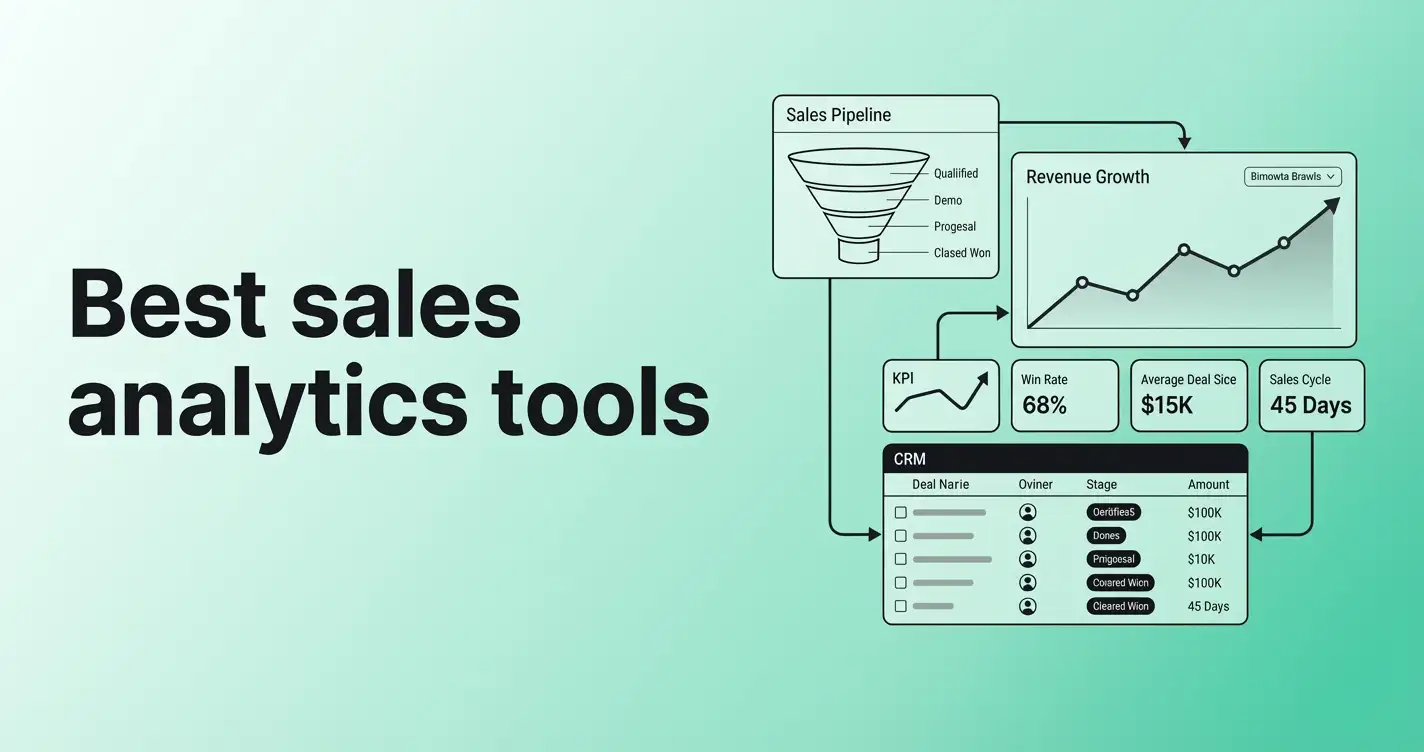
Sales analytics tools give revenue teams visibility into pipeline health, rep performance, and forecast accuracy. Most teams rely on CRM dashboards for this. But CRM reports can only analyze what reps log manually, and that data is often incomplete or outdated by the time a pipeline review happens.
The gap shows up in forecast calls that turn into debates, coaching sessions without call data, and pipeline reviews built on stale CRM fields. Salesforce's 2026 State of Data and Analytics report found that 70% of data and analytics leaders believe the most valuable insights in their organizations are trapped in unstructured data like call transcripts, emails, and meeting notes.
This guide covers 8 sales analytics tools organized by what they analyze, not by vendor name.
Key takeaways for sales analytics tools
- Sales analytics tools fall into three categories: CRM-based analytics, pipeline forecasting and intelligence, and conversation-driven analytics
- CRM analytics track what reps enter. Pipeline tools evaluate whether the forecast is real. Conversation tools capture what customers say on calls.
- Most teams need at least two of these layers to get reliable visibility into deals and revenue
- Tools covered in this guide:
- CRM-based sales analytics: Salesforce, HubSpot, Pipedrive, Zoho CRM
- Sales forecasting and pipeline analytics: Clari, Aviso
- Conversation-driven sales analytics: Gong, Avoma
- Choose tools based on which data layer your team is missing, not by feature count
What are sales analytics tools?
Sales analytics tools are software that collects, organizes, and analyzes sales data for better pipeline health, rep performance, and forecasting accuracy. They turn raw CRM records, deal activity, and conversation data into reports, and predictions. It helps sales leaders for pipeline reviews and coaching sessions.
These tools replace manual reporting and spreadsheet-based tracking. Instead of reps compiling weekly updates or managers building pivot tables, sales analytics software generates real-time views of deal progression, conversion rates, win rates, and revenue trends. AI-powered tools add predictive capabilities like deal scoring, risk detection, and automated forecasting.
How we organized the list of sales analytics tools
Sales analytics tools solve different problems depending on what data they analyze. Grouping them in a flat list obscures those differences and leads to forced comparisons between tools that serve different buyers.
This guide groups tools into three categories based on their primary data source and the decisions they support:
- CRM-based sales analytics covers tools that analyze pipeline, activity, and deal data stored in your CRM
- Sales forecasting and pipeline analytics covers tools that use AI, activity signals, and engagement data to evaluate forecast accuracy and deal risk
- Conversation-driven sales analytics covers tools that analyze recorded sales calls and meetings to surface coaching signals, buyer sentiment, and deal intelligence
How to choose the right sales analytics tool
Choosing the right tool starts with identifying which decisions need better data, not which vendor has the longest feature list. Sales reps, managers, RevOps leaders, and executives all consume analytics differently. Reps need deal-level views. Managers need coaching signals. RevOps needs forecast accuracy. Leadership needs revenue predictability. The right tool depends on which role is underserved and which data gap slows their decisions.
Step 1: Identify which decisions need better data
Map your weekly and monthly decision points. Pipeline reviews, forecast calls, coaching sessions, and deal inspections all depend on analytics. If your pipeline reviews run on CRM fields that reps update manually, that is a data quality gap. If your coaching depends on managers listening to full call recordings, that is a time gap.
One mid-market SaaS team found their reps spent close to 2 hours per day updating CRM fields after calls. The data was still incomplete. Pipeline reviews ran on stale information, and forecast calls turned into debates about what the customer said. Adding conversation analytics solved the data input problem. Call summaries, deal signals, and next steps synced to the CRM automatically. Pipeline reviews started with verified conversation data instead of manual field updates.
Step 2: Map tools to your analytics gaps
Use the three-category framework from the table above. If your CRM reporting is solid but your forecast keeps missing, the gap is in pipeline intelligence. If your pipeline data looks clean but deals stall without explanation, the gap is in conversation analytics.
Step 3: Prioritize CRM integration and data flow
Any analytics tool that does not integrate with your CRM creates a silo. The best tools sync data automatically so insights flow into the system your team already uses. Evaluate Salesforce and HubSpot integration depth before anything else.
Step 4: Test for adoption, not just capability
A tool that reps do not use produces no data. Research from Allego shows 76% of companies attribute missed sales quotas to poor tool adoption. Before committing, ask: does this tool reduce steps in the rep's workflow, or does it add another tab?
Sales analytics tools at a glance
1. CRM-based sales analytics
CRM-based analytics tools analyze data stored in your CRM: pipeline stages, deal values, win rates, conversion rates, and rep activity. They are the foundation of sales reporting for most teams.
The strength of this category is accessibility. These tools come built into the CRM your team already uses, which means adoption is higher and data is centralized. The limitation is that CRM analytics can only measure what reps enter. If deal fields are outdated or notes are incomplete, the dashboards reflect incomplete data.
Salesforce Sales Cloud
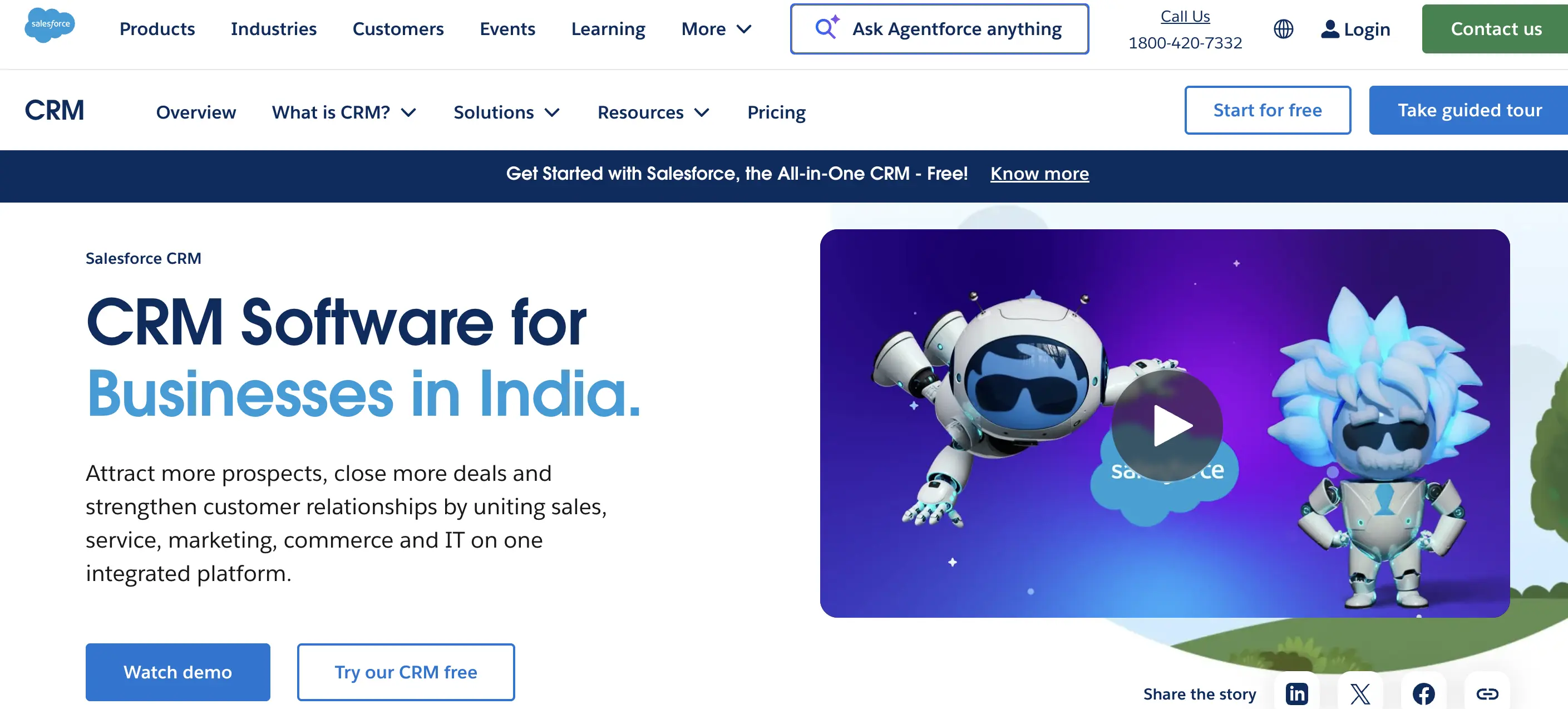
Salesforce's analytics layer is the deepest in the category. Einstein Analytics (now Tableau CRM) gives enterprise teams AI-powered lead scoring, opportunity insights, forecasting, and custom dashboards.
Best for: Enterprise teams with dedicated RevOps or Salesforce admins
Key capabilities:
- AI-powered lead and opportunity scoring
- Custom dashboards and reporting across pipeline, activity, and forecasting
- Predictive forecasting with Einstein AI
- Deep integration across the Salesforce ecosystem
Pricing: Sales Cloud starts at $25/user/month. Einstein AI add-ons start at $50/user/month. Revenue Intelligence is $200/user/month.
Notable limitation: Requires admin support to configure and maintain. Most teams use roughly 20% of its analytics capabilities.
HubSpot Sales Hub
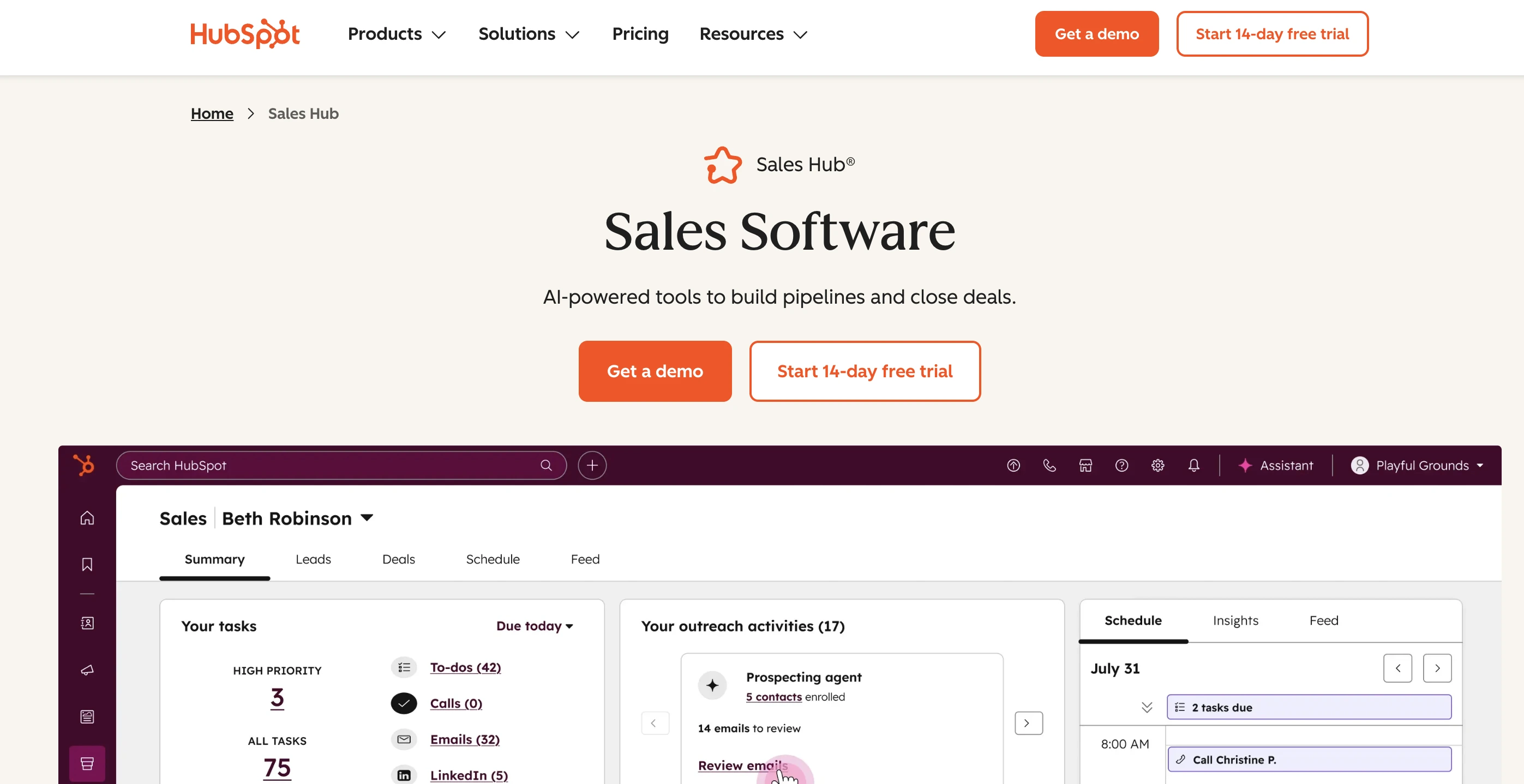
HubSpot combines CRM, marketing, and sales analytics in one platform. Its reporting is accessible out of the box, with less configuration required than Salesforce.
Best for: Mid-market teams that want CRM analytics without heavy admin overhead
Key capabilities:
- Built-in deal pipeline reporting and forecasting
- Rep activity tracking and goal monitoring
- Custom report builder with cross-object reporting
- AI-powered lead scoring on Professional and Enterprise plans
Pricing: Free CRM with basic reporting. Sales Hub Starter at $20/seat/month. Professional at $90/seat/month. Enterprise at $150/seat/month.
Notable limitation: Advanced analytics and custom reporting live in higher tiers. Cost scales fast when you add seats and contacts.
Pipedrive
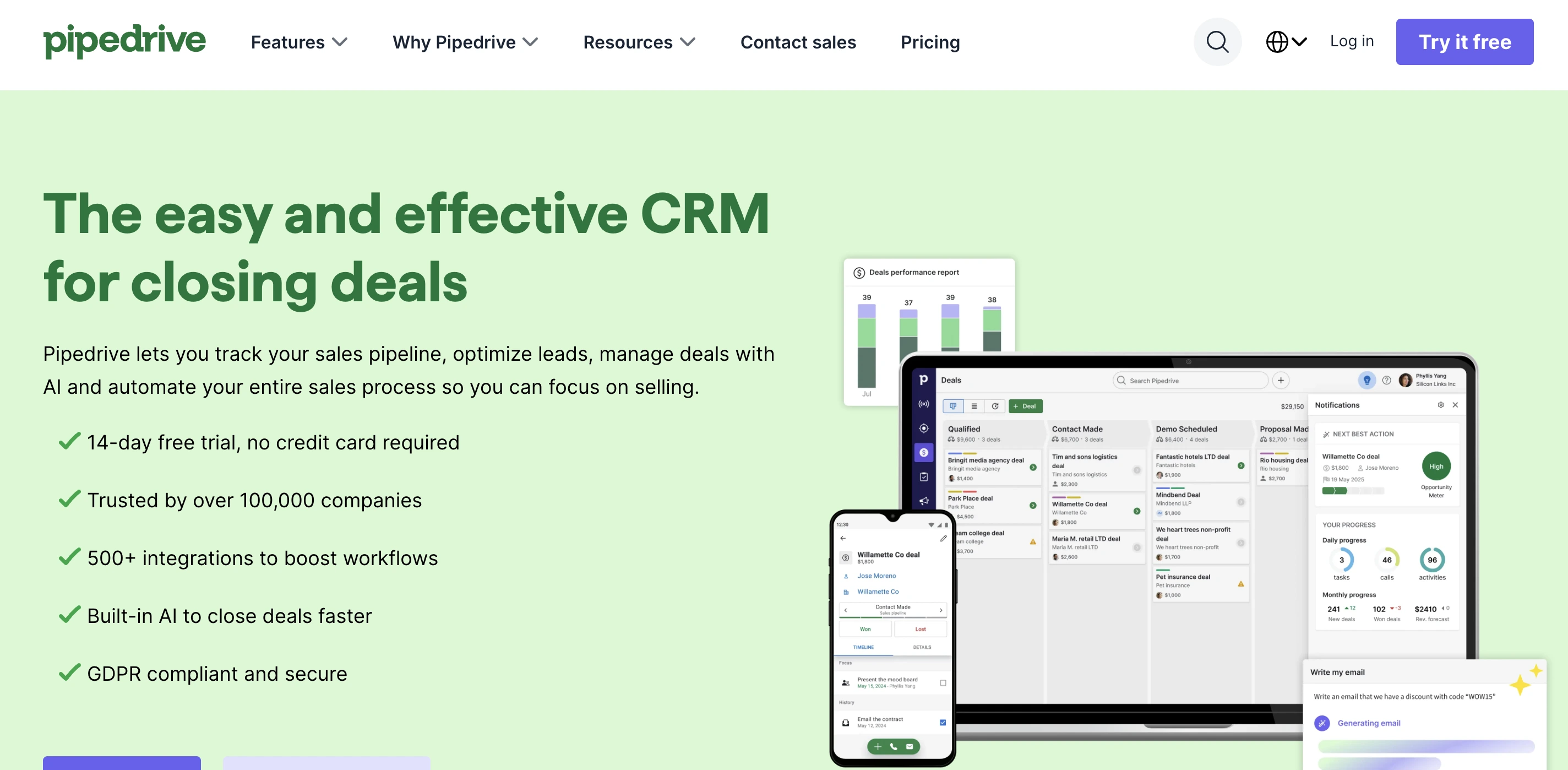
Pipedrive is a CRM built around visual pipeline management. Its analytics focus on deal tracking, conversion rates, and rep activity for small teams.
Best for: SMB sales teams that need pipeline visibility without complexity
Key capabilities:
- Drag-and-drop visual pipeline with deal tracking
- Conversion rate reporting by pipeline stage
- Goal tracking and rep performance dashboards
- Revenue forecasting by expected close date
Pricing: Starts at $14/user/month. Professional plan at $49/user/month. Enterprise at $99/user/month.
Notable limitation: Limited predictive AI and advanced analytics compared to Salesforce or HubSpot.
Zoho CRM
Zoho CRM offers a broad analytics suite at a lower price point than most competitors. Its built-in BI tool (Zoho Analytics) provides dashboards, forecasting, and custom reporting.
Best for: Budget-conscious teams that need CRM analytics with built-in BI
Key capabilities:
- Custom dashboards with drag-and-drop report builder
- Sales forecasting and pipeline tracking
- KPI tracking across reps, teams, and regions
- Integration with the broader Zoho ecosystem (50+ apps)
Pricing: Standard at $14/user/month. Enterprise at $40/user/month.
Notable limitation: Interface can feel dated compared to HubSpot or Pipedrive. Reporting depth improves at higher tiers.
2. Sales forecasting and pipeline analytics
Sales forecasting and pipeline analytics tools go beyond CRM dashboards to evaluate whether the forecast is real. They use AI, activity signals, and engagement data to score deal health, surface pipeline risks, and improve forecast accuracy.
CRM analytics can tell you what the pipeline looks like today. Forecasting tools answer whether those numbers will hold up next quarter.
Clari
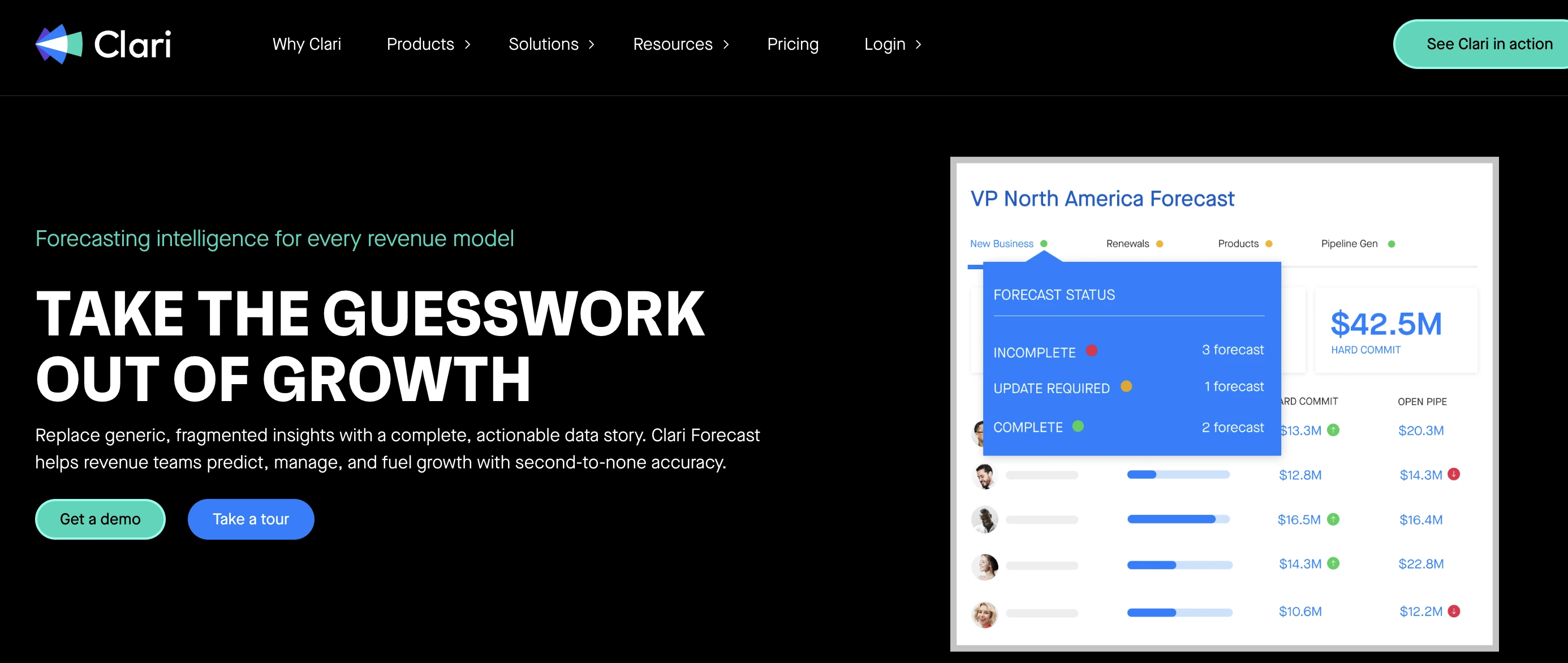
Clari is unifies CRM, email, and meeting data into a single pipeline view and uses machine learning to score deal confidence.
Best for: Enterprise revenue teams that treat forecasting as a core operational discipline
Key capabilities:
- AI-powered forecast confidence scoring
- Pipeline inspection with deal-level risk signals
- Commit, upside, and risk category management
- Cross-functional forecast rollups (regional, segment, global)
Pricing: Custom, sales-led pricing. Enterprise-level contracts.
Notable limitation: Configuration requires RevOps support. API syncs can need maintenance during high-activity periods.
Aviso

Aviso is an AI-powered revenue intelligence platform purpose-built for forecasting and pipeline management. It includes activity intelligence, relationship intelligence, and deal scoring in the core platform.
Best for: Mature RevOps organizations that treat forecasting as a strategic modeling exercise
Key capabilities:
- AI-driven forecasting with scenario modeling and multi-hierarchy rollups
- Deal health scoring based on engagement patterns, stakeholder involvement, and progression signals
- Activity intelligence that captures and maps rep actions to pipeline outcomes
- Relationship intelligence with dynamic org charts and contact engagement scoring
- Guided selling playbooks with next-best-action recommendations
Pricing: Custom, quote-based enterprise pricing.
Notable limitation: Enterprise-focused. Implementation requires RevOps maturity and clean CRM data to unlock full forecasting value.
3. Conversation-driven sales analytics
Conversation-driven sales analytics tools analyze what happens inside sales calls and meetings. They capture talk ratios, objection patterns, competitor mentions, buyer sentiment, and coaching signals from recorded conversations.
CRM dashboards cannot tell you what a customer said on a call. Pipeline tools cannot tell you whether the rep asked the right questions. Conversation analytics fills that gap by turning call recordings into structured, searchable data that feeds coaching, deal reviews, and forecast validation.
This category has matured fast. Gartner published its first Magic Quadrant for "Revenue Action Orchestration" in December 2025, signaling that conversation intelligence is now a recognized layer of revenue operations.
Gong
Gong records sales calls, analyzes them with AI, and surfaces patterns across winning and losing deals.
Best for: Mid-market and enterprise sales teams that prioritize call coaching and deal intelligence
Key capabilities:
- Call recording with AI-powered transcription and analysis
- Talk ratio, question frequency, and topic tracking
- Deal boards with engagement and activity scoring
- Competitor mention tracking and objection analysis
- Manager coaching workflows with timestamped feedback
Pricing: Enterprise-level pricing on request.
Notable limitation: Pricing is enterprise-level. Teams with smaller average deal sizes may find it difficult to justify the ROI.
Avoma
Avoma’s conversation intelligence software captures sales conversations from meetings, emails, and CRM data. It identifies topics discussed, talk patterns, customer objections, sentiment, and more.
Best for: SMB, mid-market, and enterprise companies that want conversation analytics, coaching, and CRM automation
Key capabilities:
- Analyze deal activity and momentum — how fast deals move, where they stall, and what that signals about risk
- Capture buyer engagement signals to surface deals that need attention
- Qualify and score deals based on your sales methodology (MEDDIC, SPICED, etc.) and the conversation history within each deal
- Surface deal risk signals using a combination of real-time behavior and historical benchmarks like win rates and typical deal cycles
- Talk ratio, monologue detection, and topic analytics
- Two-way CRM sync for notes, custom fields, and deal data
- Automated CRM field updates for sales methodology frameworks like MEDDIC, SPICED, and BANT
- AI-powered call scoring with 100% coverage across every rep and every call
- AI-generated win-loss analysis per deal with objection patterns and competitive insights
Pricing: Paid plans start at $19/user/month. Conversation Intelligence add-on at $29/user/month. Revenue Intelligence add-on at $29/user/month. Free 14-day trial.
Notable limitation: Focused on conversation-led analytics and deal execution. Not designed for CFO-level financial modeling.
Final thoughts
CRM dashboards show what reps entered. Pipeline tools evaluate whether the forecast holds up. Conversation analytics capture what customers said on the call. The right approach is to evaluate where your current analytics break down and add the layer that fills the gap.
Avoma captures conversation data, automates CRM updates, and surfaces deal signals that CRM dashboards miss. Start a free trial to see how it works with your team's workflow, or book a walkthrough with the Avoma team.
Frequently Asked Questions
The core metrics are pipeline value, stage conversion rates, average deal size, sales cycle length, win rate, and forecast accuracy. Conversation analytics adds talk-to-listen ratio, competitor mentions, and methodology adherence. The right metrics depend on whether you are optimizing for coaching, forecasting, or pipeline management.
A CRM stores deal and contact data. A sales analytics tool analyzes that data to surface trends, risks, and performance gaps. Most CRMs include basic reporting, but they can only analyze what reps enter. Sales analytics tools built for forecasting or conversation intelligence pull from additional data sources like emails, calls, and meetings to fill the gaps CRM dashboards miss.
Sales analytics tracks and reports on sales data like pipeline health, win rates, and rep activity. Revenue intelligence goes further by combining CRM data, conversation signals, and activity data to predict outcomes and guide deal execution. Tools like Clari and Avoma sit in the revenue intelligence category because they do not just report on what happened. They surface risks, score deals, and recommend actions.
Three signals indicate the gap. First, your forecast keeps missing despite clean pipeline data. Second, managers lack visibility into what reps say on calls and cannot coach from real interactions. Third, deal reviews depend on what reps remember rather than verified conversation data. If any of these apply, your team likely needs pipeline analytics, conversation analytics, or both.


Dive into Our Latest
Avoma Insights.

What's stopping you from turning every conversation into actionable insights?


