
Why SDR to AE handoffs break in Salesforce (and how to fix them)

Table of Contents:
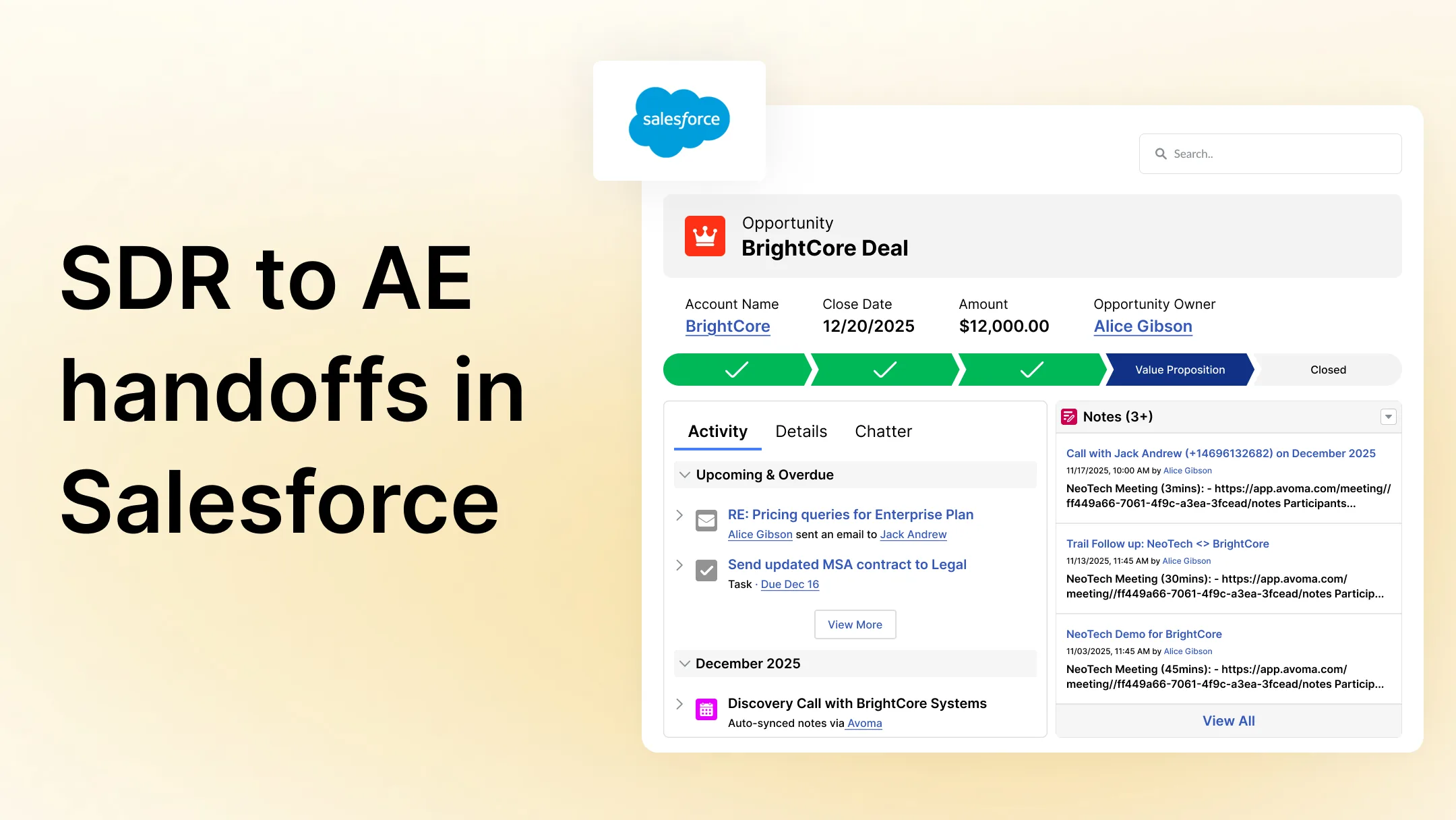
In outbound teams that run on Salesforce, SDRs (or BDRs) handle the front end inside Lead records. They do the prospecting, qualifying, and booking the first conversation. Once that meeting’s on the calendar, the AE (or closing rep) leads the call and takes ownership of the Opportunity.
Salesforce looks clean at handoff, until the AE opens the Opportunity and realizes the first real conversation is nowhere to be found. Recordings are missing, notes are on the wrong record, and key discovery context is scattered across the SDR’s invite, Activities, or old Lead history. Teams get a scramble for information they assumed would be right there.
Here’s what that breakdown looks like inside a modern Salesforce SDR to AE workflow, and why it keeps happening.
TL;DR
How SDR to AE handoffs work in Salesforce (and where they break)
In Lead-based Salesforce workflows, SDRs qualify inside a Lead record. Once there’s real intent, that Lead converts into a Contact, Account, and Opportunity and the AE takes over the deal.
The break happens at scheduling. Because the SDR owns the invite, Salesforce (and most CI tools) treat the meeting as their activity. Even if the AE runs the call, recordings, transcripts, and notes often log under the SDR or stay attached to the Lead/Contact instead of surfacing on the Opportunity.
That creates a search tax: time AEs and managers waste digging through SDR Activities, old Leads, or calendar links to find context that should already be sitting on the deal record.
Next, let’s look at how this compounds during the Lead to Opportunity conversion.
Why discovery context breaks after Lead conversion (even with native CI)
Lead conversion is where discovery starts to fragment. SDRs do the early qualification on the Lead, and once there’s real intent, the Lead converts into a Contact, Account, and Opportunity.
In theory, Salesforce can carry Activities forward. But in practice, early-stage call context rarely lands where the AE actually works the deal.
Most teams see some version of this: recordings and notes stay tied to the Lead or scatter onto the Contact/Account, while the Opportunity shows up without a clean discovery trail. So the AE has to backtrack once to piece together what already happened.
The fallout isn’t subtle:
- Buyers get forced to repeat themselves when AEs re-ask questions SDRs already covered.
- MEDDICC and qualification fields stay thin or inconsistent because the discovery evidence isn’t sitting on the Opportunity, which creates forecasting noise downstream.
Salesforce native Conversation Intelligence helps capture meetings, but it can’t guarantee this continuity across the handoff. And even with Einstein Activity Capture (EAC) syncing the calendar event, the meeting context still doesn’t reliably surface on the Opportunity.
Three structural reasons keep showing up:
- Organizer/owner logic drives visibility. If the SDR is the invite owner, CI typically associates the call to the SDR’s user and calendar, even if the AE ran the meeting.
- Activity-to-Opportunity mapping is fragile after conversion. CI may log the call as an Activity, but that Activity often stays on the Lead or Contact instead of surfacing cleanly on the Opportunity timeline.
- Behavior + calendar sync variability breaks coverage. Reps forget to enable recording, tools don’t always sync perfectly, and capture ends up depending on human consistency, not system design.
So CI works when everything lines up. But SDR-owned meetings and real-world variability make that alignment unreliable. And unreliable context is almost worse than none, because teams stop trusting what they see in Salesforce.
The real cost: buyer friction, slower deals, messy forecasts
When early-stage meeting context doesn’t reliably land on the Opportunity, the damage shows up everywhere, starting with the buyer.
- AEs walk in cold, so buyers repeat themselves. Discovery feels disconnected, and credibility takes a hit.
- Slower progression to the next step. Reps spend the call re-orienting instead of advancing the deal.
- Coaching blind spots. Managers can’t trace what was uncovered early to what happened later, so feedback stays surface-level.
- Under-credited SDR impact. Their qualification work lives in a silo, so their contribution gets invisible in pipeline reviews.
- Reporting skew. Activities tied to the wrong user or object distort stage-by-stage performance and funnel velocity.
- Time wasted searching for context. Reps and leaders burn cycles digging through calendars and old records instead of selling or coaching.
How Avoma keeps discovery context connected from Lead to Opportunity
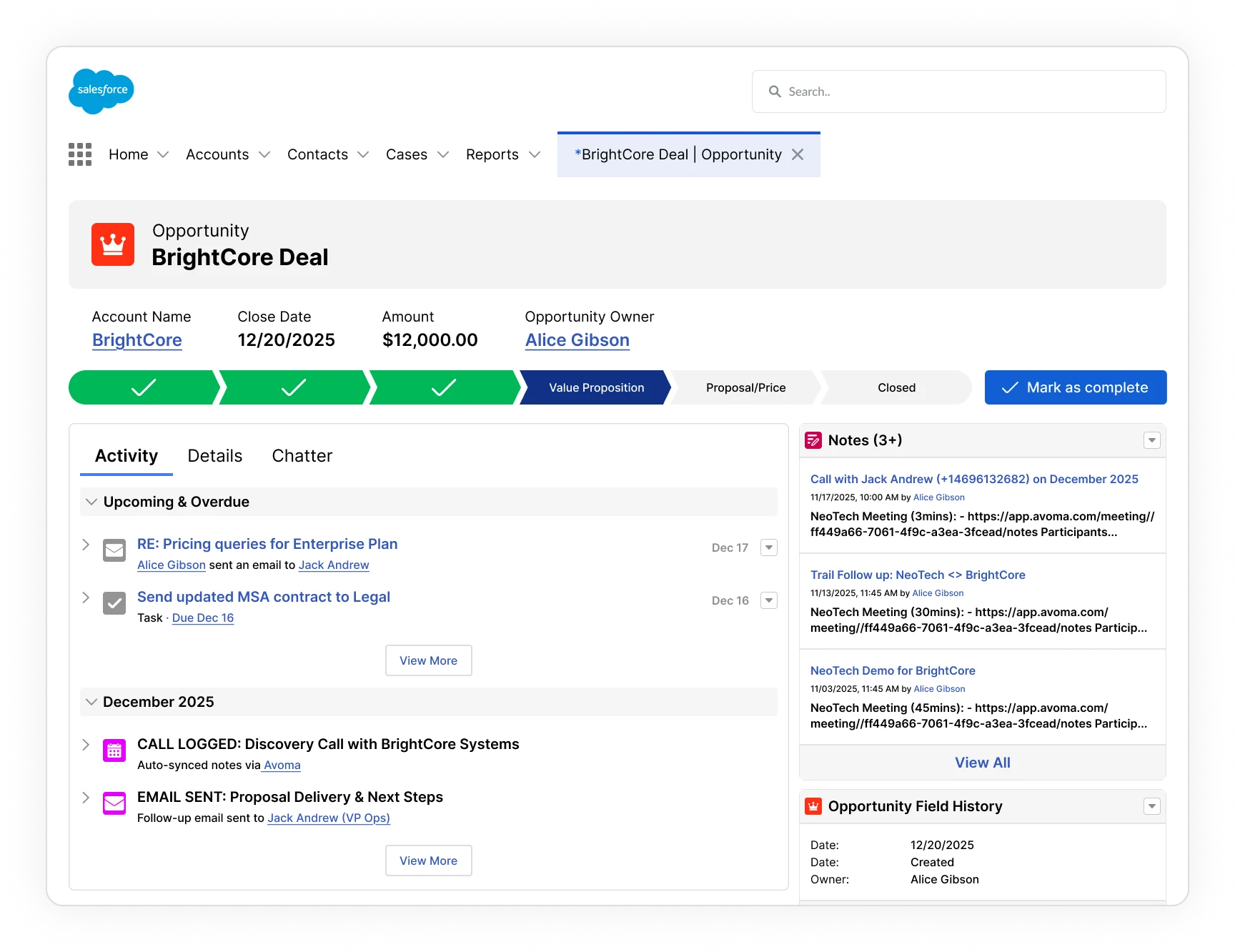
With the Avoma Salesforce integration, meetings are captured and logged so AEs can see SDR-booked call context directly in Salesforce—without hunting across Activities or calendar links.
- Captures every meeting, regardless of who booked it.
If the AE is on the invite, Avoma records it and makes it visible in the AE’s view, so AEs don’t go hunting for SDR-owned calls, and buyers don’t have to repeat themselves. - Keeps context continuous from Lead to Opportunity.
Avoma logs the recording, transcript, and notes to the Lead while it’s active, and automatically carries that full trail into the Contact, Account, and especially the Opportunity after conversion, so the deal record actually reflects the discovery that created it. - Turns meetings into structured CRM updates.
Avoma detects meeting type, applies the right template or scorecard, and pushes clean, structured fields into Salesforce. Forecasting reflects reality, and inspection isn’t guessing off sparse notes.
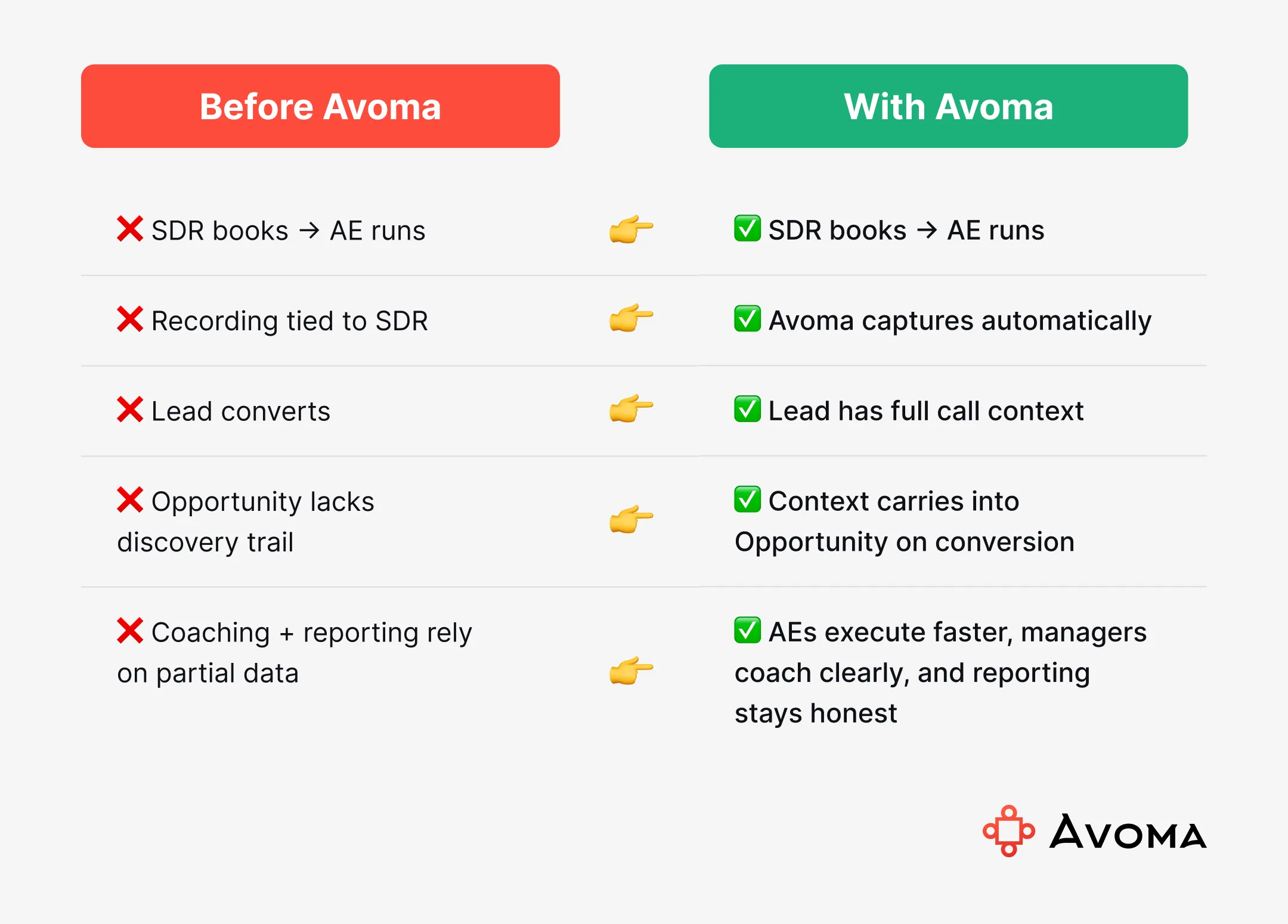
Before vs. after Avoma: One workflow, full visibility
To see the impact, it helps to lay out the before and after: same workflow, different visibility.
If Salesforce drives pipeline decisions, conversations must live there
As many sales teams acknowledge, Salesforce is a strong system of record, but it has real limits in day-to-day execution. That’s why conversation and enablement tools still sit alongside it: out of the box, Salesforce doesn’t reliably ensure meeting context flows to the right records without deliberate configuration.
That’s exactly the gap Avoma closes.
Want to see what this looks like in your Salesforce setup?
Our Salesforce and Avoma experts will review your current SDR to AE handoff, identify where context is slipping, and guide a clean integration so every discovery call lands on the Opportunity automatically.
Frequently Asked Questions
Because SDRs book the meeting and own the calendar invite, Salesforce and many conversation tools associate the activity to the SDR (or the Lead/Contact), so the Opportunity the AE works in can appear missing key discovery context.
Recordings, transcripts, and notes often log to the meeting organizer’s user/activity or attach to the Lead/Contact/Account, and don’t consistently surface on the Opportunity timeline—especially after Lead conversion.
It helps capture meetings, but it can’t reliably ensure continuity across organizer logic, Lead-to-Opportunity conversion, and inconsistent recording/sync behavior—so context still ends up fragmented.
Avoma captures meetings regardless of who booked them, logs the full call context to the Lead while active, carries it into the Opportunity after conversion, and pushes structured updates into Salesforce so discovery stays attached to the deal record.




What's stopping you from turning every conversation into actionable insights?


