
6 Best sales presentation templates for B2B teams

Table of Contents:
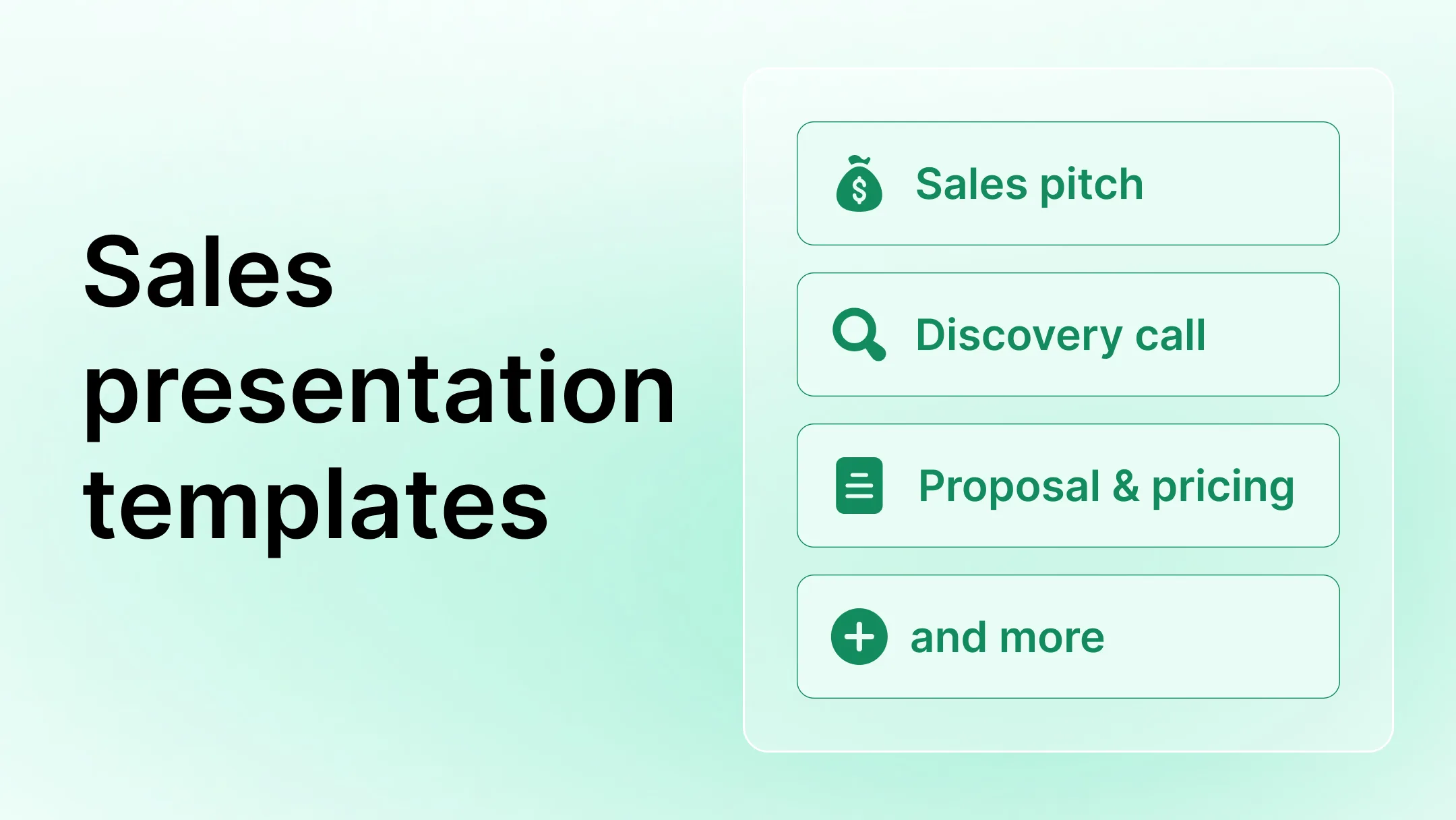
Most sales presentation templates give you a layout and leave you guessing on what to say. You get a slide titled "Value Proposition" with a placeholder box and no direction on what belongs in it.
That gap matters more than most teams realize. 6sense's 2024 Buyer Experience Report found that 81% of B2B buyers have already picked a preferred vendor before they talk to a sales rep. By the time your team gets that first meeting, the presentation has to earn the next one.
We have created six templates that map to how B2B deals move, from the first structured meeting to the quarterly review that protects your renewal. Every slide includes guidance on what to include, what to skip, and why the structure works for sales teams running a multi-stage deal cycle.
1. Sales pitch deck template
9 slides · 30 to 45 min · AEs, SDRs, Founders
Use when: First structured meeting after initial contact. The goal is to frame the problem and earn the right to go deeper.
Download sales pitch deck template
Why most pitch decks lose attention early
Reps open with their company story. Founding year, customer count, award logos. By the time they reach the prospect's problem, the meeting is half over and the prospect has mentally checked out.
What makes this deck structure work
The deck opens with a named market shift, something that has changed in the prospect's industry that makes the status quo untenable. That creates urgency without manufactured pressure.
Emblaze's 2024 research found that when sellers and buyers align on the problem definition, win rates improve by 38%. This deck structure forces that alignment from slide one.
From there, it moves to what that shift costs teams like theirs, what the best-performing teams do differently, and only then, your product. By the time your logo appears, the prospect already wants the outcome you sell. Our guide on making your sales pitch work covers how to structure this around real use cases.
Three things that determine whether you get a next meeting
- A specific, quantified cost-of-status-quo slide. Avoid vague "inefficiency" language.
- A before/after customer story matched to the prospect's industry or company size.
- A single clear ask at the end. One next step, not three options.
2. Discovery call presentation template
6 slides · 30 to 45 min · SDRs, AEs
Use when: Before a demo, before a proposal, before anything. The goal is to define pain, impact, and success criteria with enough specificity to make everything that follows relevant.
Download discovery call presentation template
This template is a conversation guide
The slides are minimal by design. They exist to structure the meeting and stay on screen as a backdrop, not to be presented at. Top-performing reps spend more time listening than talking in discovery calls. A deck that keeps you talking is costing you deals.
AI-meeting assistants like Avoma, lets you pre-define discovery categories (situation, impact, criteria) using Smart Templates. It organizes notes under those topics automatically, so reps get structured output from every discovery call without manual note-taking.
The slide that stays on screen the entire meeting
A set of open-ended questions organized across three categories: situation (current state), impact (what the problem costs), and criteria (what success looks like). The goal is to get the prospect talking about consequences, not describing their setup.
One constraint worth knowing
Top reps uncover 3 to 4 problems per discovery call. Chasing more than four diffuses the conversation and gives you too many threads to manage when you build the demo.
3. Sales demo presentation template
8 slides · 45 to 60 min · AEs, Sales Engineers
Use when: Post-discovery, once you know enough to make the demo specific to this prospect. The goal is to prove capability against the problems they described, not run a generic feature tour.
Download sales demo presentation template
Why generic demos fail
Most demos open with a product tour and get to the prospect's priorities in the last 10 minutes, when the energy in the room is gone. This template opens with a verbatim recap of what the prospect said in discovery and connects every use case directly to those stated priorities.
The rule that separates good demos from forgettable ones
If a feature does not connect to something the prospect said in discovery, do not show it. Every additional feature that is not directly relevant adds noise and dilutes the three things you need them to remember.
Why personalization matters here
Personalized, use-case-driven demos convert at higher rates than generic walkthroughs. The difference is not the product. It is whether the rep built the demo around what they learned in discovery. Nailing your sales discovery and demo depends on how well those two meetings connect.
4. ROI and business case presentation template
9 slides · 45 to 60 min · AEs, Sales Managers, Champions
Use when: The economic buyer (CFO, VP Finance, COO) enters the deal and needs a financial case, not a product pitch. The goal is to quantify value in a format that survives an internal finance review without you in the room.
Download ROI and business case presentation template
Why late-stage deals stall
The champion usually believes in your product. The problem is they do not have a business case that can survive a finance committee review without someone there to explain it. Every slide in this template is written as if it will be forwarded, because it will be.
What CFOs evaluate
Four things: cost reduction, revenue impact, risk mitigation, and payback period. The ROI model in this template is built from the prospect's own inputs (team size, process cost, time estimates from discovery), not from generic benchmarks. When buyers can see where the number comes from, they believe it.
The slide most reps skip
A risk assessment that addresses implementation risk, adoption risk, and exit risk head-on. CFOs spend significant mental energy on downside scenarios. Handling it proactively is one of the most underused moves in enterprise sales and one of the fastest ways to build trust with a buyer who has seen every vendor overpromise. Strong objection handling at this stage can prevent deals from stalling in finance review.
5. Proposal and pricing presentation template
9 slides · 30 to 45 min · AEs, Account Managers
Use when: Final commercial alignment, once both sides have confirmed fit and the conversation is about scope, price, and timeline. The goal is to close cleanly or surface the real objection so it can be handled immediately.
Download proposal and pricing presentation template
One rule for every proposal
Never send it cold. Always walk through it live. When a prospect receives pricing without context, they see the cost without the value. Objections that would take two minutes to handle on a call turn into a three-week email thread, or silence.
Why this structure works
It opens with a recap of what the prospect told you (their pain, their priority, their success criteria) before a single price appears on screen. By the time you reach the investment slide, the number has a foundation.
The section most proposal decks skip
A pre-objection slide that answers the top three questions buyers raise at this stage before they ask: contract flexibility, data portability, and integration timeline. Prospects raise these regardless of whether you surface them first. Answering proactively removes the friction that stalls final decisions. Answering proactively removes the friction that stalls final decisions, especially when you are trying to win competitive deals.
Once the deal closes, the conversation shifts from selling to proving value. The QBR template below is built for that transition.
6. QBR presentation template
10 slides · 60 min · CSMs, Account Managers
Use when: Post-sale quarterly review with strategic accounts. The goal is to prove value delivered, surface gaps honestly, and set mutual goals for next quarter from a position of demonstrated ROI.
Download QBR presentation template
What separates QBRs that protect renewals from ones that accelerate churn
Three things: executive stakeholders on both sides, honesty about where you fell short, and more time spent on next quarter than on last quarter. QBRs that skip any of these become a CSM narrating a green dashboard while the customer quietly questions the renewal.
The slide most CSMs leave out
A hits-and-misses section that names gaps, explains root cause, and commits to a resolution timeline. Customers who sense a manufactured success story become churn risks before they say anything out loud. Honesty here builds more loyalty than any positive metric. Teams that use QBRs to add value to their customers instead of running status updates see stronger renewal rates.
How the meeting should end
With a mutual commitment slide: specific, measurable goals for next quarter with named owners and due dates on both sides. Without it, the QBR was a presentation. With it, the QBR was a partnership checkpoint.
Make your sales presentations easier to prepare
Preparing a presentation takes time. Reviewing past call recordings, pulling CRM data, and finding the right customer quotes to include in your deck can take hours per deal.
Avoma gives sales teams AI-generated notes and transcripts from every conversation, so the insights you need for each presentation are already captured. Discovery call summaries feed directly into your demo prep. Customer quotes from past calls can go straight into your ROI slide. And because Avoma syncs conversation data to your CRM automatically, your pipeline context is always current when you build your business case.
If your team runs the presentations in this guide, Avoma helps you prepare each one faster and with better data. Get in touch with us for a free demo.
Frequently Asked Questions
Start with the prospect's problem, not your company. The strongest B2B sales presentations follow a consistent arc: name a market shift or challenge the prospect faces, show the cost of staying with the status quo, describe what high-performing teams do differently, then introduce your product in that context. Close with a relevant customer story and one clear next step. This structure works because the prospect is already invested in the outcome before your solution appears on screen.
The 5/5/5 rule is a slide design guideline: no more than 5 words per line, no more than 5 lines of text per slide, and no more than 5 text-heavy slides in a row before introducing a visual break. The goal is to keep slides clean so your audience listens to you instead of reading the screen. For sales presentations, this rule is especially useful because it forces reps to lead with conversation and use slides as support, not a script.
Preparation starts with the previous conversation. Review your discovery notes to identify the prospect's stated pain, business impact, and success criteria. Build your deck around those three things. Research the prospect's industry, company size, and recent news for relevant context. Rehearse the flow, not a script, so you can adapt in real time. If you are presenting an ROI or business case, use the prospect's own numbers from earlier conversations instead of generic benchmarks.
Open with a verbatim recap of what the prospect said in discovery. Map every feature you show to a specific problem or success criterion they described. If a feature does not connect to something they raised, skip it. The goal is to show three things they will remember, not fifteen things they will forget. Personalized demos convert at higher rates because the prospect sees their own situation reflected in the product.


Dive into Our Latest
Avoma Insights.


What's stopping you from turning every conversation into actionable insights?


