
Sales enablement strategies that scale beyond playbooks

Table of Contents:
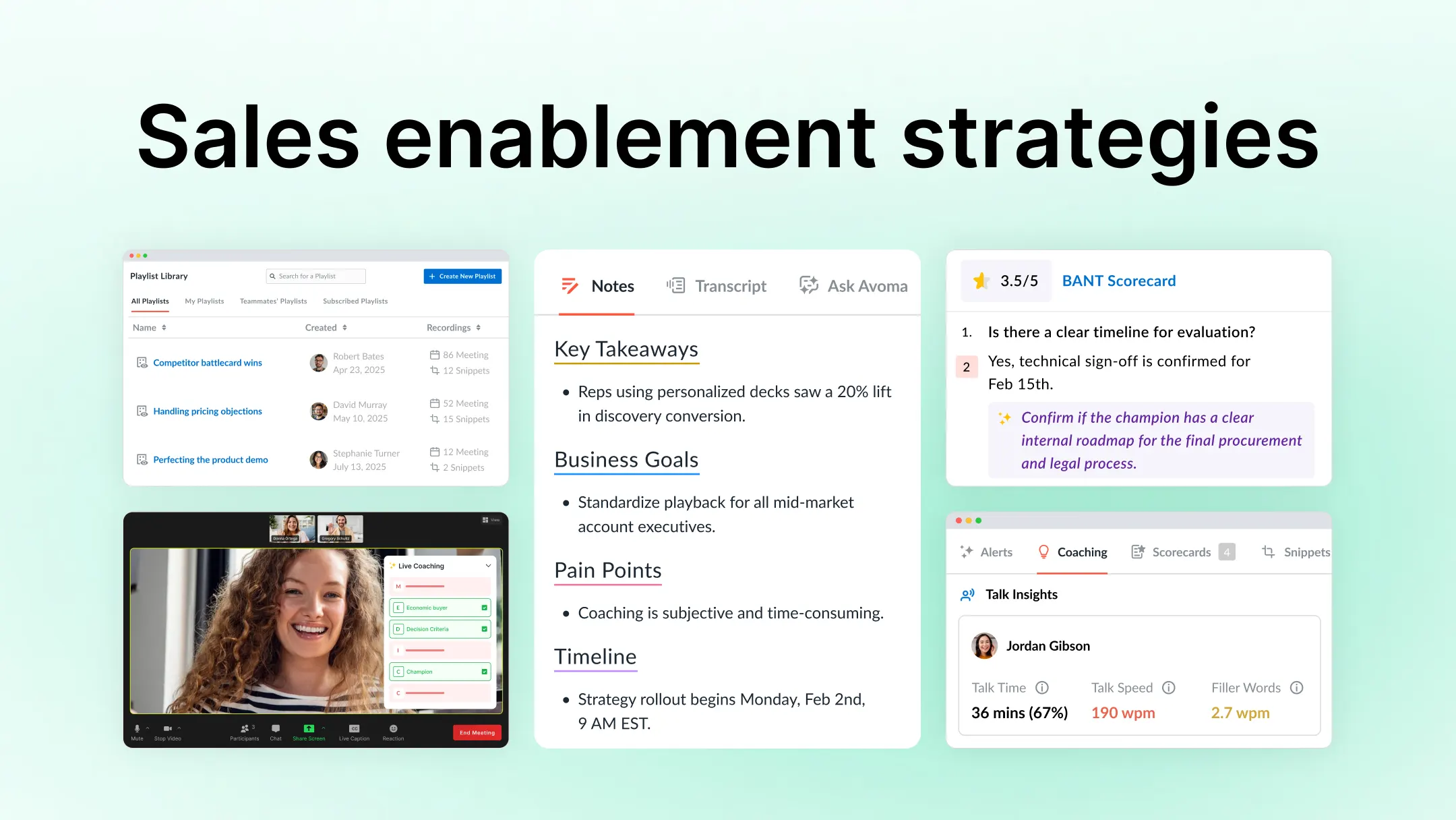
You’ve likely tried a few enablement tools already for onboarding, content, or coaching. They work up to a point. But as your team grows and strategies multiply, keeping everything aligned gets harder.
This section breaks down when point tools are still useful and when it's time to shift to a platform that supports more complex execution.
TL;DR: Key takeaways
- Sales enablement strategies work only when they drive daily behavior change, not just training or content usage.
- Playbooks and tools are tactics while strategy is the system that connects coaching, deals, and workflows.
- Legacy enablement fails because it’s event-based, not embedded in live sales execution.
- As teams scale, disconnected tools create friction that reps and managers won’t push through.
- Effective enablement shows up inside rep and manager workflows, tied to real deals and conversations.
- Scaling multiple strategies requires infrastructure, not more point solutions.
What is a sales enablement strategy?
A sales enablement strategy is a structured system that equips revenue teams with the content, training, coaching, and tools needed to close deals effectively. It is the operational 'how' that ensures reps execute consistently and managers coach effectively. This is different from a sales process, which defines the stages of a deal.
What makes a sales enablement strategy effective today?
An effective sales enablement strategy drives consistent behavior change across reps and managers. It is embedded in daily workflows and tied directly to revenue. It's also structured to scale beyond a single person's effort.
Too often, strategy is confused with tactics like playbooks or content pushes. The strategy is the repeatable system behind those tactics. It defines when, where, and how enablement should intervene to improve outcomes.
- Strategy vs. Tactic: A strategy is the system (e.g., continuous coaching), while a tactic is a specific action (e.g., a one-off training session).
Modern sales teams need strategies that treat enablement as infrastructure, not a one-time initiative.
Let’s clear up where most teams go sideways.
Sales enablement strategy vs. tactics vs. tools
A sales enablement strategy defines the system; tactics are the specific plays, and tools are what bring them to life or stall them out.
Strategies answer: What needs to happen consistently to drive better performance?
Tactics answer: How do we make that happen this week?
And tools answer: Where does this live, and who owns it?”
Confusing these layers leads to two common outcomes: Over-engineered tactics with no throughline, or tech stacks that look full but don’t move the needle. A real enablement strategy holds the system together.
Why legacy sales enablement approaches fall short
Legacy enablement fails because it’s built for events, not systems.
One-off training sessions, static content libraries, and quarterly initiatives that rely on reps remembering what to do. These approaches might check the box, but they rarely shift behavior, especially in fast-moving, high-variance sales cycles.
What’s missing is continuity. When sales enablement isn’t tied to live deals, real conversations, or pipeline movement, it becomes noise.
An effective sales enablement strategy today needs to show up where reps work, not in a separate track they’re expected to follow later.
Lets break down the strategies that actually meet that bar.
7 sales enablement strategies that drive revenue
Here are seven proven sales enablement strategies that address specific breakdowns in modern sales execution. Each requires ongoing workflows and tools that support how reps and managers actually work.
1. Continuous coaching instead of periodic reviews
Coaching works when it’s tied to real calls, active deals, and day-to-day behaviors and not just reviews after the quarter’s over. Sales cycles are faster now, and teams are spread out. If managers wait weeks to step in, deals are already gone and reps keep making the same mistakes.
To make coaching consistent, teams need access to conversations, defined workflows, and systems that help managers follow through. Without that, coaching becomes scattered, buried in Slack, forgotten in docs, and disconnected from outcomes.
Unless feedback is timely, trackable, and built into how reps work, it won’t drive change. And it won’t scale.
2. Deal-level enablement instead of generic content pushes
Deal-level enablement means supporting reps based on where the deal is, not just who they're selling to. This includes enabling the buyer with relevant content, especially when navigating deals with over 11 stakeholders. To make this work, teams need systems that surface the right content at the right moment.
To make this work, teams need clear pipeline visibility, accurate deal data, and systems that surface enablement at the right moment, not buried in shared drives or in a CMS.
Most teams miss here. Content shows up too late or gets ignored. Reps don’t know what to use, and enablement can’t see what’s working.
This inconsistency shows up for buyers too. According to Gartner Sales Survey, 69% of B2B buyers report conflicting information between what’s on a company’s website and what sales reps share. That kind of mismatch erodes trust and slows deals.
Without centralized deal context, enablement turns into a guessing game. The strategy breaks because reps are left to connect the dots on their own.
3. Conversation intelligence as a feedback loop
Conversation intelligence should help reps sell better, not just record what they said.
Calls contain useful data: objections, messaging gaps, missed cues. But most teams don’t act on it. The insights sit in dashboards or get lost in tools no one checks.
To make it useful, you need to capture calls consistently, pull out patterns, and apply them to coaching and content. Both reps and managers need to see clear value.
Where this fails is execution. Reps feel like they’re being watched. Managers don’t follow up. Insights don’t lead to changes.
Unless conversation intelligence drives specific actions, it’s just another system reps learn to ignore.
4. Enablement aligned to pipeline stages, not just personas
Stage-based enablement gives reps what they need based on where the deal is. For example, a discovery call requires different support than a late-stage negotiation call. This requires CRM-integrated workflows and content mapped to pipeline steps.
Deals stall for different reasons at each pipeline stage. Early-stage calls need discovery support. Late-stage deals need objection handling or stakeholder alignment. Generic enablement doesn’t cut it.
To make this work, you need CRM-integrated workflows, stage-based triggers, and content mapped to actual pipeline steps. Otherwise, reps default to guesswork.
Most teams miss here. Enablement is built for personas, not stages. Managers can’t see where deals are stuck, and reps get the same support no matter the context.
Aligning enablement to stages increases coordination needs. Without shared systems, teams either overbuild or leave gaps. Strategy loses consistency fast.
5. Rep-first automation to reduce admin work
Automation should reduce rep effort, not add to it. For example, Avoma's automatic CRM data entry eliminates manual note-taking and saves reps 4+ hours per week. If automation isn't built into how reps already work, it gets skipped.
Follow-ups, updates, and content need to happen inside the tools reps already use. If it takes extra clicks or context switching, it won’t get used.
Useful automation is triggered by real activity, like deal stage or meeting type, and delivers what reps need without interrupting their flow.
Where it breaks: reps get alerts they ignore, tasks they don’t trust, or systems that feel bolted on.
6. Manager enablement that turns inspection into action
Managers don’t need more dashboards. They need clear direction on who to coach, when to step in, and what to focus on.
Even with good data, action stalls without next steps. Most managers don’t have time to dig through reports or build their own workflows.
This strategy only works if systems provide structured signals and specific actions.
Where it usually fails: managers see issues but don’t act. They’re either overwhelmed or stuck in tools that stop at diagnosis.
If enablement doesn’t help managers take action inside their workflow, the system just adds noise.
7. Measuring enablement impact beyond vanity metrics
Enablement measurement works when it tracks behavior change, deal progression, and revenue influence. Leadership needs to see how enablement impacts real outcomes. Key KPIs to track include:
- Time to productivity (ramp time)
- Win rate by rep/team
- Average deal size
- Sales cycle length
- Content engagement → closed-won correlation
Why sales enablement strategies fail as teams grow
Even strong strategies collapse under scale if execution isn’t centralized. Because when you scale, you’re no longer solving for ideas, you’re solving for orchestration.
The pressure compounds as deal complexity increases. The average B2B purchase now involves over 11 stakeholders, more than double what it was a decade ago. Each additional stakeholder adds more opinions, more internal debate, and more chances for the deal to stall or fall apart. Enablement needs to account for this shift or risk becoming noise.
- Disconnected tools disrupt sales enablement execution: Disconnected systems create extra steps. Reps switch between tools, managers lose visibility, and enablement can’t run a consistent process. Strategy becomes a set of disconnected tasks.
- Reps don’t adopt sales enablement workflows that add effort: When strategy adds work, reps skip it. Even solid enablement plans fail if they’re hard to follow.
- Why managers struggle to act on enablement insights: Managers spot issues but often don’t follow up. It’s not a priority problem — the systems don’t help them take action. Insights without clear workflows go unused.
Sales enablement strategy requires better tools to execute
Running one sales enablement strategy is manageable with basic tools. But as soon as you add more like coaching, deal support, or manager workflows, the execution gets more complex.
Most teams struggle because their tools don’t work well together. Reps lose time, managers lose visibility, and enablement can’t run consistent processes. At that point, the problem is with the system.
This section explains why execution starts to break down and what kind of tooling supports it at scale.
The difference between enablement tools and enablement platforms
Tools solve narrow problems, like hosting content or recording calls. Platforms support entire workflows, connecting reps, managers, and enablement in one motion. The difference is in the execution coverage.
What happens when sales teams run multiple enablement strategies at once
Each strategy alone is manageable. Together, they create complexity fast: more systems, more steps, more ways to drop the ball. That’s when point tools start colliding and adoption falls apart.
Enablement execution approaches (comparison table)
Curious how common tools stack up? This breakdown of sales enablement tools shows where most point solutions fall short once strategy volume increases.
Choosing the right enablement approach for your team
Different teams need different levels of tooling. If you're only running one sales enablement strategy, a simple tool may be enough. But as teams grow and add more motions, tool limitations start to show.
This section outlines when point tools work and when a centralized platform becomes necessary.
When point tools are enough
If you’re running one enablement motion, say, onboarding or content delivery, a focused tool might get the job done. Especially in early-stage orgs, simplicity beats sophistication.
When centralized platforms become necessary
The moment you combine strategies like coaching, content, pipeline-stage alignment, manager enablement, fragmentation becomes the bottleneck. You need one system that supports the whole motion, or execution drags.
What to look for in an enablement platform
Skip the feature checklists. Look for workflow coverage. Can reps act without toggling? Can managers coach without extra admin? Can enablement see and shape behavior without chasing data?
Execution-grade sales enablement platforms like Avoma are designed for teams running multiple strategies in parallel. They centralize conversation insights, coaching workflows, and deal-level enablement in one system. That means less drag for reps, more visibility for managers, and real adoption for enablement.
According to Elizabeth Jones, Senior Director Analyst in the Gartner Sales practice many B2B sales teams are also using AI to meet rising buyer expectations while managing cost. From AI assistants to generative tools, these technologies improve pre-sales interactions, support digital-first buyers, and automate early-stage engagement. This adds another layer of scalability, especially for teams juggling multiple enablement motions.
If your team is trying to run multiple strategies at once, you need to choose an infrastructure rather than a tool.
Build sales enablement strategies that actually scale
Every sales org has ideas about how to improve performance. But execution is where those ideas either become motion — or die in a folder.
If your team is hitting friction while running multiple strategies, it's not a playbook problem. It's an infrastructure problem caused by disconnected systems.
Execution doesn't scale on intent. It scales on infrastructure.
Trying to run more than two of these strategies at once?
See how Avoma helps teams operationalize enablement without the tool sprawl.
Frequently Asked Questions
They can, but only at small scale. Without software, enablement relies on manual effort, tribal knowledge, and inconsistent execution. That doesn’t hold up when teams grow or motion complexity increases.
Most fail in execution, not intent. Great ideas fall apart when tools are fragmented, adoption is low, or no one owns the follow-through. Strategy only works when workflows are aligned.
The tipping point is strategy volume. If you're running more than one motion and need reps and managers executing in sync — it's time. Point tools won’t scale with you.
Tools are specialized — they solve one piece of the puzzle. Platforms connect the pieces: content, coaching, analytics, rep workflows, and manager visibility. One supports activity. The other drives adoption. For a full walkthrough of modern enablement strategies, see this deep-dive guide.





What's stopping you from turning every conversation into actionable insights?


