
What is sales enablement? A practical GTM guide for 2026

Table of Contents:
90-day ramp times. Inconsistent messaging across your team. Deals that stall in legal review for weeks. If these sound familiar, there’s a sales enablement problem behind them.
Sales enablement, done right, is the operating system that connects what your reps know, what they say, and how they win.
This guide breaks down what it actually is, why most companies get it wrong, and how to build a framework that turns enablement from overhead into revenue infrastructure.
What is sales enablement?
Sales enablement is the practice of equipping your sales team with the content, training, tools, and insights they need to engage buyers effectively at every stage of the deal. It's the strategic function that ensures reps can have the right conversation, with the right person, at the right time.
Sales enablement is one part of a broader business enablement system: the umbrella that aligns Sales, CS, Marketing, and RevOps around one GTM motion. This guide focuses on the pre-sale side of that engine.
At its core, effective enablement comes down to three things:
- Content aligned to deal stages and buyer personas
- Coaching tied to real, live deals
- Metrics that measure enablement impact on deals
A sales enablement platform helps teams deliver those pillars at scale by surfacing the right content and coaching in the rep’s workflow, and proving impact on deals.
Most companies get this wrong by focusing on volume—more playbooks, more training, more content. Enablement isn’t about having more. It’s about reps knowing what to use, when, and how.
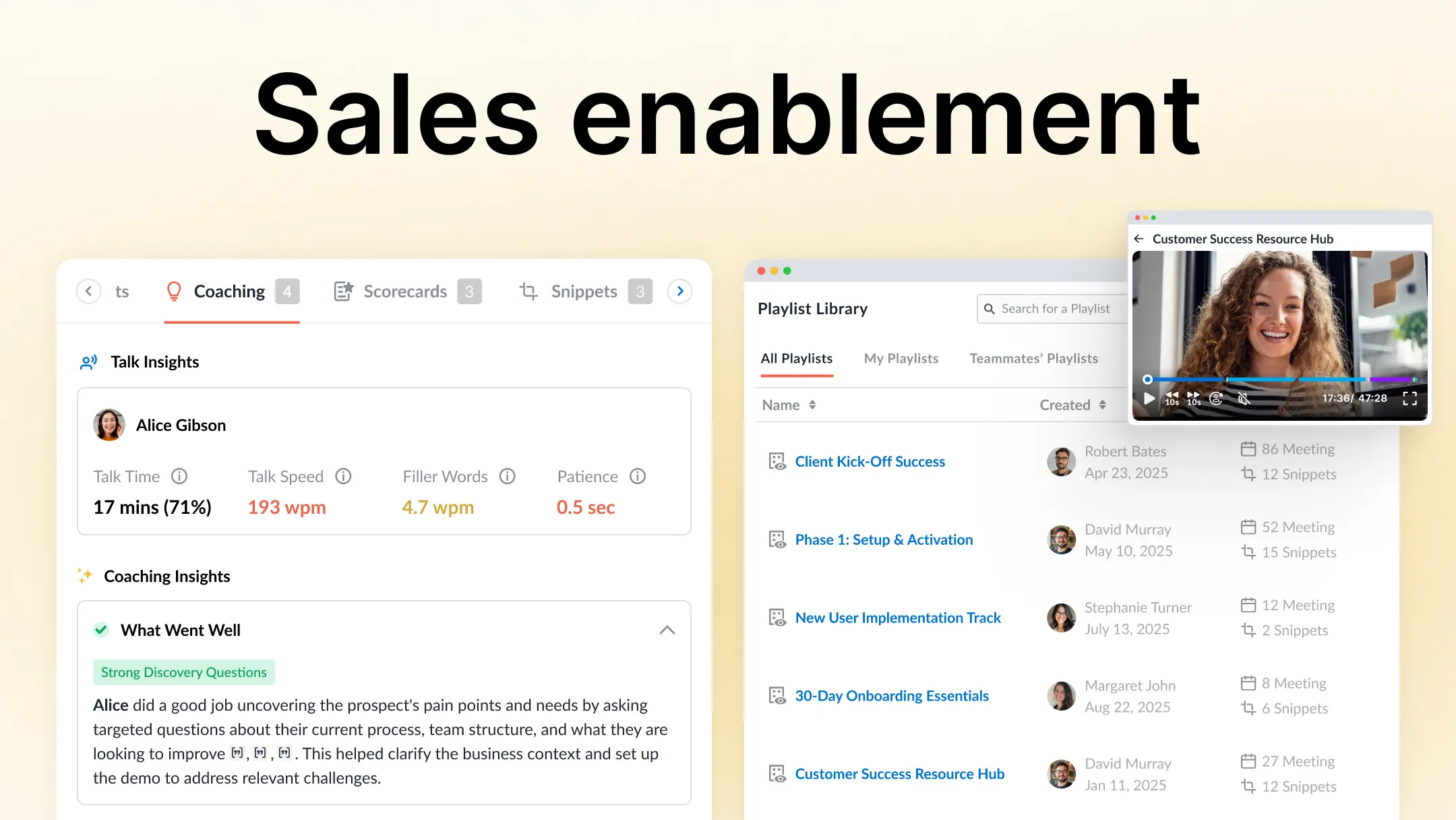
That’s why modern enablement teams use conversation intelligence to power the system. Platforms like Avoma capture real calls, surface objection and talk-pattern trends, and auto-summarize key moments—turning live conversations into onboarding assets, targeted coaching, and measurable performance improvement.
So if the definition is clear, why do so many enablement programs still fail to move the needle?
Why sales enablement fails (and how to fix it)
Most enablement programs don’t fail because of effort. They fail because three structural issues turn strategy into busywork.
1. Ownership confusion
Ownership confusion creates gaps across the sales lifecycle. Sales enablement needs one clear owner accountable for rep performance from onboarding through deal execution and handoff. That owner is typically a Head/Director of Sales Enablement (or Enablement Manager in smaller orgs), even if they sit under Sales, RevOps, or Marketing.
What matters is the mandate. The enablement owner should be responsible for:
- Onboarding and ramp to productivity
- Messaging and content activation in live deals
- Coaching systems and rep skill development
- Enablement measurement tied to pipeline outcomes
- Cross-functional alignment with Sales Ops/RevOps, Marketing, and Product
2. Tool overload
Tool overload adds friction that reps learn to avoid. CRMs, LMSs, content hubs, CI tools, and sales engagement platforms all claim to “enable” the team. But when prep means bouncing between systems, reps skip them and wing it. Enablement works only when the right asset or insight shows up in the workflow with minimal effort.
3. Reactive mindsets
Reactive mindsets produce a patchwork library instead of a cohesive system. Enablement often responds after something breaks—a lost deal, a competitor move, a messy onboarding cycle. That leads to rushed decks, outdated playbooks, and no clear source of truth. Over time, reps stop trusting what exists and default to whatever feels current.
Fixing this doesn’t require a bigger team or a fancier platform. It requires a framework that treats enablement like a revenue function and runs on repeatable systems.
Elements of a modern sales enablement strategy
Effective sales enablement on the pre-sale side isn't built on more content or more training. It's built on three interconnected systems that actually change how reps sell.
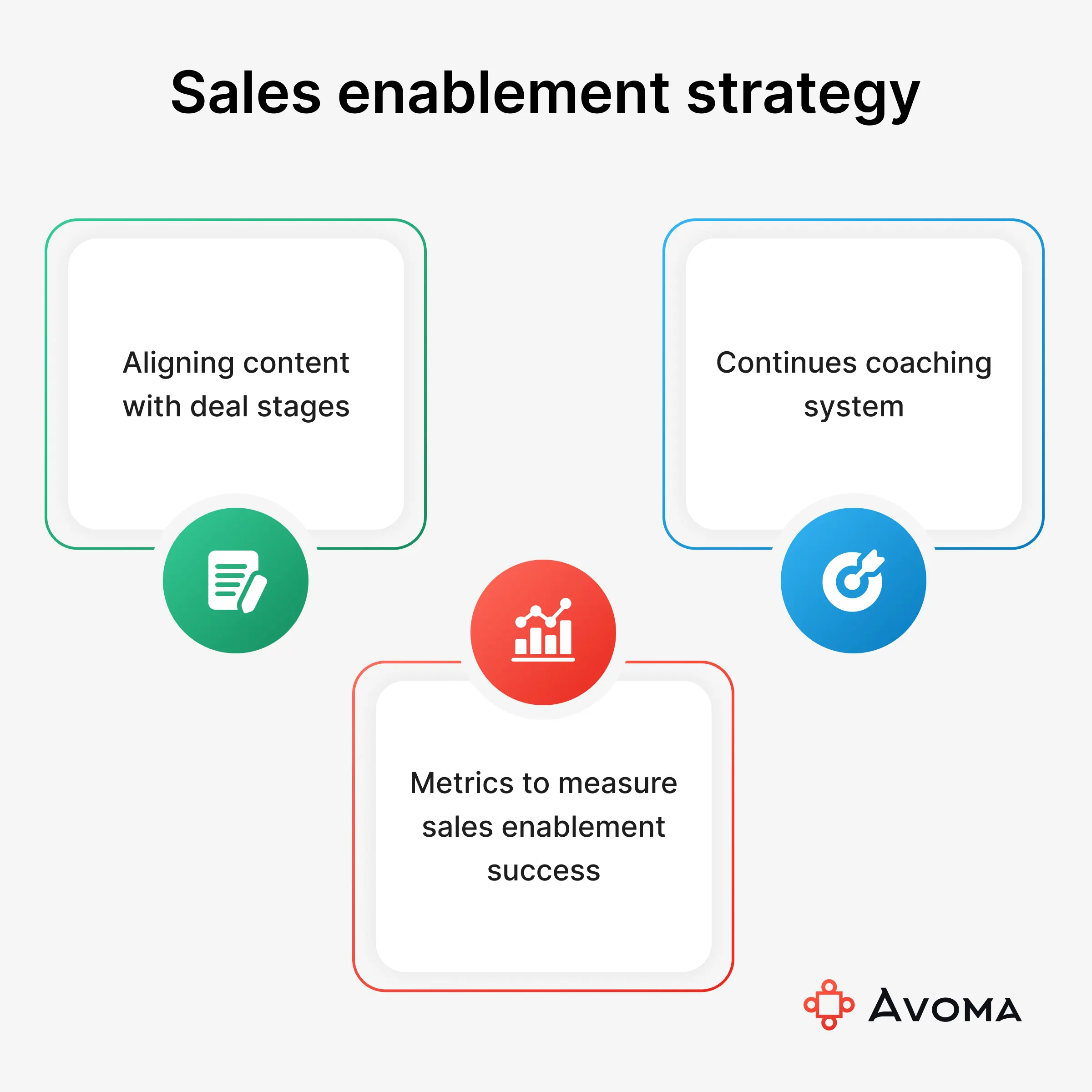
1. Aligning content with deal stages
Your reps don't need 200 slides. They need the right six assets mapped to the moments that matter:
- discovery
- technical validation
- economic buyer conversations
- procurement, and
- close
A modern enablement system tags content by deal stage, buyer persona, and use case. So when a rep is prepping for a CFO call, they're not scrolling through a shared drive. They're pulling the ROI calculator, the security overview, and the reference story that matches the prospect's industry.
2. Continuous coaching system
Onboarding gets reps to competent. Coaching gets them to quota. But most coaching is inconsistent. Some managers do it weekly, others do it never. A coaching system involves defining the behaviors that correlate with wins (such as multi-threading, discovery depth, and objection handling), tracking those behaviors in real-world deals, and creating feedback loops that are independent of manager availability.
3. How to measure sales enablement success
You measure sales enablement success by tracking whether rep behavior changes and pipeline outcomes improve. In practice, that shows up as:
- Faster ramp to first deal
- Higher win rates (especially for new rep cohorts)
- Shorter sales cycles
- Larger average deal sizes
- Clear improvement in targeted behaviors like discovery depth, objection handling, and multi-threading
This framework only works if enablement and sales operations are actually aligned — which brings up one of the most misunderstood distinctions in revenue teams.
What is the difference between sales enablement and sales operations
The confusion between sales enablement and sales operations is real, and it creates turf wars that hurt both functions.
Here's the simplest way to think about it: sales operations builds the engine, and sales enablement teaches people how to drive it.
Roles and responsibilities
Sales operations owns the infrastructure: CRM hygiene, territory design, quota setting, pipeline reporting, tool administration, and forecasting accuracy. They make sure the machine runs.
Sales enablement owns performance: onboarding, training, content strategy, coaching frameworks, and skill development. They make sure reps know how to use the machine to close deals.
Ops answers "what's happening in the pipeline?" Enablement answers "why are reps winning or losing, and how do we fix it?"
The overlap happens in a few places — conversation intelligence platforms, sales engagement tools, and performance dashboards can live in either camp depending on how they're used.
If the tool is about workflow automation and data capture, that's ops.
If it's about coaching, learning, or content delivery, that's enablement.
There must be clarity on who owns what, so reps aren't getting conflicting guidance or duplicate requests.
Collaboration, not conflict
The best revenue orgs don't pit these functions against each other. They integrate them.
Ops identifies the pipeline problem (low conversion at the demo stage), and enablement builds the solution (a demo certification program with real call reviews).
Enablement spots a messagincg issue (reps are all pitching features differently), and ops surfaces the data that shows which messaging correlates with wins.
When these teams share goals and communicate regularly, you get a feedback loop that makes the entire go-to-market motion faster and more consistent.
Theory is one thing. Execution is another. Here's what this actually looks like in practice.
Sales enablement in practice: two quick examples
Scenario 1 – Enterprise SaaS ramp-up
A fast-growing enterprise SaaS team saw new AEs taking ~5 months to close a first deal because onboarding ended early and reps were left to figure out complex, multi-stakeholder sales on their own.
Enablement rebuilt ramp around deal milestones, not calendar weeks: reps shadowed full cycles, then led discovery before running deals. They paired that with a focused asset set mapped to personas and stages, plus structured deal reviews using real call examples.
Result: Faster time-to-first-deal, more consistent execution, and higher new-hire win rates.
Scenario 2 – Messaging alignment
A growth-stage company kept losing to the same competitor, but reps blamed different reasons.
Enablement dug into win/loss and call patterns and found the real issue: reps pitched features instead of outcomes and had no consistent competitive response. They launched a simple objection-based battlecard, trained reps through live role-plays, and reinforced it in weekly coaching tied to active deals.
Result: Competitive win rates improved because reps had one repeatable narrative.
Getting started with sales enablement
Find where enablement is leaking revenue
Before you add training, content, or tools, get precise about what’s slowing revenue down. Start with last quarter’s pipeline and look for patterns: where deals stall, which stages convert poorly, and how long new reps take to land their first win. That tells you whether the leak is in discovery, demos, pricing conversations, or late-stage execution.
Then validate it with reps. Talk to top performers about what they use and how they run key calls. Talk to struggling reps about where they get stuck. The gap between those two groups is your enablement priority list.
Do a quick content cleanup so reps aren’t working off outdated or irrelevant assets.
Set up the three-tool foundation
You don’t need more tools—you need a system. Start with three essentials: a CRM, a searchable content hub mapped to deal stages, and call recording/review through conversation intelligence. Everything else can wait.
Build onboarding around deal milestones, not weeks. Define what reps need to know at each stage, who teaches it, and how you’ll validate it in live deals. Keep playbooks lean and usable in real time.
Automate sales enablement
AI automation in enablement means turning real calls into summaries, tagged moments, and coaching insights automatically—so training scales without extra admin.
If enablement is going to scale, it has to run on real conversations. Conversation intelligence (like Avoma) captures calls, scores conversations, surfaces objections and talk-pattern trends, and turns top-performer moments into onboarding and coaching assets.

That lets enablement teams:
- build onboarding from best calls,
- coach with real behavior data, and
- tie improvement to pipeline outcomes.
Every call becomes training. Every insight becomes repeatable. Ramp time drops because reps learn what actually wins.
Conclusion
Sales enablement is a revenue enablement system. It works when you standardize what great reps do, coach it consistently, and measure the impact on pipeline.
Start with clear ownership, focus on the few behaviors and assets that move deals, and track outcomes like ramp time, win rate, and sales cycle.
Avoma supports this by capturing and analyzing real sales calls, turning top-performer moments into onboarding playlists, and giving coaches data on objections, talk patterns, and deal execution.
Want to see it in action? Start a free Avoma trial or book a demo to learn how conversation intelligence fits into your enablement system.
Frequently Asked Questions
Sales enablement is the function that helps reps sell effectively by giving them the right content, coaching, tools, and insights for each stage of the deal. The goal is consistent rep performance and predictable revenue.
You measure enablement success by whether rep behavior changes and pipeline outcomes improve. Track ramp time to first deal, win rate by rep cohort, sales cycle length, average deal size, and improvement in targeted behaviors like discovery depth or objection handling.
A solid enablement strategy includes:
- Stage- and persona-aligned content
- Structured onboarding and continuous coaching
- Clear ownership and cross-functional alignment
- Behavior and outcome metrics tied to pipeline
- A tech stack that reduces friction and supports learning in workflow
The best enablement software is the one that drives adoption and measurable revenue impact. Look for tools that:
- Map content to deal stages/personas and surface it in workflow
- Support onboarding and coaching with real deal data
- Provide analytics tied to outcomes (not just usage)
- Automates admin (summaries, tagging, CRM updates)
Integrates cleanly with your CRM and meeting stack If it adds steps for reps, it won’t get used—no matter how powerful it is.
Automate enablement by removing manual work from training, coaching, and content delivery. Prioritize workflow automation like auto-capturing calls, generating summaries, tagging key moments, recommending relevant assets, and syncing insights to CRM so reps don’t have to hunt or document everything themselves.
Sales enablement automation is using AI and integrated tools to scale enablement without extra headcount—turning real sales activity into reusable training, coaching cues, and performance insights automatically.
Leading AI enablement tools typically fall into a few buckets:
- Conversation intelligence (auto-capture calls, insights, coaching signals)
- Content enablement (recommendations, personalization, stage mapping)
- Sales readiness/coaching AI (certifications, skill tracking)
Revenue analytics AI (behavior → outcome analysis) The “best” AI platform is the one that connects these to your workflows and proves impact on pipeline—not the one with the longest feature list.
AI is moving enablement from manual programs to continuous, data-driven systems. Expect more real-time coaching prompts, automatic content personalization by deal context, and tighter linking of conversation behaviors to revenue outcomes.
Sales enablement should have a single accountable owner—usually a Head/Director of Sales Enablement (or an Enablement Manager in smaller teams). Regardless of reporting line, that owner must be responsible end-to-end for onboarding, coaching, content activation, and enablement impact on pipeline.


Dive into Our Latest
Avoma Insights.


What's stopping you from turning every conversation into actionable insights?


