
Sales onboarding tools by type: LMS, enablement, and workflow

Table of Contents:
Most sales onboarding tools treat ramp like content delivery. Companies hand reps a learning path, assign a few certifications, and expect them to sell. But reps ramp through pressure when they get exposure to real calls, live deals, and feedback from managers in the moment.
This category needs a reset. LMS, enablement, CI, each plays a role, but high-performing teams treat onboarding as a workflow: structured learning, simulated practice, and live execution. What tools support that approach? That’s what this list is built to show.
What are the types of sales onboarding tools?
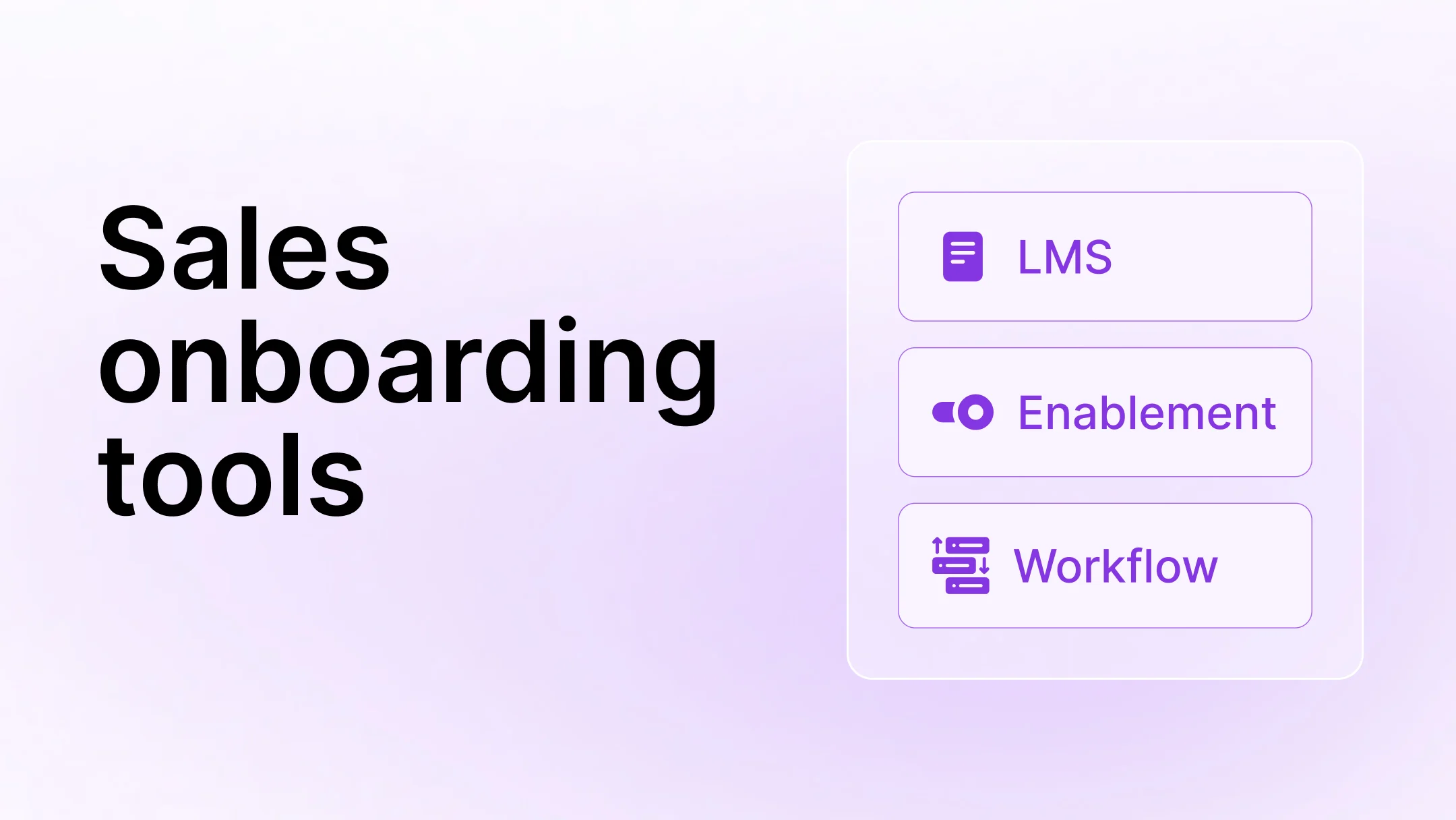
Sales onboarding tools fall into three categories: content-led platforms, enablement and coaching systems, and workflow-based solutions. Each supports a different philosophy of ramping reps from structured learning to hands-on selling.
Here’s the breakdown:
1. Content-led onboarding tools
These tools focus on delivering structured training through LMS-style modules, playbooks, and certifications. Think: formal curricula, automated quizzes, and self-paced content libraries.
Best for: Larger orgs with standardized onboarding programs and long ramp cycles.
Limitation: These tools often stop short of real-world selling. Reps “finish” training before facing real pressure.
2. Enablement platforms
These platforms go beyond static content. They support roleplay, call reviews, feedback loops, and skill assessments, typically layered on top of CI tools.
Best for: Teams investing in rep development over time, often paired with coaching cultures.
Limitation: Many still rely on staged or post-call scenarios. They support learning about selling, not learning while selling.
3. Workflow-based onboarding & coaching platforms
This is where onboarding happens inside sales conversations. Reps learn through live deals, real calls, and manager-guided coaching in the moment, not as a separate phase.
Best for: Teams that want onboarding to mirror the pressure and pace of real selling.
Limitation: These platforms may offer less formal course control, but they speed up contextual ramp.
Tools in the same “onboarding” category solve very different problems. The list below maps to these three types, so you can pick based on your onboarding reality.
The 7 best sales onboarding tools in 2026
Content‑led onboarding tools
Structured learning through LMS‑style modules and playbooks
1. Lessonly by Seismic
Lessonly (now part of Seismic) is a learning management platform that helps revenue teams build structured training paths with customizable lessons, practice scenarios, and assessments. The platform focuses on consistency and repeatability so new reps can internalize messaging, product knowledge, and process before they engage in coaching or live selling. Programs can integrate with sales workflows, helping teams unify onboarding and ongoing skills development.
- Best for: Mid‑size to enterprise teams with standardized training needs
- Strengths: Step‑by‑step lesson flows, practice exercises, progress tracking
- Limitations: Training happens outside of live workflows; pricing is custom and often quoted per organization, typically starting around custom plans (often reported ~$300/mo depending on scale) with higher tiers for advanced coaching features.
- When to choose it: When you want a structured, scalable content‑centric onboarding curriculum.
2. Trainual
Trainual is a centralized platform for documenting processes, policies, and onboarding content with editable templates, collaboration tools, and structured training paths. It helps small to midsize teams systematize onboarding knowledge and track completion without requiring a full LMS build‑out. Pricing typically starts around $249–$419 per month when billed annually depending on team size and plan level.
- Best for: Startups and small teams needing fast, organized onboarding content
- Strengths: Quick setup, SOP documentation, role‑based learning
- Limitations: Lacks real‑time coaching and integration into live selling workflows
- When to choose it: When simplicity and documentation clarity are priorities.
Enablement platforms
Roleplay, certification, feedback, and ongoing skill development
3. Mindtickle
Mindtickle frames onboarding as a readiness journey with analytics, simulated role‑plays, and skill tracking. Enablement teams can assign training modules, benchmark rep skills, and create guided learning paths that align with enterprise performance objectives. While exact pricing isn’t publicly published, it’s typically positioned as an enterprise platform with quote‑based costs tailored to complex onboarding and readiness requirements.
- Best for: Large sales orgs with performance benchmarks and certification needs
- Strengths: Readiness scoring, simulated practice, detailed analytics
- Limitations: Limited native live‑call immersion
- When to choose it: When onboarding success ties strongly to measurable capability benchmarks.
4. Highspot
Highspot is an AI‑driven sales enablement platform that combines content management, training tasks, and coaching insights. Instead of being solely LMS‑centric, it embeds guidance into sales workflows letting reps access the right playbooks, content, and learning recommendations at the moment of need. Highspot uses seat‑based pricing with custom quotes and typically sits in the enterprise band (often low‑five‑figure annual contracts or higher) depending on users and features.
- Best for: Teams aligning onboarding with enablement and AI‑assisted guidance
- Strengths: Unified content + training + analytics
- Limitations: Pricing and packaging require a sales engagement to uncover exact pricing
- When to choose it: When onboarding happens alongside content delivery and skills reinforcement.
5. Showpad
Showpad offers a sales enablement suite focused on content, training modules, and coaching workflows. Its plans often start around $50–$65 per user per month for essential tiers and scale upward with additional analytics and enterprise capabilities, making it relatively transparent compared with some competitors.
- Best for: Teams with structured enablement programs and content needs
- Strengths: Clean training UI, CRM integrations, content access
- Limitations: Call insight and real‑time coaching are limite
- When to choose it: When onboarding blends content mastery with guided coaching checkpoints.
Workflow‑based onboarding & Coaching platforms
Live‑call learning, coaching, manager feedback, and execution context
6. Gong
Gong is a conversation intelligence and revenue platform that helps teams analyze actual sales calls. It’s widely adopted and excels at surfacing skills gaps through real interactions. Pricing isn’t publicly listed; deals are typically multi‑year and enterprise in structure, often bundled with onboarding success programs.
- Best for: Teams using real call data to coach and accelerate onboarding
- Strengths: Deal‑level insights, call tagging, coaching workflows
- Limitations: Onboarding structured around post‑call debriefs rather than integrated ramp paths
- When to choose it: When onboarding is driven by real conversation analysis.
7. Avoma
Avoma is built around real calls and live deals, letting reps learn through conversations, manager feedback, and contextual guidance rather than separate training phases. Pricing is transparent: Startup ~$19/recorder seat/mo, Organization ~$29/recorder seat/mo, Enterprise ~$39/recorder seat/mo (billed annually) with a free 14‑day trial available.
- Best for: Teams that embed onboarding into everyday selling conversations
- Strengths: Real‑call learning, manager coaching inside deals, CI plus onboarding in one
- Limitations: Less formal course sequencing than rigid LMS tools
- When to choose it: When onboarding must accelerate resistance‑free contextual selling readiness.
Sales onboarding tool comparison table (2026)
This table compares the tools based on onboarding outcomes, not features, helping you see where each tool excels or falls short in real-world ramp scenarios.
LMS vs enablement vs workflow: Quick comparison
This mini-table shows how the three onboarding archetypes differ in philosophy and execution.
Ready to rethink oinboarding?
Most onboarding tools were built for content, not selling. But reps ramp faster when onboarding happens inside sales conversations with coaching, context, and customer signals from day one.
If that’s your goal, explore how Avoma supports onboarding inside live deals — not outside them.
Book a demo to see workflow-based onboarding in action.
Frequently Asked Questions
The best tool depends on how your reps ramp. For structured learning, LMS platforms like Lessonly or Trainual work well. For real-call immersion and faster contextual ramp, workflow-based platforms like Avoma or Gong offer stronger onboarding-in-action.
Sales onboarding tools don’t always replace LMS platforms — but some expand beyond them. Workflow-based tools (like Avoma) eliminate the need for separate LMS + conversation intelligence setups during ramp by embedding onboarding into real sales calls.
Onboarding timelines vary, but top-performing teams aim for first-call readiness in 2–4 weeks. Tools that embed reps into real selling environments accelerate time-to-ramp more than static content alone.
Yes — especially for coaching and real-call exposure. Conversation intelligence platforms like Gong and Avoma allow managers to guide reps using actual sales calls, which reinforces training with real context.
Absolutely. Tools with built-in coaching workflows and call tagging give managers clear insight into rep ramp progress — and let them intervene with feedback where it matters most.
Enablement supports ongoing rep development. Onboarding is about ramping new reps fast and effectively. The best tools bridge both — giving reps structure at the start and reinforcement over time.





What's stopping you from turning every conversation into actionable insights?


