
Sales call recording explained: Benefits, legal requirements, and evaluation guide

Table of Contents:
Sales call recording gives revenue teams full visibility into buyer conversations so they can coach better, forecast more accurately, and close more deals. Instead of relying on memory or scattered notes, modern sales organizations use AI-powered call recording software to turn conversations into measurable performance data.
In this guide, we’ll cover:
- What sales call recording is
- The key benefits for sales teams
- Legal considerations and compliance
- Common challenges
- How AI-powered tools like Avoma turn recordings into revenue insights
What is sales call recording?
Sales call recording is the practice of capturing audio and video from conversations between sales reps and prospects or customers. It creates a verifiable record of every interaction, moving teams from relying on memory to using a single source of truth for every deal.
Revenue teams use these recordings for several strategic purposes:
- Training: Onboard new hires faster with real world examples.
- Coaching: Provide reps with specific, data driven performance feedback.
- Compliance: Follow legal and internal policies.
- Collaboration: Share direct customer feedback with marketing and product teams.
5 Benefits of sales call recording for revenue teams
If you’re not convinced of the power buried inside call records, here’s how they can work for you.
1. Capture every detail with stress-free recordings and notes
Reps need to jot down plenty of things when speaking with a prospect. Their main job is to ask penetrating questions. The answers to those questions can affect the outcome of the whole opportunity.
But no prospect makes it easy on them. They speak their mind as objections and pain points come to them—often all at once.
As your team is jotting something down, the prospect says another thing worth adding to the notes. It’s impossible to catch every detail, no matter how consequential each is. Your sales team is constantly struggling with this.
Recorded calls take the pressure off of sales teams. They can focus on being present while intelligent technology records their meetings, takes meaningful notes, and catches insights. Being present in those conversations allows them to do what they are relied on to do—communicate the perfect solution and close the deal.
The best call-recording software removes the need to manually write notes and will automatically connect to your calls/meetings, so they don’t have to think twice about these easily automated tasks.
2. Streamline sales enablement and training
Successful sales teams aren’t made overnight. They’re created. Built on hard data and teachable moments.
According to the Salesforce State of Sales report, more than half of reps say traditional enablement materials like courses and guides do not give them the skills they need for real conversations. What they want instead is personalized coaching. Yet many report they do not receive enough feedback on their sales calls or chances to practice important discussions ahead of time.
That gap explains why generic training falls short. Skills improve when coaching is tied to actual buyer conversations, not static materials.
All the key moments of a sale happen on the phone. That means 90% of sales coaching will focus on the sales approaches used on those calls. No recordings mean no visibility into what went on during those crucial moments.
Managers need a way to have eyes and ears on every rep’s calls. Accessing those phone conversations and meeting transcripts helps determine if sales reps stuck to the agenda, positioned the product effectively, and asked the right questions.
With visibility and enablement training, poor sales pitches and calls steadily improve. Newer reps get onboarded quickly and are more likely to hit quota faster. Deals move through the pipeline faster. Win rates increase, ramp time shortens, and pipeline velocity improves.
But nothing happens by accident. Staying theoretical is the slowest way to teach hard skills. Instead:
- Use your one-on-ones to play back snippets of phone calls and give direct feedback about the actual sales conversations they’ve had.
- Create playlists of exemplary calls where the sales rep did all the right things.
- Nurture a culture of success by knowing (and communicating) winning playbooks.
Managers should use AI-generated sales scorecards to find the best and worst calls quickly. This makes timely coaching sessions more manageable than ever by providing at-a-glance conversation insights for managers. Scores can also be abstracted to track team-wide performance and find the biggest opportunities for sales process changes and coaching.
3. Improve cross-functional collaboration
No team works in isolation. What sales hears affects product. What product builds affects marketing. What marketing promises affects sales.
Sales is the only team that speaks with buyers every day, both the ones who close and the ones who walk away. That feedback should not stay inside the sales org.
When marketing hears real objections from calls, messaging gets sharper.
When product listens to feature requests and deal blockers, roadmap decisions improve.
When leadership reviews closed won and closed lost conversations, strategy becomes grounded in buyer reality.
The problem is simple. In most companies, that information does not travel.
Recording sales calls is step one. Sharing key clips and summaries with other teams is what makes the feedback usable. Short snippets, organized by theme or objection, make it easy for marketing and product to act on what customers are actually saying.
Automated alerts can also be set up to track specific verbal triggers in meetings. That way, information is disseminated as it is captured. AI notes can also track custom topics important to your business, like the most requested features by leads, and share those routinely with product teams.
These help create a customer-first mindset throughout the organization with an easy-to-manage VOC (voice of the customer) initiative.
Is it legal to record sales calls?
Yes, recording sales calls is legal in most situations, but compliance is non negotiable. You need to understand your obligations to build trust and avoid legal trouble.
Understanding one party vs. two party consent laws
The main legal difference is between one party and two party consent laws. Federal law in the United States requires one party consent, meaning only one person in the conversation, including you, needs to give permission to record.
Some states have two party consent (also called all party consent) laws. These require you to get permission from everyone on the call before recording.
Important: If even one participant is in a two party consent state, you must follow that state’s stricter law.
Which states require two party consent?
As of today, eleven states require two party consent: California, Connecticut, Florida, Illinois, Maryland, Massachusetts, Michigan, Montana, Nevada, New Hampshire, and Washington. Always verify current laws, since they can change.
Best practices for staying compliant
- Announce recordings: The safest approach is to say the call is being recorded at the start of every meeting.
- Use automated notifications: Turn on automated recording notifications in tools like Zoom and Microsoft Teams.
- Get verbal consent: For phone calls, start with a simple script like, “This call is being recorded for quality and training purposes. Is that okay?”
- Consult legal counsel: For questions tied to your industry or global operations (like GDPR), check with your legal team.
Disclaimer: This information is for general educational purposes and does not constitute legal advice. Laws change frequently and vary by jurisdiction.
Common challenges with sales call recording
Recording sales calls sounds simple. Turn it on and you are done. In practice, most teams run into a few predictable roadblocks.
Getting rep buy in
Some reps hear “call recording” and think “micromanagement.”
If recordings are used only to point out mistakes, adoption drops fast. If they are used to highlight winning talk tracks, shorten ramp time, and protect reps from misremembered details, the mindset shifts.
Make the purpose clear. Recordings are for coaching and shared learning, not surveillance.
Managing legal and compliance risk
Laws vary by state and country. Some regions require consent from one party. Others require consent from everyone on the call.
If your team sells across regions, this gets complex quickly. Clear disclosure at the start of every call and automated recording notifications reduce risk. Your legal team should define the standard once so reps are not guessing.
Finding time to review calls
Managers are busy. Listening to full recordings can take hours each week. As a result, only a small fraction of calls ever get reviewed.
That creates a blind spot. Coaching is based on a handful of conversations instead of patterns across the team.
The fix is not “listen more.” It is structured summaries, searchable transcripts, and clear markers that show where pricing, objections, or next steps were discussed. When you can jump to the right moment, reviews take minutes instead of hours.
Keeping data organized
Recording calls is easy. Finding what you need later is harder.
If transcripts, notes, and recordings live outside your CRM, information gets scattered. Reps update fields manually. Managers chase context before pipeline reviews.
Call data should map directly to CRM fields and deal records. That way, conversations update the system automatically instead of creating more admin work.
Avoiding data overload
More recordings do not automatically mean better decisions. Without structure, you end up with hours of audio and no clear takeaways.
The goal is not to collect conversations. It is to turn them into usable data. Track themes like pricing discussions, competitor mentions, next steps, and buyer engagement so patterns show up across deals.
Sales call recording works when it reduces guesswork. It fails when it creates more noise.
How to choose the best sales call recording software
Most tools can record a call. That is table stakes.
The real question is what happens after the meeting ends.
When you evaluate sales call recording software, look beyond audio and transcripts. Focus on how the system fits into your workflow and what it changes for your team.
Here is what to look for.
Does the software record sales calls automatically?
The tool should join meetings on its own and start recording without manual steps.
Reps should not click buttons or remember to upload files. If recording depends on rep behavior, data gaps are guaranteed.
Transcripts should be searchable so managers can jump to pricing discussions, objections, or next steps in seconds.
Does it provide AI transcription and structured call notes?
A transcript alone does not help you coach.
Look for automatic summaries organized into clear sections like pain points, competitors mentioned, budget, decision process, and action items.
Structured notes reduce review time and make information usable across teams.
Does it sync call data to your CRM?
If reps still need to copy notes into the CRM, the system is incomplete.
Call data should map directly to CRM fields and update deal records automatically. That includes next steps, meeting dates, and key deal details.
The goal is fewer manual updates, not more.
Can you search and filter call recordings easily?
Managers need to review calls quickly.
Look for bookmarks, topic markers, and filters that let you sort by rep, deal stage, or keyword. Without navigation, recordings pile up and rarely get reviewed.
Does it support sales coaching and performance tracking?
Recording is only step one. Improvement comes from pattern recognition.
The platform should help you compare calls across reps, identify gaps in talk tracks, and track coaching progress over time.
If you cannot answer “What are top performers doing differently?” the tool is not doing enough.
Can you share voice of customer data across teams?
Sales conversations contain buyer feedback that marketing and product need.
Look for easy ways to create short clips and share them with other teams. Long recordings rarely get watched. Short, focused snippets do.
How Avoma meets modern sales call recording software requirements
Most tools record calls. Avoma connects conversations to pipeline execution.
Here is how it maps to what revenue teams actually need.
Automatic recording and transcription
Avoma joins meetings automatically through your calendar, dialer, and video platform.
Reps do not need to remember to press record. Every meeting is captured and transcribed in real time.
Managers can search transcripts by keyword and jump directly to pricing discussions, objections, or next steps. No scrolling through hour long recordings.
What changes:
You move from partial visibility to full conversation coverage.

Structured sales call notes aligned to your sales process
Instead of long transcripts, Avoma generates structured notes based on call type.
A discovery call can automatically capture:
- Pain points
- Current tools
- Budget and timeline
- Decision process
- Competitors mentioned
- Next steps
You can customize templates to match your sales methodology. That means every rep documents calls the same way without manual formatting.
What changes:
Coaching becomes consistent. Pipeline data becomes standardized.

CRM sync that updates deal records automatically
Avoma maps conversation data directly to CRM fields.
If budget, timeline, or next steps are discussed, those details can sync to the related opportunity automatically. Reps spend less time updating records and managers review deals based on actual conversations.
What changes:
Pipeline reviews rely on real meeting data, not rep summaries.
Searchable recordings with topic based navigation
Each meeting includes topic markers that label parts of the conversation such as pricing, objections, competitors, or closing discussions.
Managers can filter calls by rep, deal stage, or account and jump to the relevant section instantly.
What changes:
Call reviews take minutes instead of hours.

AI driven sales coaching and performance visibility
Avoma tracks patterns across calls, not just individual meetings.
Activity dashboards show talk ratios, engagement levels, and conversation trends across reps and accounts. AI scorecards highlight where coaching is needed, whether that is qualification gaps, weak next steps, or missed buying signals.
You can compare top performers against the rest of the team using real conversation data.
What changes:
Coaching shifts from subjective feedback to observable behavior.
Voice of customer data shared across teams
Sales conversations contain feedback that marketing and product rarely hear firsthand.
With Avoma, you can create short clips from any meeting and share them through a link or Slack. Product teams can review repeated feature requests. Marketing can hear common objections. Leadership can listen to late stage deal risk.
What changes:
Voice of customer data moves from isolated calls to company wide visibility.
Sales forecasting based on real conversation and deal activity data
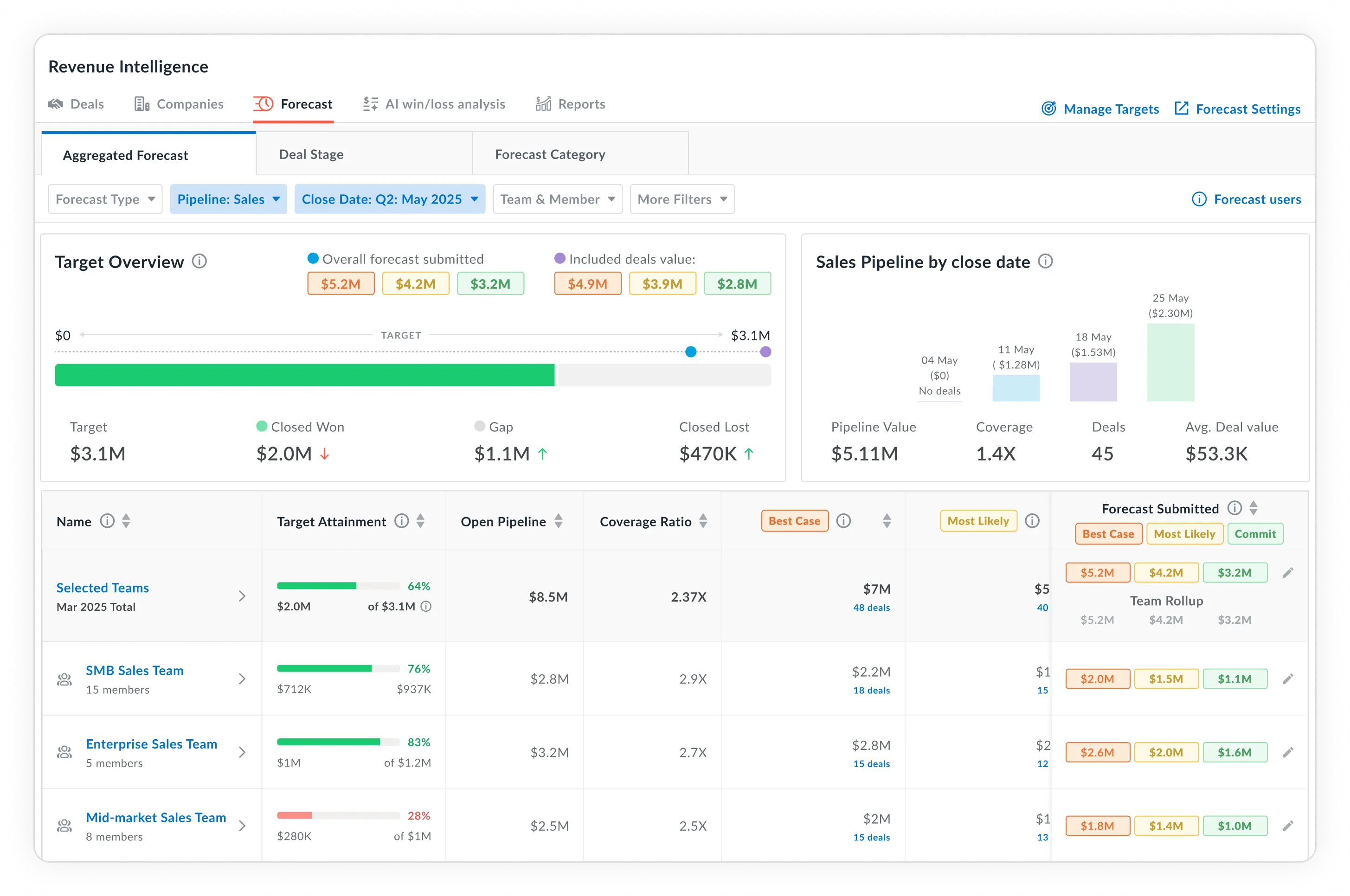
Forecasts often rely on rep judgment and manual CRM updates. That creates blind spots.
Avoma pulls data from recorded calls, buyer engagement, deal activity, and CRM fields to show the full picture of each opportunity.
You can:
- Track deals as they move through stages
- See when activity drops off
- Identify accounts with low buyer engagement
- Flag stalled deals before they slip
Deal health alerts highlight risks based on sentiment, activity levels, and engagement patterns. Instead of waiting for quarter end surprises, managers see risk signals early.
Avoma also uses predictive models to estimate expected revenue based on actual deal behavior, not just stage probability. High risk accounts stand out. Likely to close deals are easier to prioritize.
What changes:
Forecast reviews move from opinion based updates to data backed discussions.
From recorded sales calls to pipeline visibility
Most sales teams record meetings. Few turn those conversations into structured pipeline data.
Avoma connects call recordings, CRM updates, coaching workflows, and deal health tracking in one system. Managers see which deals are active, which accounts are disengaged, and where reps need support without chasing updates.
If you are responsible for revenue, the question is simple:
Are your forecasts based on conversation data
Or on rep recollection
See how Avoma turns recorded sales calls into measurable pipeline execution.
Frequently Asked Questions
Sales call recording improves close rates when conversation data is actively analyzed and used for sales coaching. By reviewing objection handling, qualification depth, pricing discussions, and next-step clarity, sales managers can identify behavior patterns that influence win rates. AI-generated scorecards and conversation analytics help teams reinforce high-performing talk tracks and correct gaps. The impact depends on structured review processes, not simply storing audio files.
Sales call recording software can track talk-to-listen ratio, buyer engagement signals, objection frequency, competitor mentions, pricing conversations, next-step commitments, and sentiment trends. When synced with a CRM, these conversation metrics connect directly to pipeline stage progression and deal health. Aggregated insights allow sales leaders to compare top performers, detect stalled opportunities, and forecast revenue using real interaction data rather than rep recollection.
AI transcription accuracy depends on audio quality, industry terminology, speaker clarity, and background noise. Most modern AI transcription systems achieve high accuracy in structured business environments. For coaching, keyword tracking, and performance analysis, minor transcription errors typically do not affect trend identification. However, for compliance reviews or contractual disputes, the original sales call recording remains the authoritative source.
Most enterprise sales call recording platforms integrate with CRM systems such as Salesforce and HubSpot, as well as VoIP dialers and video conferencing tools like Zoom and Microsoft Teams. Integration enables automatic meeting capture, transcription, note generation, and CRM field updates. Proper integration reduces manual data entry and ensures pipeline visibility reflects actual buyer conversations.
Buyer trust is generally maintained when recording disclosures are clear and consistent. In the United States, consent requirements vary between one-party consent and two-party consent states, and international regulations such as GDPR may apply. Transparent notification at the beginning of a call supports compliance and professionalism. Lack of disclosure can create legal exposure and reputational risk.
Retention policies for sales call recordings should align with internal governance standards, industry regulations, and data privacy laws. Frameworks such as GDPR emphasize data minimization and purpose limitation, which may discourage indefinite storage. Some industries require specific retention timelines, while others allow shorter coaching-focused storage periods. A documented retention schedule reduces legal risk and supports compliance audits.
In remote and hybrid sales environments, managers lack in-person visibility into live conversations. Recorded calls, searchable transcripts, and AI-generated summaries provide asynchronous access to rep performance and buyer engagement. This enables standardized onboarding, structured coaching, and consistent pipeline reviews across distributed teams. Conversation intelligence platforms reduce reliance on subjective summaries and increase data-backed decision-making.
Sales call recordings can serve as supporting evidence in contract disagreements or compliance investigations if consent requirements were met. They provide a verbatim record of representations, pricing discussions, and commitments made during the sales process. Admissibility varies by jurisdiction and industry regulation. Privacy and recording laws differ across states and countries and may change over time, so legal consultation is recommended before relying on recordings for evidentiary purposes. Recordings supplement written agreements but do not replace formal contracts as the primary legal document.


Dive into Our Latest
Avoma Insights.


What's stopping you from turning every conversation into actionable insights?


