
Best revenue intelligence software in 2026: 7 tools compared for sales and RevOps teams

Table of Contents:

If you're comparing revenue intelligence platforms, you've probably moved past the "what is it?" stage. Now you're trying to determine which solution best fits your sales organization.
This guide compares seven leading revenue intelligence platforms using the same evaluation framework. We assess each product based on feature depth across core revenue intelligence use cases, G2 customer ratings, whether pricing is published, and who each platform is and isn't a good fit for. By the end, you should have a clear shortlist based on your team's needs.
Since Avoma offers revenue intelligence software, we've included ourselves in this comparison. We applied the same evaluation criteria to every vendor, including our own platform.
If you're looking for a foundational overview instead, read our guide to revenue intelligence, which covers how it differs from CRM and conversation intelligence and when it makes sense to invest.
TL;DR
- Avoma - Best all-in-one for B2B sales and RevOps teams. Covers automated activity capture, coaching at scale, pipeline inspection, and forecasting in one connected platform.
- Gong - Best for enterprise sales coaching depth (100+ reps). The category benchmark for conversation intelligence.
- Clari (+ Salesloft) - Best for enterprise forecast management and revenue orchestration.
- Salesforce Revenue Intelligence - Best for orgs already deep in Salesforce who don't want a separate vendor.
- Chorus by ZoomInfo - Best for teams already in the ZoomInfo ecosystem.
- Revenue Grid - Best for Salesforce-first orgs focused on CRM hygiene automation.
- HubSpot Sales Hub - Best for early-stage teams already on HubSpot who want basic RI built in.
A note on scope: tools like Outreach, Salesloft, and Apollo are sales engagement and prospecting platforms. Both categories are useful, but they're distinct. We haven't included them here.
How we selected these tools
We included a tool if it covers at least two of the core revenue intelligence use cases: pipeline inspection, deal risk monitoring, sales forecast management, conversation intelligence (tied to deal outcomes), or CRM auto-sync from meeting data.
We used G2 aggregate ratings as a proxy for user satisfaction - aggregate scores across hundreds or thousands of reviews, not individual cherry-picked quotes. Tools with published pricing got credit for it; tools with quote-only pricing are flagged clearly.
Avoma is the publisher of this article and is included in the list. We applied the same criteria to ourselves that we applied to every other tool.
Quick comparison: best revenue intelligence software at a glance
The best revenue intelligence software platforms
1. Avoma
Best for: B2B sales and RevOps teams across SMB, mid-market, and enterprise who want pipeline visibility, forecast accuracy, and deal intelligence in one connected platform
Avoma connects conversation data to pipeline outcomes across every team size and replaces three typical point solutions:, note-taking, call coaching, and forecasting tools, with one platform.
Key features:
- Automatic CRM logging: Notes, action items, objections, and stakeholder details captured from every call and synced bi-directionally to Salesforce or HubSpot without rep input
- AI sales methodology scoring (MEDDIC, SPICED, Sandler, or custom) with evidence-backed numeric scores per deal across calls and emails
- AI-assisted forecasting with weighted amounts, custom forecast categories, target attainment tracking, and a full submission audit trail
- Deal risk and forecast risk alerts pushed to Slack from live conversation signals
- Win-loss analysis across all deals to understand what drove outcomes at the pipeline level
Pricing: Base plans from $19/user/month. Revenue Intelligence add-on is $29/user/month (annual billing). No platform fees.
G2 rating: 4.6/5 across 1,352+ reviews
Who should look elsewhere: Teams that don't record calls. Avoma's RI signals come from conversation data, so if call recording isn't in your workflow, the deal health and pipeline scoring lose much of their input.
See Avoma's revenue intelligence features | Compare Avoma pricing
2. Gong
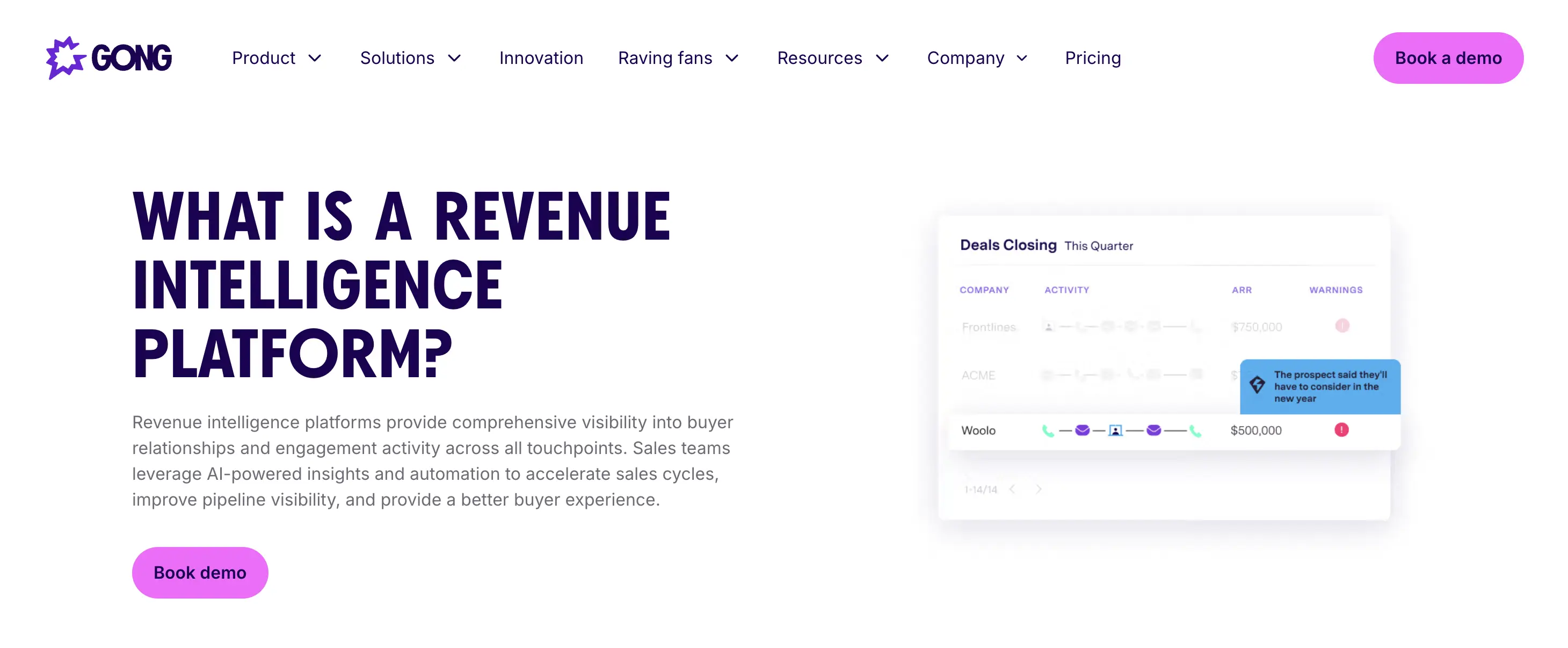
Best for: Enterprise sales organizations (100+ reps) that prioritize deal intelligence and pipeline forecasting at scale
Gong's Revenue AI OS runs on the Revenue Graph. It is a continuously updated map of every call, email, and meeting tied to deal and account records. Gong Forecast draws on that data to produce close predictions and at-risk deal flags for revenue leaders. For enterprise teams with high call volumes and complex multi-level forecasts, it's a preferred option in the category.
Gong crossed $500M ARR in 2026 and shipped a multi-agent OS (Mission Andromeda) in February 2026.
Key features:
- Gong Forecast: Pipeline prediction with call-data-backed close probability at rep, team, and org level
- Gong Engage: AI-assisted seller workflows that surface next best actions based on deal signals and buyer behavior
- Pipeline health analytics with deal-by-deal risk flags, stage stall detection, and trend reporting
- Gong Enable: Rep coaching tied to specific deal outcomes and win-rate patterns
Pricing: Not publicly listed. Typically structured with a platform fee plus per-seat costs, often with 2–3 year contract terms. Teams under 50 reps consistently report difficulty justifying the cost. Request a quote to get current pricing.
G2 rating: ~4.7/5 across 5,000+ reviews
Who should look elsewhere: SMB and mid-market teams with under 50 reps who don't have the headcount to justify enterprise pricing. Teams that also need scheduling, lead routing, or a single platform for the full meeting lifecycle - Gong doesn't cover those. Avoma's Gong comparison page has a detailed breakdown.
3. Clari (now part of the Salesloft group)
Best for: Enterprise revenue leaders who need rigorous pipeline inspection and multi-level forecast roll-ups
Clari is built around one problem: enterprise revenue teams can't trust their forecasts because rep-submitted numbers are opinions, not data. Clari validates those submissions against actual deal activity - calls logged, emails sent, stage changes - and rolls the corrected view up from rep to manager to CRO. The Salesloft merger (August 2025) extended that into sales engagement, so the activity data feeding the forecast is now generated inside the same platform.
A Forrester TEI study (September 2025) cited 398% ROI and $96.2M in value for a modeled enterprise deployment.
Key features:
- Activity-based forecast validation: rep-submitted numbers checked against actual deal engagement, not self-reported
- Multi-level forecast roll-ups: rep to manager to VP to CRO, with override tracking at each level
- Deal risk scoring across the full pipeline based on engagement signals and stage velocity
- Post-merger: Salesloft engagement sequences feed activity data directly into Clari's forecasting layer
Pricing: Not publicly listed. Enterprise pricing, typically quote-based.
G2 rating: ~4.6/5 across 500+ reviews for Clari (verify at g2.com; the merger may affect review aggregation)
Who should look elsewhere: SMB and mid-market teams. The product is built for enterprise complexity and is priced accordingly. Post-merger product integration is still evolving, so buyers evaluating the combined Clari + Salesloft stack should account for that in their timeline. Check how Clari compares with Avoma.
4. Salesforce Revenue Intelligence
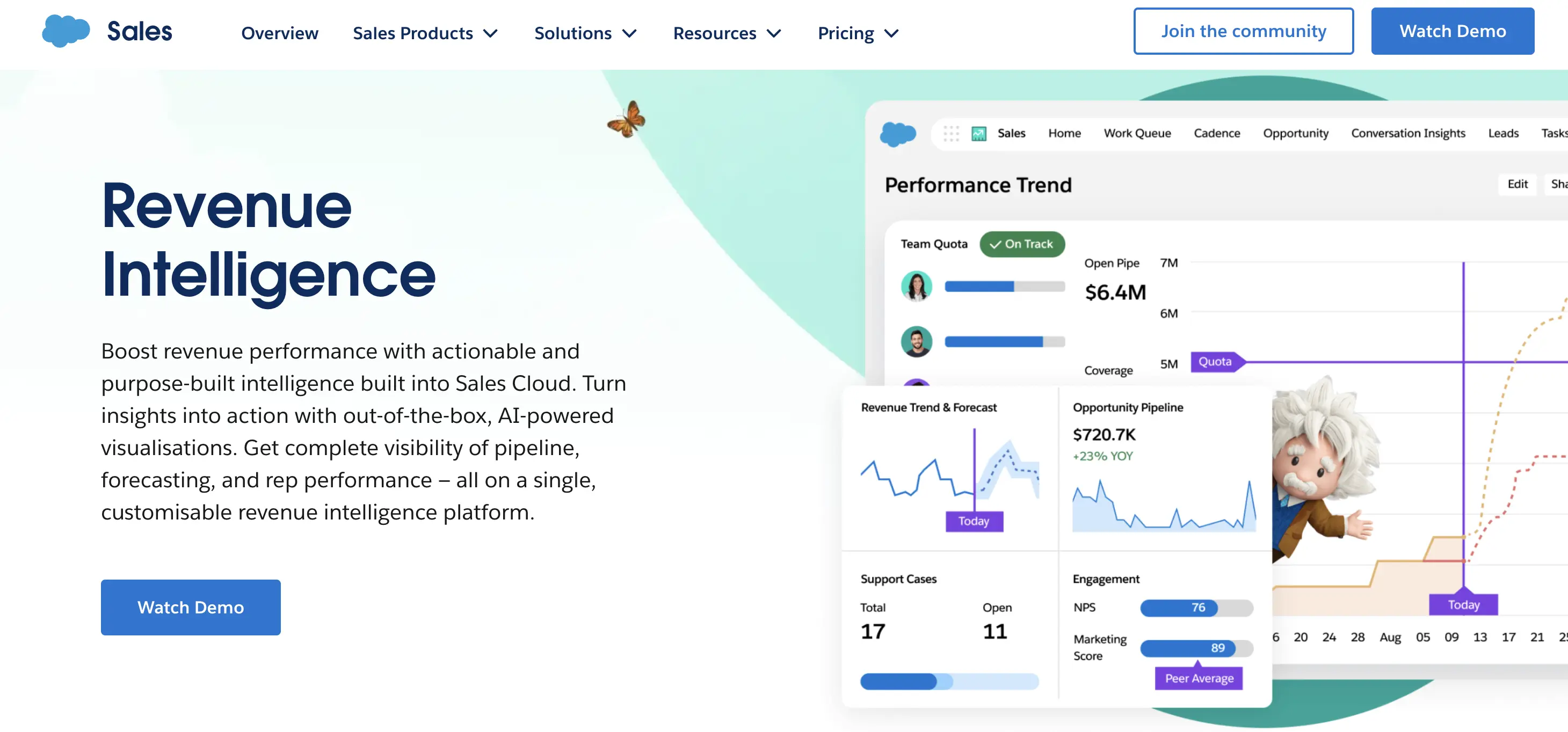
Best for: Teams already on Salesforce who want revenue intelligence built into their existing CRM
Salesforce Revenue Intelligence is a dedicated add-on to Sales Cloud that brings pipeline analytics and forecasting dashboards into the CRM without a separate vendor. For orgs already operating on Salesforce, it's the path of least resistance: no new integration, no separate data layer, no second contract.
Key features:
- Revenue Insights: quota attainment, win rates, and pipeline by rep and team with historic trend comparisons
- Forecast Insights + Commit Calculator: velocity and pipe coverage monitoring with what-if scenario modeling to show how adding or removing deals affects revenue targets
- Sales Rep Command Center: personalized quota tracking with stuck and overdue opportunity flags for rep-level action
- AI Account Management: account health scoring and upsell/cross-sell identification based on purchase patterns from similar accounts
- 50+ native connectors to blend external data sources with Salesforce data in custom dashboards
Pricing: Salesforce Revenue Intelligence is an add-on to Sales Cloud, starting at $220/user/month (billed annually). Some higher-tier Sales Cloud editions include it. Full pricing at salesforce.com.
G2 rating: ~4.4/5 (G2 ratings vary by product module)
Who should look elsewhere: Teams not already on Salesforce. The RI capability here depends entirely on CRM data quality. If CRM field hygiene is poor, the signal is weak. Implementation complexity is higher than most other tools on this list.
5. Chorus by ZoomInfo
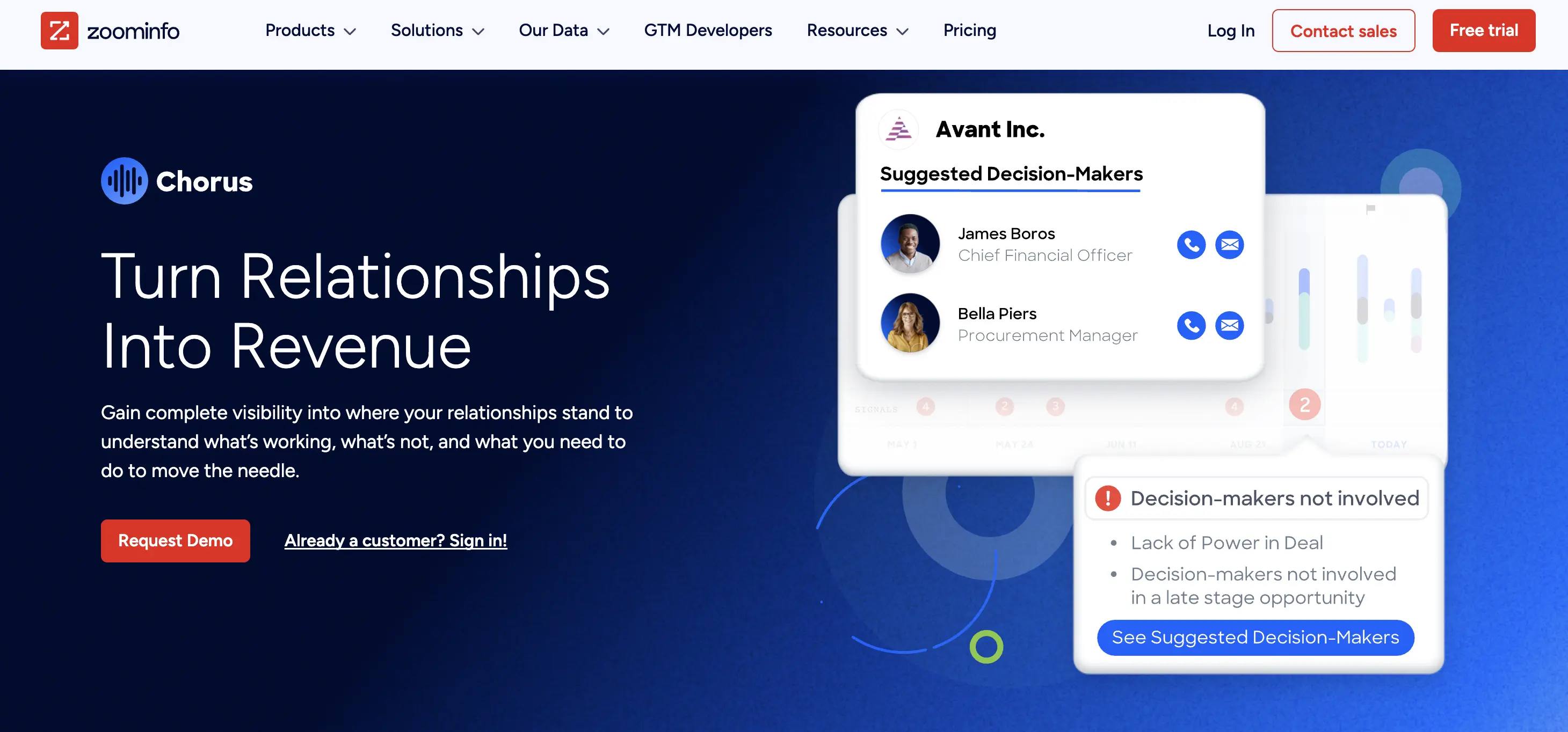
Best for: Teams in the ZoomInfo ecosystem who want deal intelligence without adding a separate vendor
Chorus is primarily a conversation intelligence tool, but it qualifies here because of its Deal Intelligence and Market Intelligence modules. Deal Intelligence tracks deal health from CRM-synced call and email data. Market Intelligence pulls win/loss patterns from actual deal recordings rather than post-deal rep surveys. Since ZoomInfo's acquisition, development focus has moved to ZoomInfo Copilot, which combines Chorus's CI capabilities with ZoomInfo's contact and B2B intent data.
Key features:
- Automatic contact and communication capture from calls, meetings, and emails to Salesforce CRM without rep input
- Competitive intelligence: surfaces how often and in what context competitors come up by deal stage and outcome
- Win/loss analysis from recorded deal conversations rather than rep-reported reasons
- ZoomInfo Copilot: account-level buying intent signals layered on top of deal conversation data
Pricing: Quote-based, tied to ZoomInfo contracts.
G2 rating: ~4.5/5 across 2,900+ reviews for Chorus were published on G2 prior to merger. But the Chorus listing is no more available since ZoomInfo shifted development to Copilot.
Who should look elsewhere: Buyers evaluating Chorus as a standalone product should understand that the roadmap now runs through ZoomInfo Copilot. If you're not also buying ZoomInfo, the strategic fit is weaker. Teams that need depth on forecasting and pipeline inspection beyond CI will find the feature set thinner than dedicated RI platforms. See Avoma's comparison with Chorus.
6. Revenue Grid
Best for: Salesforce-heavy organizations that want cleaner pipeline data and guided deal execution
Revenue Grid's premise is that most pipeline data is unreliable because it depends on rep entry. Their "True Pipeline" view is built from automatic activity capture - email, calendar, and call data mapped to the right Salesforce records without rep involvement - so what managers see reflects real deal engagement.
Key features:
- Activity capture from Gmail, Outlook, and calendar to Salesforce records automatically, with no rep action required
- AI Mentor: deal-level coaching recommendations based on activity gaps, stage stalls, and CRM signal patterns
- Guided selling next steps tied to deal stage, relationship data, and account signals
- Relationship intelligence: tracks stakeholder engagement depth and contact coverage per opportunity
Pricing: Quote-based.
G2 rating: ~4.6/5 across 300+ reviews
Who should look elsewhere: Teams that need conversation intelligence from call recordings, deep forecasting tools, or a platform that works across multiple CRMs. Revenue Grid is narrow by design. It does its job well, but it's not a full RI platform.
7. HubSpot Sales Hub
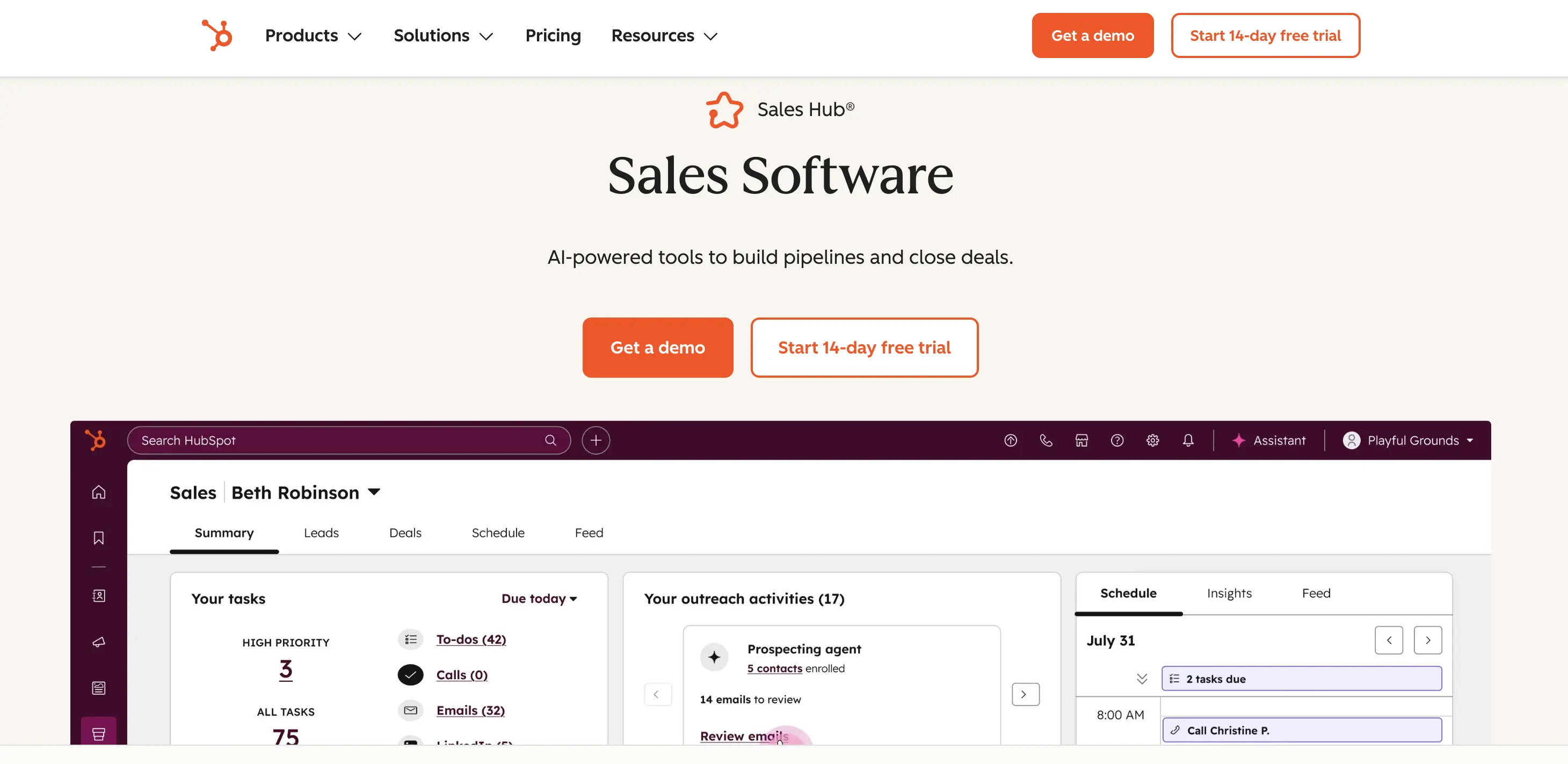
Best for: Teams already on HubSpot who want built-in deal intelligence and pipeline reporting without a separate vendor
HubSpot Sales Hub covers the RI fundamentals - deal scoring, pipeline reporting, forecasting, and conversation intelligence - natively inside the CRM. It's wide by design: built for teams that want RI built in rather than a dedicated platform. Depth is the trade-off.
Key features:
- AI Deal Scores: predicted close likelihood scored from deal activity, contact engagement history, and behavioral signals
- Smart Deal Progression (Beta): reads call transcripts and deal history to suggest specific CRM field updates, draft follow-ups, and recommend next steps
- Breeze AI forecasting: pipeline projections with quota attainment tracking and coverage gap visibility
- Conversation Intelligence: call transcripts and key moments surfaced inside CRM contact and deal records
Pricing: Sales Hub Professional starts at $100/user/month (billed annually). Full pricing is published at hubspot.com.
G2 rating: ~4.4/5 across 13,000+ reviews for Sales Hub
Who should look elsewhere: Teams that need depth on call coaching, AI-driven methodology scoring, advanced forecasting, or deal risk alerts based on conversation signals. HubSpot's RI features are wide, not deep. As teams grow and pipeline complexity increases, most graduate to a dedicated RI platform.
How to choose the right revenue intelligence platform
Four questions will get you to a shortlist fast.
What's your primary use case?
If call coaching is the priority, scoring every call against a rubric, understanding why top reps win, building a library of what good looks like, Gong is the category benchmark. Avoma covers the same use case at a price point that works for teams Gong prices out.
If pipeline inspection and forecast accuracy come first, Clari is the enterprise standard for multi-level forecast roll-ups at the very top of the market. Avoma covers pipeline inspection, deal health scoring, and AI-assisted forecasting across SMB, mid-market, and enterprise teams, with the addition of automated compliance and consent enforcement for orgs that need it.
How many reps do you have?
Gong and Clari are built around enterprise procurement cycles and contract structures that add friction for smaller teams. Avoma works across SMB, mid-market, and enterprise, with published per-seat pricing and a self-serve option that doesn't require a sales process to get started.
What's your CRM?
Salesforce-first orgs should evaluate Revenue Grid for CRM hygiene automation and Salesforce Revenue Intelligence for native AI deal scoring. Both depend on Salesforce being your actual source of truth.
On Salesforce, HubSpot and most prime CRMs, Avoma has a native 2-way CRM sync. HubSpot Sales Hub is the built-in option, with less RI depth but zero additional vendor complexity.
How do you want to buy?
Avoma and HubSpot publish pricing and let you start without a sales call. Gong, Clari, and Salesforce are all quote-based. That is appropriate for large orgs with procurement requirements, but slower for teams that need to move quickly.
One more thing: if you need scheduling and lead routing in the same platform as your RI tools, Avoma is the only option in this list that includes both natively.
For B2B sales teams that want conversation intelligence, coaching, and revenue intelligence without managing multiple vendors, Avoma covers all of it in one platform with pricing that works at any stage.
See Avoma's pricing | Try free - no credit card required
Where to go from here
The fastest way to evaluate any RI tool is to bring a real deal and see how it reads it. Avoma's free trial requires no credit card - you can run pipeline inspection, deal health scoring, and methodology tracking against your own calls before you commit.
Frequently Asked Questions
Pricing varies by team size and feature depth. Avoma's Revenue Intelligence add-on is $29/user/month (annual billing) on top of base plan pricing. HubSpot Sales Hub Professional starts at $100/user/month. Gong and Clari don't publish pricing - both are quote-based and typically target enterprise teams. For SMB and mid-market, expect a range of $20–$100/user/month for a dedicated RI platform; enterprise platforms often have platform fees on top of per-seat costs.
Yes, if you're losing deals you don't fully understand, building forecasts from rep gut feel, or coaching without visibility into what's actually happening on calls. The business case for RI doesn't require a large team - it requires a repeatable process you want to improve. Tools like Avoma and HubSpot Sales Hub are priced for teams at this scale and don't require enterprise procurement cycles to get started.
Yes. Avoma is used by teams across SMB, mid-market, and enterprise. For enterprise orgs, the platform covers the requirements that matter at scale: automated recording compliance with SOC 2, GDPR, HIPAA, EU-US DPF, and CPRA certifications; org-wide consent enforcement; bi-directional Salesforce sync; pipeline visibility across large rep teams; and coaching at scale without manual call review. Enterprise teams that want one platform covering notes, coaching, pipeline inspection, and forecasting - instead of managing three separate vendor contracts - are a strong fit.
Avoma's revenue intelligence layer covers pipeline inspection, deal health scoring, and forecast management across large rep teams. Deal health scores update automatically from call and email signals for every rep's pipeline, so managers see an accurate view without waiting on rep updates. The forecasting module supports weighted amounts, custom forecast categories, target attainment tracking, and a full submission audit trail - giving RevOps leaders the data to hold reps accountable to forecast commits. Sales methodology compliance (MEDDIC, SPICED, Sandler, or custom) is tracked across every call, so qualification gaps surface across hundreds of deals rather than only in spot-check reviews. For enterprise RevOps teams looking to consolidate vendors, Avoma covers conversation capture, CRM sync, pipeline inspection, coaching, and forecasting in one platform.


Dive into Our Latest
Avoma Insights.


What's stopping you from turning every conversation into actionable insights?


