
Sales ramp: How to combine role play and live coaching to get new reps selling sooner

Table of Contents:

Most ramp plans put their structure into the first few weeks: product training, the pitch and a handful of shadowed calls. Then the rep starts taking live calls, and the support they get depends on how much time their manager has that week.
That second stretch is where most ramp time goes, and it's the part role play and live coaching can shorten. By the end, you'll have a 90-day plan that uses both, plus a scorecard for deciding when a rep is ready to sell alone.
TL;DR
- Sales ramp is the time from a rep's start date to full productivity, most often measured as their first full-quota month. Bridge Group's 2025 research puts average SDR ramp at 3.0 months.
- Each method builds a different skill. Shadowing builds context, role play builds repetition, and live call coaching builds judgment with real buyers.
- AI roleplay fits the first 6 weeks, for repetition on the pitch and common objections. Judgment calls need a manager.
- Gate solo calls on a scored mock demo, and let reps practice as many times as they need to pass it.
- The Four-Gate Ramp splits 90 days into 4 stages, each with an exit gate, and keeps coaching going after the first live call.
- Track leading metrics every week and lagging metrics by cohort.
What is sales ramp, and how long should it take?
Sales ramp is the period between a rep's start date and the point where they perform at full productivity. Most teams set that point at the rep's first month at full quota.
Bridge Group's 2025 sales development report, based on 351 B2B companies, puts average SDR ramp at 3.0 months. AE ramp tends to run longer, because it tracks the length of the sales cycle.
"Sales ramp up" and "ramp time" mean the same thing. The end point changes from team to team, and that's why most ramp numbers can't be compared.
Pick one of these definitions and use it for every cohort:
- Time to first deal: Days from start date to the rep's first closed-won deal. It suits long sales cycles, where quota attainment takes months to show up.
- Time to first full-quota month: The most common definition, and the one leadership tends to mean when they ask about ramp.
- Time to first solo call: Days until the rep runs a call without a manager. It's a leading signal, so you see a stalled ramp in week 4 instead of month 4.
Data Point: Bridge Group's 2025 report puts average SDR ramp at 3.0 months, the lowest it has recorded since 2010. That's down from a peak of 3.8 months in 2014. The survey covered 351 companies, and 83% of them were B2B SaaS.
If training takes a few weeks, the rest of those 3 months goes somewhere specific, and the next section shows where.
Why ramp plans stall between training and the first live call
Most ramp plans stall because they teach knowledge and skip practice. Reps learn the product, the ICP and the sales process in a few weeks.
Then they go into live calls with few chances to use that knowledge under pressure. Once they're on those calls, support is thin.
The sticking points look like this:
- Knowledge vs execution: A rep can explain the pricing model in a quiz and freeze when a buyer says it's too expensive.
- Passive learning: Shadowing shows what good sounds like, but someone else does the talking. What the rep sees depends on which calls land that week.
- Scarce manager time: Mock calls need a manager to play the buyer, and that hour competes with deals.
- Slow feedback: Feedback on a live call arrives days later, if at all. By then the rep has repeated the mistake on 3 more calls.
Common Mistake: Treating a finished onboarding course as proof a rep is ready for calls. The course proves the rep can recall information. It says little about using it while a buyer pushes back.
Each method on a ramp plan fixes one of these problems, so the next step is matching each method to a stage.
Mock calls vs shadowing vs live call coaching: What each method teaches
Each ramp method builds a different skill. Shadowing and call libraries build context: what buyers ask and how strong reps answer.
Mock calls and role play build repetition and recall, whether a manager, a peer or AI plays the buyer. Live call coaching, during and after real calls, builds judgment with real buyers. A fast ramp uses all of them, in sequence.
| Method | What it builds | Best ramp stage | Manager time | Main limit |
|---|---|---|---|---|
| Shadowing live calls | Context, tone and call structure | Weeks 1–4 | Low | The rep watches and doesn't practice |
| Call library and playlists | Pattern recognition across many calls | Weeks 1–6 | Low after setup | The rep listens but never speaks |
| Manager-led mock call | Realistic practice with expert feedback | Weeks 2–5 | High | Hard to schedule as much as reps need |
| Peer role play | Repetition and comfort with the pitch | Weeks 2–5 | Low | Feedback quality varies by peer |
| AI roleplay | Unlimited repetition on the pitch and objections | Weeks 1–6 | Low | Buyers can sound scripted, and judgment calls need a manager |
| Live call with real-time guidance | Handling real objections with support on screen | Weeks 5–8 | Low to medium | Covers the moments you've prepared for and nothing else |
| Scored post-call review | Judgment and self-correction over time | Week 5 onward | Medium | Depends on the quality of the rubric |
The order follows risk. In the first weeks, a mistake should cost nothing, so practice happens where no buyer is listening.
As reps prove they can handle the common moments, they move into real calls with support. The support drops away as their scores climb.
Manager time matters as much as the skill each method builds. A plan that depends on manager-led mock calls breaks the first week a manager has 3 deals closing.
Methods that need little manager time should cover most practice hours. Save manager time for the moments that need judgment, like reviewing calls and deciding when a rep is ready. The readiness check later in this guide turns that decision into a score.
If you want practice material for these stages, there are 10 role-play exercises with full scripts you can adapt.
AI roleplay is the one method on this list that teams buy as a separate tool, so it gets a closer look next.
Where AI roleplay helps ramp, and where it falls short
AI roleplay helps most in the first 6 weeks of ramp. It gives reps unlimited, low-stakes repetitions on the pitch, discovery questions and common objections, with no manager in the room.
It helps least on judgment calls that depend on a real buyer's context. It works best paired with coaching on live calls.
A rep can run the same objection 10 times in an afternoon, against the same scenario and scoring as every other rep. The limits are clear too:
- Realism: Generic buyers sound generic, and reps learn to beat the bot.
- Stale scenarios: Scripts that aren't built from your own calls drift away from what buyers say today.
- Judgment: Deciding when to push and when to back off takes a manager. Mindtickle's own buyer's guide to AI role play software makes the same point.
What to look for in an AI roleplay tool for ramp:
- Scenarios and buyer personas built from your own call recordings
- Practice scored with the same rubric you use on live calls, so the two scores mean the same thing
- Practice suggested from moments a rep missed on recent live calls
- Feedback that names one fix and lets the rep retry that exact moment
- Integrity checks, so silent, scripted or gamed sessions don't count
- Reporting on whether practiced skills improve on later live calls
If you're designing the full practice program, this walkthrough of running a role-play program that changes live calls covers session formats, rubrics and how often to practice.
AI roleplay for remote sales team onboarding
AI roleplay suits remote onboarding because it replaces the informal practice an office provides, like overhearing calls or grabbing a manager for a quick role play.
Async AI practice and a shared library of recorded calls give remote reps repetition and context on their own schedule. Keep one live session a week with a manager to check practice scores against human judgment.
Pro Tip: Build your first scenarios from the 3 objections that show up most in your lost deals. New reps will hear those objections in their first weeks.
Practice gets a rep ready for the first call, but most of ramp happens after it, on real calls with real buyers.
How real-time coaching helps new reps on live calls
Real-time coaching tools listen to a live call and detect moments like an objection, a competitor mention or a missed qualification step. When one comes up, the rep sees a pre-approved talking point on screen.
In Avoma, these prompts are Answer Cards. Admins write them and set the trigger phrases, and only the rep sees them during the call.
How Answer Cards work in Avoma:
- An admin writes a card with talking points, 3 to 5 example trigger phrases and keywords.
- During the call, Avoma detects a matching phrase and shows the card for 20 seconds. The rep can reopen it from a drawer for the rest of the call.
- The rep uses the card or dismisses it. External participants never see it.
- After the call, the rep rates whether the card helped. Managers see which cards fired and how the rep handled each moment.
Avoma's real-time guidance also shows an in-call methodology overlay for frameworks like MEDDIC, BANT and SPIN. It marks which steps the rep has covered.
Reps can type or speak a question to Ask Avoma mid-call to pull CRM data or deal history. After the call, AI Scorecards grade the call against your rubric, and AI Coaching Recommendations list what went well and what to work on next.
Plan for the limits of real-time guidance:
- Cards fire on the triggers you've set up, so an objection you didn't plan for gets no card.
- Too many cards distract a new rep. Start with the 5 to 10 moments that cost deals most often.
- Spotting patterns across a rep's calls, and coaching on them, takes a manager.
Best Practice: Keep each card to 2 or 3 short bullets a rep can read in one glance. Avoma's setup guide recommends bullets for card content for the same reason.
Real-time guidance lowers the risk of early calls. The next question is how to decide when a rep is ready to take those calls.
How to assess new hire sales demos before live calls
Run a recorded mock demo with a manager or peer playing the buyer. Score it against the same rubric you use on real calls, and require a passing score before the rep runs calls alone.
The shared rubric makes the gate fair. A 4 out of 5 on objection handling in the mock demo should mean the same thing as a 4 on a real call.
| Criterion | What a pass looks like | Weight |
|---|---|---|
| Discovery questions | Asks about the current process, the pain and its impact before demoing | 20% |
| Pain confirmed | Restates the buyer's problem and gets agreement | 15% |
| Demo tied to pain | Shows the features that solve the stated problem and skips the rest | 20% |
| Objection handled | Acknowledges, asks a clarifying question, answers and confirms | 20% |
| Next step secured | Ends with a dated next meeting or a clear action | 15% |
| Talk ratio | The buyer does a meaningful share of the talking | 10% |
Score each criterion from 1 to 5. A starting pass bar might be an average of 3.5, with no criterion below 3. Calibrate it by scoring a few of your top reps' recent calls with the same rubric.
Let reps practice in private as many times as they want. To pass, they need one attempt without hints or help that meets the bar. If a rep is stuck after many attempts, that's the cue for a conversation with their manager.
Key Takeaway: A readiness gate turns "I think she's ready" into a score you can defend. It also shows the rep what to fix before a real buyer finds it.
The gate sits at the end of stage 2 in the 90-day plan, where practice ends and live calls begin.
The Four-Gate Ramp: A 90-day plan that combines role play and live coaching
The Four-Gate Ramp splits a new rep's first 90 days into 4 stages. Each stage ends with a gate the rep has to pass before moving on.
The first 2 stages focus on practice. Stage 3 adds live calls with support, and stage 4 moves to scored reviews once the rep sells alone.
- Stage 1, learn and practice (weeks 1–3): Product, ICP and process training, plus daily practice on the pitch and the 3 to 5 most common objections. Use AI or peer role play for volume and a call library for context. Manager time is low. The gate: the rep handles the pitch and the top objections in practice at a passing score.
- Stage 2, observe and rehearse (weeks 3–5): Shadow live calls, review recorded calls from top reps, and run manager-led mock calls on discovery and demo. Manager time is medium. The gate: the scored mock demo from the readiness check.
- Stage 3, assisted live calls (weeks 5–8): The rep runs real calls with real-time guidance on screen, and a manager joins the first few demos. Every call gets scored. Manager time is medium. The gate: a set run of scored calls at or above the bar, for example 5 in a row.
- Stage 4, solo with scored review (weeks 8–12 and beyond): The rep sells alone. A weekly scored call review picks one skill to work on. When a live call shows a miss, the rep runs a short practice drill on that moment, and does a quick prep run before important calls. Manager time is low to medium. The gate: your team's ramp definition, such as the first full-quota month.
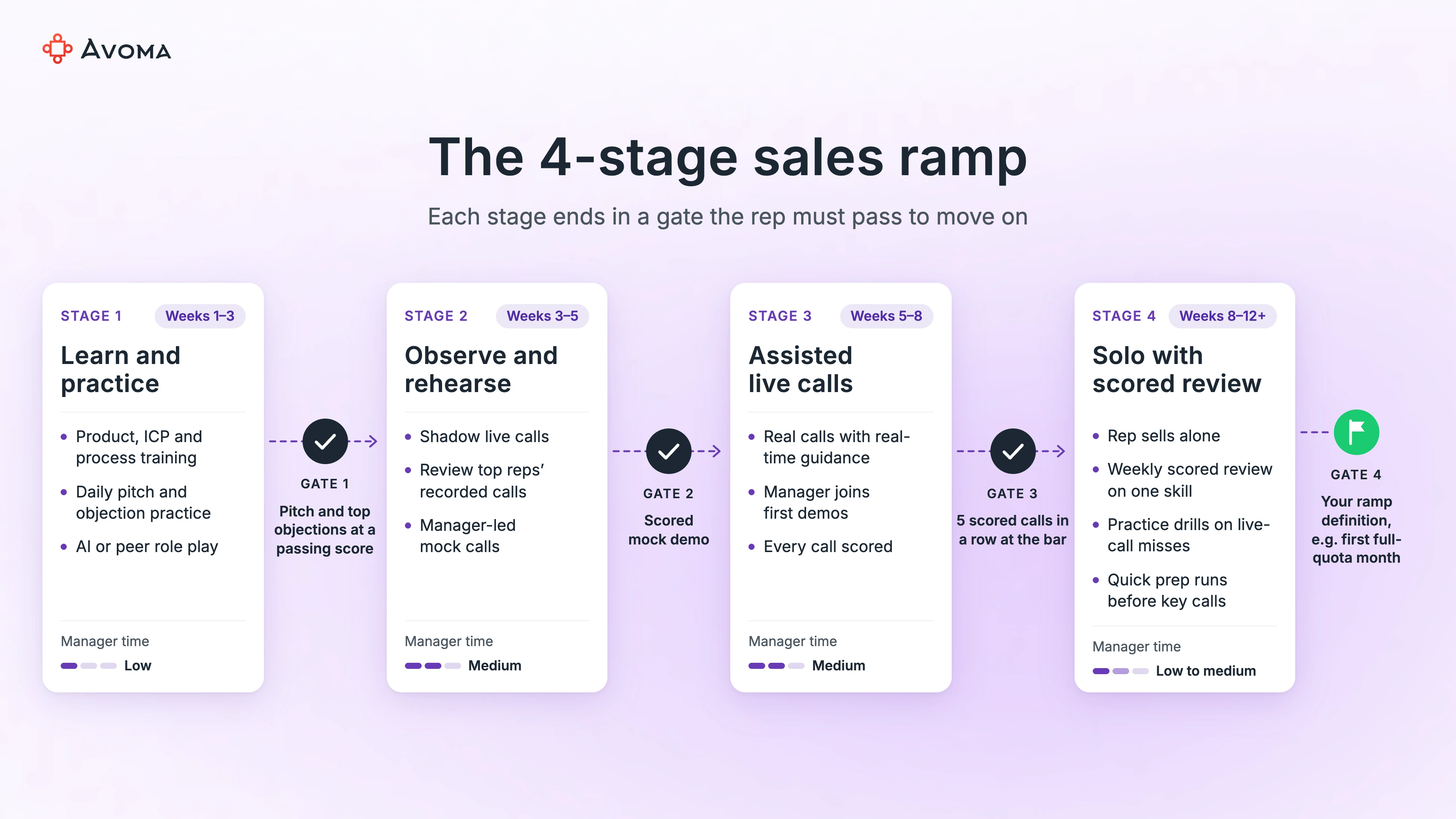
Adjust the timeline to the role. SDR plans can compress stages 1 to 3 into about 6 weeks, and Bridge Group's 3.0-month SDR average is a useful check on the whole plan.
AEs with long sales cycles stay in stage 4 longer, because their first deals take longer to close.
Pro Tip: Write each gate's pass bar down before the cohort starts. Reps know what they're working toward, and managers stop deciding readiness case by case.
A plan proves itself in the numbers, so the last step is choosing which ones to watch.
How to tell if your ramp is getting shorter
Track lagging metrics by cohort and leading metrics every week. Lagging metrics tell you whether ramp got shorter. Leading metrics warn you in time to fix a problem.
Leading metrics (weekly):
- Readiness gate pass rate and attempts to pass
- Scorecard trend per rep, by skill
- Objection-handling scores on live calls
- Whether a skill a rep practiced scores higher on their next live calls
Lagging metrics (by cohort):
- Time to first solo call
- Time to first deal
- Time to first full-quota month
Compare cohorts when you judge the plan. One rep's fast ramp can come from a lucky territory. A cohort that ramps faster after you change the plan is evidence the change worked.
Make live calls part of the ramp plan
Most of a new rep's ramp happens on live calls. That's also where coaching drops off, because no manager can join every call.
Avoma backs up new reps during the call with Answer Cards and an in-call methodology guide. After the call, Avoma scores every conversation against your rubric, so managers see where each rep needs help without listening to every recording.
If your team is hiring, see how Avoma helps you coach new reps on their own calls.
Frequently Asked Questions
The number depends on the rep and the sales motion, so a pass bar is a better guide than a fixed count. A rep who passes a scored mock demo in week 2 is ready sooner than one who needs 10 attempts. Set the pass bar first, then let practice volume vary by rep.
Real-time guidance can distract when too many prompts fire or when each prompt is long. Teams reduce that risk by starting with a small set of high-impact moments and keeping each prompt to a few short bullets. Reviewing which prompts reps rate as helpful after calls shows which ones to rewrite or remove.
Experienced hires can skip ahead when they show they're ready. A common approach is to give them the stage 2 readiness gate in their first week. If they pass, they move straight to assisted live calls. Product and process training applies to everyone, because experience at another company doesn't cover a new product, ICP or pricing model.



What's stopping you from turning every conversation into actionable insights?


