
Sales role play scenarios: 10 exercises with full scripts

Table of Contents:
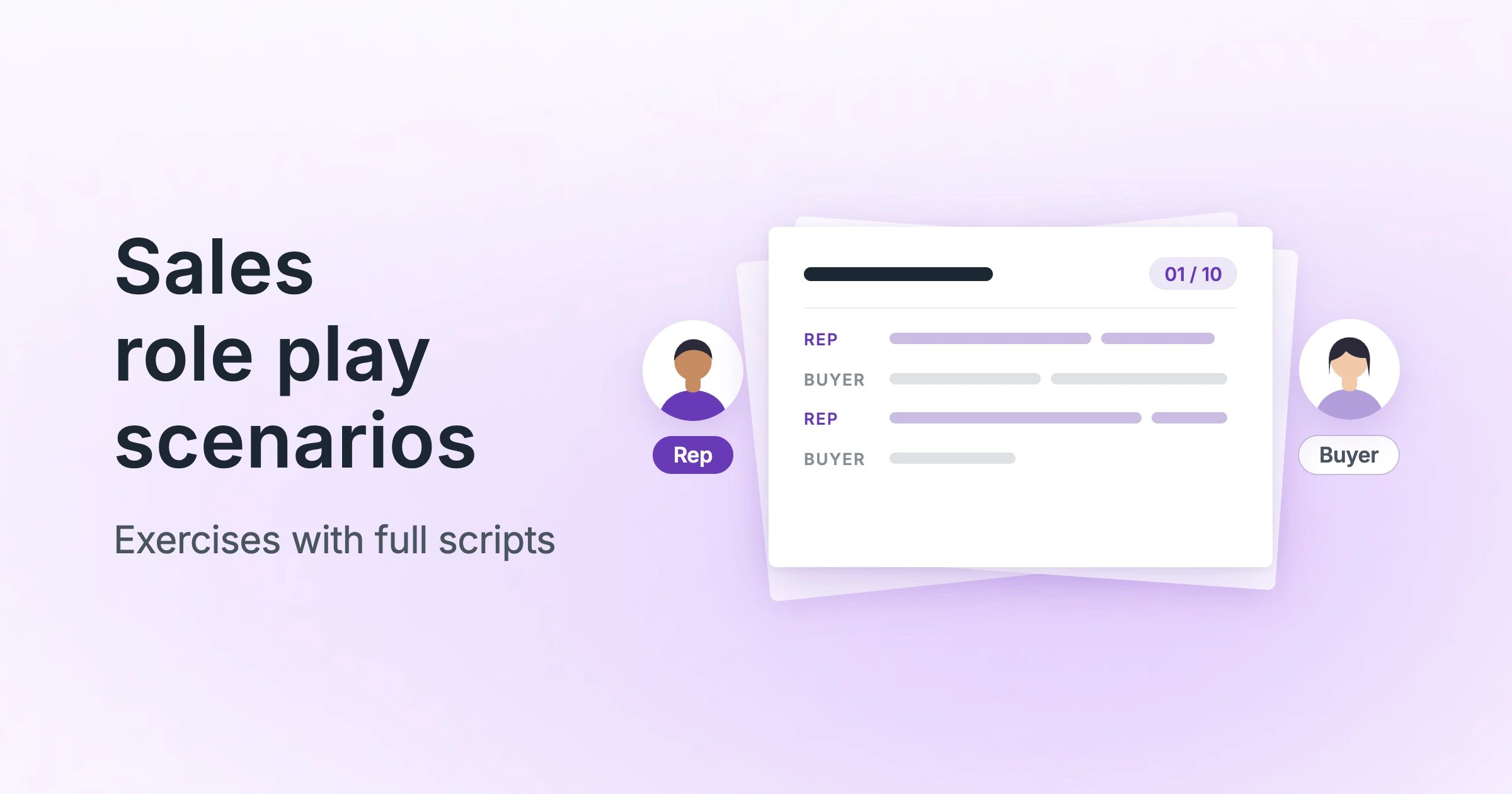
Sales role plays tend to fall apart at the second objection. The rep handles the first pushback, the colleague playing the buyer runs out of ideas, and nothing changes on the next live call.
If you run enablement or manage reps, this guide gives you 10 scenarios that hold up past the first exchange. Many of the buyer lines come from real sales calls. The last section shows how to build new scenarios from your own recordings.
TL;DR
- A sales role play scenario is a practice conversation built around a single moment where deals stall, with a buyer brief, a win condition, and planned pushback.
- Pick 2 or 3 scenarios that match the stage where your team loses deals, and repeat them.
- Every script has the buyer push back at least twice, because the second objection is where reps fold.
- Rotate 6 exercise formats so practice doesn't go stale.
- Write new scenarios with the Call-to-Drill method: find the stall in recorded calls, copy the buyer's words, drill, then check real calls.
- Copy the Ask Avoma prompt to pull your team's top objections and turn one into a scenario.
How to pick the right role play scenario
Start with the stage where your deals stall most, then match the scenario to the rep's role. Each scenario below names the 2 behaviors to score, so feedback stays focused.
| # | Scenario | Stage | Rep role | Skill trained |
|---|---|---|---|---|
| 1 | "I'm not interested" | Prospecting | SDR | Earning 30 more seconds |
| 2 | The guarded discovery call | Discovery | AE | Questioning depth |
| 3 | "Send me some information" | Prospecting | SDR, AE | Dated next step |
| 4 | "What we have is good enough" | Discovery | AE | Cost of inaction |
| 5 | "It's too expensive" | Evaluation | AE | Holding value |
| 6 | "We're also looking at [competitor]" | Evaluation | AE | Buyer's criteria |
| 7 | The skeptical executive | Evaluation | AE | ROI from buyer numbers |
| 8 | The deal that slowed down | Negotiation | AE | Next-step discipline |
| 9 | Procurement wants a discount | Negotiation | AE | Trading concessions |
| 10 | The renewal at risk | Renewal | CSM | Recovering value |
Running 1 scenario 3 times teaches more than running 5 scenarios once.
The research points the same way. A 1977 research review in the Academy of Management Review found role playing works best when people take an active part and the issue matters to them. In a 1990 study of personal selling students, peers and outside evaluators rated second-round sales presentations as more effective than the first.
With 2 or 3 scenarios picked, here are the scripts.
10 sales role play scenarios with scripts
The buyer keeps pushing until the rep earns the win condition, and each rep response draws on standard objection handling techniques. Several buyer lines come from real sales conversations, anonymized and trimmed for length. Once a scenario feels familiar, the call replay format covered after the scripts runs the same moment on a real recording.
1. Cold call: "I'm not interested"
Setup: An SDR calls an operations director who has never heard of the company.
Win condition: A 15-minute call on a specific date.
Buyer: I'm not interested, thanks.
Rep: Fair enough, most ops leads say that. The ones who stay on tend to lose Fridays to manual reporting. Is that you?
Buyer: Just send me an email.
Rep: Happy to send one. So I send the right thing, what's eating your team's time right now?
Buyer: Month-end reporting, if I'm being honest.
Rep: Then 15 minutes is worth it. Does Thursday at 10 work?
What good looks like: The rep names a specific problem and turns the email request into a question.
Common miss: Agreeing to send the email and hanging up with no next step.
Score focus: Opening, next step.
2. Discovery with a buyer who gives short answers
Setup: A manager agreed to the call but answers in single words and wants pricing.
Win condition: The buyer names a problem, its cost, and who else cares.
Buyer: We're just looking around.
Rep: What prompted the look this month?
Buyer: Nothing big has changed. Can you tell me the price?
Rep: I will before we hang up. It depends on what you're solving. What happens if nothing changes by next quarter?
Buyer: We'd miss the hiring plan again, I'd guess.
Rep: Who feels that most?
Buyer: It's my VP. She's asked about it twice.
What good looks like: The rep defers price with a reason, asks about consequences, and listens actively for what the short answers leave out.
Common miss: Giving a price range to fill the silence.
Score focus: Discovery questions, listening.
3. "Send me some information"
Setup: A mid-market buyer is trying to end the call after a first demo.
Win condition: A dated follow-up with a stated reason to meet.
Buyer: Maybe look into that information and send it to me. If we need to, we can schedule a call.
Rep: I'll send it today. What would it need to show for a second call to make sense?
Buyer: I'd pass it along. Maybe we touch base in 3 weeks or so.
Rep: Who are you passing it to?
Buyer: Our ops lead and the CFO.
Rep: Then let's hold 20 minutes 3 weeks from Tuesday with your ops lead. I'll tailor it to her questions.
What good looks like: The rep asks what the material must prove and books the date on the call.
Common miss: Sending a generic deck and chasing by email for 3 weeks.
Score focus: Handling brush-offs, next step.
4. "What we have is good enough"
Setup: The buyer's team stitches together free tools and AI chat assistants, and it does the job for now.
Win condition: The buyer agrees the cost of staying put is worth reviewing.
Buyer: We drop calls into ChatGPT and get something good enough with duct tape and staples.
Rep: That's a smart setup. Who maintains it?
Buyer: Our CRO does most of it. Look, it's not a priority this quarter.
Rep: I hear you, and if he left next quarter, what would break?
Buyer: All of it, if I'm honest.
Rep: Then it's worth 30 minutes with him to price what that setup costs. Does next week work?
What good looks like: The rep respects the setup, then exposes its hidden cost through the buyer's own answers.
Common miss: Criticizing the setup, which makes the buyer defend it.
Score focus: Value articulation, discovery questions.
5. "It's too expensive"
Setup: A champion liked the demo but has seen the quote. Treat the competitor figure as part of the role.
Win condition: Price is discussed against value, with no unprompted discount.
Buyer: I have no way of justifying this to my finance department.
Rep: Thanks for saying it straight. What will finance compare it against?
Buyer: [Competitor] is about half the price, and they say they do the same things.
Rep: Then let's check whether it does the same things on the outcomes your finance team cares about.
Buyer: How would we test that?
Rep: Pick the 2 outcomes finance cares about most. I'll show how each tool handles them, with cost next to each.
What good looks like: The rep moves the conversation from price to outcomes finance cares about.
Common miss: Dropping the price in the first exchange, which tells the buyer the number wasn't real.
Score focus: Objection handling, value articulation.
6. "We're also looking at [competitor]"
Setup: An evaluator mid-cycle leans toward a competitor based on review sites.
Win condition: The rep learns the buyer's criteria and proposes a test against them.
Buyer: It's between you and [competitor], and we're feeling more comfortable with them.
Rep: That's good to know. What's driving that?
Buyer: They have more reviews and higher scores.
Rep: Reviews tell you how it works for other teams. What would they need to prove in your own setup?
Buyer: That it works on our calls, every time.
Rep: Then let's test that. Run both for 2 weeks with success criteria we agree on today.
What good looks like: The rep treats the competitor as a fair option and turns the comparison into a test.
Common miss: Listing feature differences, which the buyer will settle on price.
Score focus: Competitive handling, discovery questions.
7. The skeptical executive joins the demo
Setup: The CFO joins 10 minutes late, wary after past tools disappointed the team.
Win condition: A follow-up with a business case built on the CFO's numbers.
Buyer: There's a lot of distrust in these tools here. What's the ROI?
Rep: Let's build it with your numbers. What does a new rep close in their first 6 months?
Buyer: Maybe $30K less a month than a tenured rep.
Rep: Across how many new reps this year?
Buyer: We're hiring 5 this year.
Rep: If we closed part of that gap, would it cover the cost?
Buyer: As long as I can show there's ROI that's hidden, the price is justifiable. Send me the math.
What good looks like: The rep builds the case from figures the executive supplied.
Common miss: Quoting a vendor percentage, which a skeptical executive discounts on sight.
Score focus: Value articulation, next step.
8. The deal that slowed down
Setup: The champion went quiet after the proposal. The rep reaches them by phone 2 weeks later.
Win condition: A dated next step, or a clear no that closes the deal out.
Buyer: Sorry, we move slow over here.
Rep: No problem at all. Where does it sit right now?
Buyer: We're kicking off annual planning. Late November or December might be better.
Rep: Is this in next year's plan, or does it need to earn a spot?
Buyer: It needs to earn a spot.
Rep: Then let's get it in front of the planning group before the plan closes. Who runs it, and when do they meet?
What good looks like: The rep ties the next step to the buyer's own planning process.
Common miss: Accepting "December" and setting a reminder with no reason for the buyer to engage.
Score focus: Next step, discovery questions.
9. Procurement asks for a discount
Setup: It's the last week of the quarter, and procurement wants a lower price before signing.
Win condition: Every concession is traded for term, volume, timing, or a case study.
Buyer: We'd need a much better number to sign this quarter.
Rep: I hear you, so what would make a better number work for us too?
Buyer: See what you can get approved if we went to 40 or 50 seats.
Rep: I'll take that to leadership. Would you commit to that volume on a 2-year term?
Buyer: A 2-year term is a stretch. And I need to know what happens to pricing when we add seats next year.
Rep: That's a fair concern. If I put volume pricing for future seats in writing, can we do 2 years?
What good looks like: The rep answers every request with a request and writes the buyer's concern into the contract.
Common miss: Giving the discount first and asking for nothing back.
Score focus: Negotiation, objection handling.
10. The renewal at risk
Setup: A CSM meets a customer with low usage and a new executive questioning the spend.
Win condition: An agreed success plan with a check-in date.
Buyer: To be honest, we haven't been using it much.
Rep: Thanks for telling me. What got in the way?
Buyer: I don't want to pay for things I don't use. Until it's a habit, what am I paying for?
Rep: That's the right question. Which 2 workflows would make it a habit?
Buyer: Call prep, maybe, and the weekly report.
Rep: Let's set both up this week and review usage in 30 days. If it isn't sticking by then, we'll rework the setup together.
What good looks like: The CSM agrees with the concern, narrows to 2 workflows, and sets a date to measure.
Common miss: Defending features to a customer who hasn't used them.
Score focus: Discovery questions, next step.
Pro Tip: Score the 2 behaviors listed for each scenario and nothing else. A rep who gets feedback on 7 things changes none of them.
Running the same script every week gets stale, so the next lever is the format.
6 sales role play exercise formats (and when to use each)
The same scenario trains different skills depending on how you run it.
| Format | How it works | Best for | Group | Time |
|---|---|---|---|---|
| Standard 1:1 | 1 rep, 1 buyer, and 1 observer scoring | Learning a new scenario | 3 | 10-12 min a round |
| Hot seat | 1 rep stays on while the team takes turns throwing objections | Speed under pressure | 4-8 | 5 min per rep |
| Role reversal | The rep plays the buyer, the manager plays the rep | Hearing how pushback feels | 2-3 | 10 min |
| Rapid-fire | Each rep gets 30 seconds per objection, then rotates | Talk-track recall | 4-10 | 15 min |
| Tag team | Reps take turns continuing the same call | Multi-step calls like negotiation | 3-6 | 15-20 min |
| Call replay | Play a recording to the moment the deal stalled, pause, and a rep handles it | Real situations | 2-8 | 10 min a clip |
Call replay is the closest to what reps face, because the buyer's words are real.
Best Practice: Start new reps on standard 1:1 rounds during onboarding, and move them to hot seat once they hit the win condition twice in a row.
That clip library is also where your own scenarios come from, covered next.
How to write your own role play scenario from real calls
The most realistic scenarios come from your own recorded calls. Find the moment deals stall, copy the buyer's exact words, and build a buyer brief around them. We call this the Call-to-Drill method, and it's how several scripts above were written.
- Find the stall: Review 10-15 lost or stalled deals and note the objection that shows up most.
- Collect the buyer's words: Pull exact phrasing from 3-5 calls.
- Write the buyer brief: Note the buyer's role, situation, what they care about, 2 objections in their exact words, and the rep's win condition.
- Script 2 rounds of pushback: Use the buyer's real lines for both.
- Drill, then check real calls: After 2-3 weeks of practice, listen for the same moment on live calls.
Example: Scenario 5 started this way. Reviewing recent sales calls for pricing pushback, we found a buyer at an 80-person B2B firm telling the rep, "I have no way of justifying that to my finance department."
That line became the first objection. A buyer on a different call, comparing two vendors on price, supplied the second.
Expert Insight: Step 5 is the one leaders skip. A sales leader at a network-monitoring software company described the usual pattern on a recorded call: "Every deal we lose... then you go back through and you try to figure out like, hey, what happened? But [by] that point [it's] too late."
In Avoma, Smart Topics capture objections and competitor mentions from recorded calls into the meeting notes once an admin sets them up. Smart Playlists pull in each recording that matches rules you set, such as a Smart Category, keyword, or sales stage, so the call replay library fills itself.
Ask Avoma answers questions like "What objections came up most in late-stage deals this quarter?" AI Scorecards grade live calls on your own framework, which shows whether practice stuck.
To build your first scenario from real calls, copy this prompt into Ask Avoma:
Ask Avoma prompt
Review our sales calls from the last 90 days. List the 5 objections buyers raised most often in late-stage deals. For each one, show how often it came up, 2 or 3 exact buyer quotes with the meeting they came from, and how our reps responded in deals we won versus deals we lost. Then turn the most common objection into a role play scenario with a buyer brief, 2 rounds of pushback in the buyer's own words, and a win condition for the rep.
Where to start this week
Pick 2 or 3 scenarios that match where deals stall, run each until reps hit the win condition twice, and rotate formats. Between sessions, AI-assisted sales coaching keeps the same behaviors in focus on live calls.
To see which objections your reps face, Avoma surfaces them across your recorded calls and scores live calls on the behaviors you practice. Start with your team's next 2 weeks of calls.
Frequently Asked Questions
Reps should learn the structure of each response and the win condition, then use their own words. A memorized line breaks the moment a buyer phrases an objection in new words. After the first round, the person playing the buyer should vary the wording while keeping the same objection.
Give the person playing the buyer a written brief with the exact objections and a rule to push back at least twice before agreeing to anything. The most realistic lines come from recorded calls, because they use the words real buyers use.
AI role play tools let a rep practice a scenario on demand against a simulated buyer and receive automated feedback, which adds practice between team sessions. The buyer brief from any scenario can be entered as the AI persona. A manager or peer still adds judgment about context and deal strategy that automated feedback can miss.
Standardize on a small set of scenarios and a single scorecard so every manager runs and grades sessions the same way. Use peer pairs and call replay so practice doesn't wait on a manager's calendar, and refresh scenarios from recorded calls each quarter.



What's stopping you from turning every conversation into actionable insights?


