
System of record vs. System of intelligence: How revenue teams use both

Table of Contents:
The system of record vs. system of intelligence distinction comes down to two jobs: maintaining trusted business data and interpreting what that data means in context.
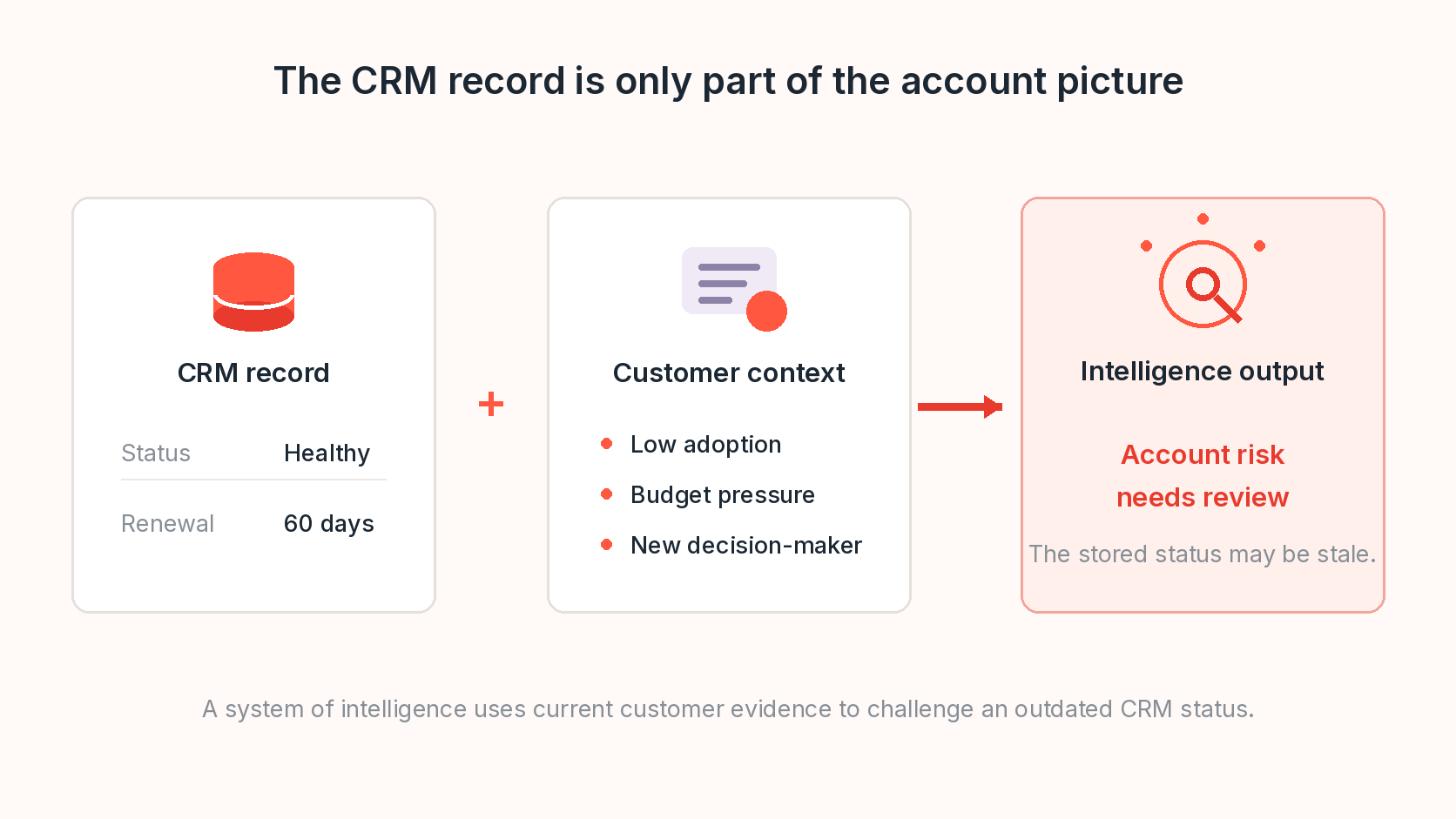
Consider a customer account marked healthy in the CRM with a renewal due in 60 days. Recent calls show low adoption, a new decision-maker, and growing budget pressure that the account record does not yet capture.
The CRM stores the account’s last confirmed status, while a system of intelligence uses recent conversations to determine whether that status is still accurate.
This guide explains how the systems differ, work together, and connect with a system of action.
TL;DR
- A system of record maintains authoritative business data. A CRM serves this role for account, contact, opportunity, activity, and forecast data.
- A system of intelligence combines business records with context from conversations, emails, engagement, and connected sources. It identifies patterns, risks, and opportunities that a record alone cannot explain.
- The two systems work as a loop. The CRM supplies the accepted business state, conversations and other signals add context, the intelligence layer supports a decision, and validated updates return to the CRM.
- A system of action comes after intelligence. It recommends, triggers, or executes the response based on the insight.
- Reliable intelligence requires relevant context, interpretation, traceable evidence, and workflow delivery. CRM writeback and human ownership govern what happens next.
System of record vs. System of intelligence at a glance
The core difference lies in the job the software performs. A system of record preserves the accepted state of the business. A system of intelligence interprets that state alongside new signals.
These roles can exist inside one product or across connected products. The distinction describes responsibility within a workflow. It does not define two competing software categories.
What is a system of record?
A system of record is the authoritative source for a defined type of business data. IBM describes it as the source that holds verified information about customers, employees, products, suppliers, or other business entities.
For revenue teams, the CRM holds authority over:
- Accounts and contacts
- Opportunities and deal stages
- Activities and tasks
- Pipeline values and close dates
- Account ownership
- Forecast categories
- Customer history
When two connected platforms show different opportunity amounts, the CRM should contain the accepted value. RevOps defines the data model, permissions, validation rules, and field ownership that support this authority.
A system of record organizes structured information, preserves history, controls access, and supports reporting and workflows. It gives revenue teams and leadership a shared set of business facts.
The limitation appears when customer context changes outside the record.
A prospect may raise a pricing concern during a meeting. A new stakeholder may join an email thread. A customer may describe an adoption problem before the renewal review. The CRM cannot reflect those changes until a person or connected system identifies the signal, interprets it, and associates it with the right record.
The record can remain valid while missing information that should change the team's view. The intelligence layer addresses this gap.
What is a system of intelligence?
A system of intelligence combines trusted business records with context from other sources and interprets the significance of that information.
For a revenue team, it can answer questions such as:
- Which opportunities need attention before the pipeline review?
- Which forecast submissions conflict with customer engagement?
- Which reps need coaching on a defined skill?
- Which accounts show renewal or expansion signals?
The term describes an architectural role. Vendors use the label across CRM, analytics, revenue intelligence, data, and AI products. Evaluate the behavior behind the label.
A system of intelligence needs four capabilities to support revenue decisions.
Relevant context. The system needs access to the records, conversations, emails, engagement, and other signals that inform the decision.
Interpretation. The system must connect those signals and determine their significance for a defined decision. A transcript summary alone does not provide that interpretation.
Traceable evidence. The output should point to the record, conversation, email, or event that supports the conclusion. Evidence lets users check the work before they use it in a forecast, coaching session, or customer decision.
Workflow delivery. The insight must reach the person responsible for the decision. A risk signal has limited value when it remains in a dashboard that managers do not use during pipeline reviews.
How systems of record and intelligence work together
The two systems create value through a connected workflow:
Record → Context → Interpretation → Decision → Updated record
Consider a $75,000 opportunity with a September 30 close date.
The intelligence layer depends on the record for identity, history, ownership, and business state. Weak handoffs cause problems. An insight may reach a manager while the CRM remains unchanged. An update may arrive without supporting evidence. A call signal may fail to reach the opportunity record.
A connected architecture closes those gaps while preserving the CRM's authority.
Where a system of action fits
A system of action extends the workflow after interpretation. It recommends, triggers, or executes the response.
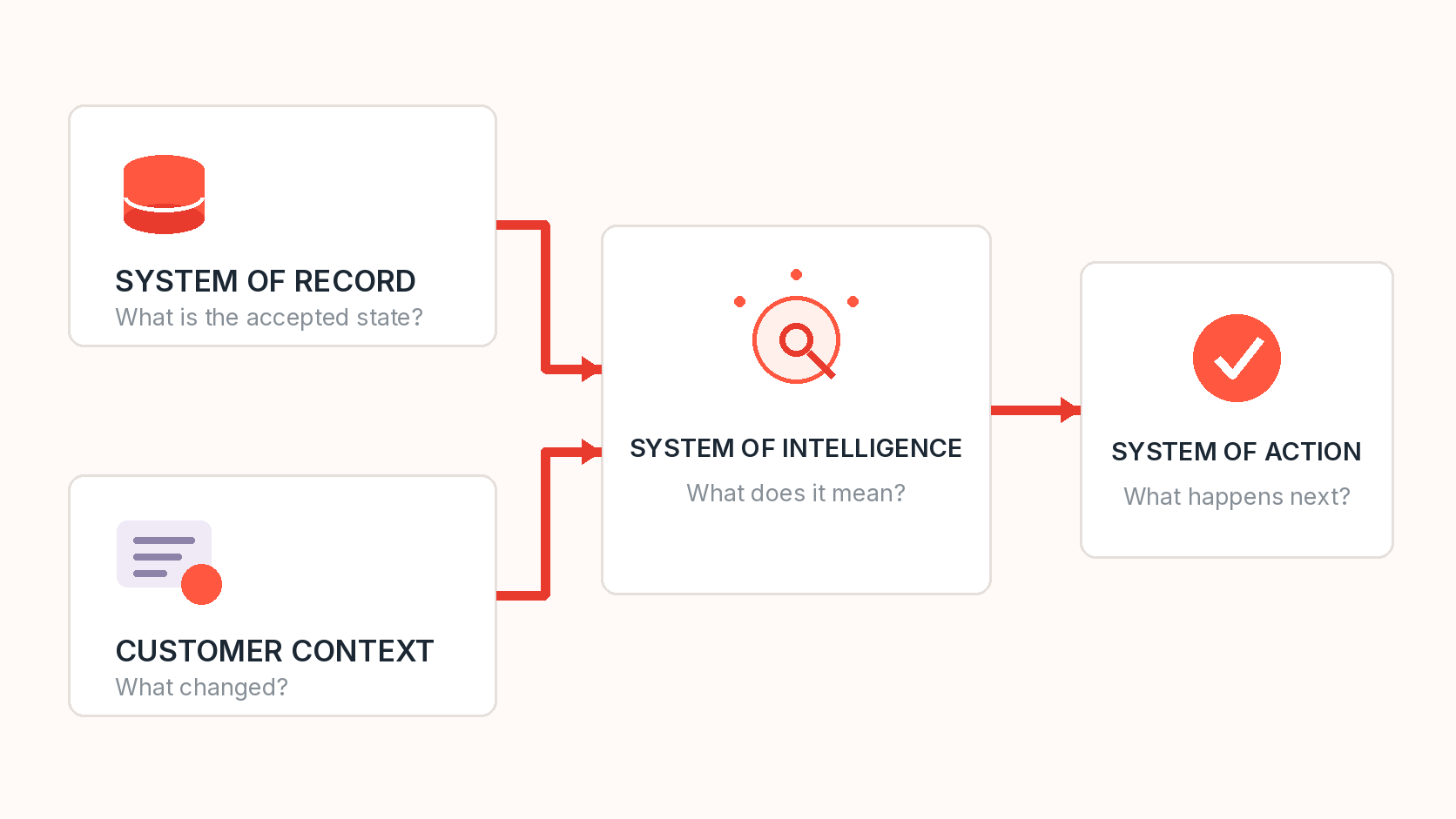
These layers can share a platform. Their responsibilities still need clear boundaries.
An intelligence output may state that a deal has risk. An action workflow may notify the owner or change a CRM field. The action requires permissions, audit history, and human control that matches its consequence.
What a system of intelligence looks like for revenue teams
The value of the intelligence layer becomes clear when it improves a recurring decision.
Pipeline inspection
The CRM stores stage, amount, close date, activity, next step, and opportunity owner. Customer conversations add information about objections, stakeholder engagement, internal process, and decision timing.
An intelligence layer can compare the stored state with those signals. It may surface a deal in negotiation after the prospect delayed implementation and left the next meeting unconfirmed. The manager enters the review with a specific issue and uses the discussion to decide how to respond.
Forecasting
A forecast combines submitted categories, opportunity values, close dates, stage history, and manager judgment. Customer context can strengthen or challenge those inputs.
The intelligence layer can identify a commit deal with weak engagement, a pushed timeline, or unresolved approvals. It may also surface customer commitment that the CRM stage misses. The forecast owner retains responsibility for the call and uses the evidence to inform that judgment.
Sales coaching
Managers can review a limited set of calls during a week. An intelligence layer can analyze more conversations against a defined scorecard. It may show that a rep skips economic-impact questions, struggles with pricing objections, or fails to confirm next steps. Source links let the manager inspect the relevant moments and prepare focused coaching.
Renewals and customer success
Renewal risk may appear in a conversation before it appears in a health score. A customer may describe low adoption, question value, mention budget pressure, or introduce a new decision-maker.
An intelligence layer can connect those signals with account history, support activity, product usage, and renewal timing. The CSM can act before the formal renewal discussion. The same model can surface expansion signals, such as a new use case, team, or business requirement.
What a system of intelligence cannot fix
An intelligence layer can improve how teams interpret business data. It still depends on the quality of the foundation and the workflow around it.
- Missing source data reduces context. The system cannot analyze an absent call recording, an unsynced email, or a product signal outside its access. Teams should define the sources required for the decision before assessing output quality.
- Weak identity matching creates harmful conclusions. A signal loses value when the platform associates it with the wrong account or opportunity. Record matching deserves the same attention as model quality.
- Unsupported output weakens trust. AI can infer intent or risk beyond the source material. Users need evidence and a correction path.
- Too many alerts reduce attention. Low-value signals create noise. The team should define which decisions deserve an alert and who owns the response.
- Disconnected delivery creates another silo. Insights belong in pipeline, forecast, coaching, account, or customer workflows. A separate dashboard adds work when users must copy conclusions into the CRM.
- Governance needs human ownership. Teams need access controls, audit history, correction, and named owners for sensitive decisions.
How to evaluate a system of intelligence platform
Evaluate the platform against one decision your revenue team needs to improve. A broad AI demo can hide weak context, limited evidence, or poor workflow fit.
- Review context and data coverage. The platform should connect the authoritative CRM record with the conversations, emails, activities, and other signals required for the decision. Confirm that it associates new context with the correct account, contact, and opportunity. A long integration list has limited value when the sources do not contribute to the analysis.
- Require traceable evidence. Inspect a risk, pattern, or recommendation and follow it to the supporting source. The platform should show which CRM fields, conversation moments, emails, or activities shaped the conclusion. This test separates grounded intelligence from an unexplained score.
- Check workflow delivery and writeback. The insight should appear where the team makes the decision, such as a pipeline review, forecast, account view, or coaching workflow. Validated context should return to the CRM through controlled fields, notes, tasks, or activities. The CRM must remain the accepted record.
- Confirm permissions and accountability. Administrators need control over data access, field changes, and workflow permissions. Users need a way to correct unsupported conclusions. Audit history should show the source, output, review, and resulting change. A named person should own sensitive or uncertain decisions.
If the platform can also act on insights, apply the same checks used for agentic AI for sales: what the agent can decide, which tools it can use, and when it must request approval.
Run a pilot on one workflow using your data. Track source coverage, accepted insights, corrections, time from signal to insight, and CRM freshness. These measures show whether the platform improves the decision without adding work.
How Avoma adds intelligence to your CRM
Avoma works with the CRM as the system of record. It connects customer conversations with synced CRM and email data, then produces structured information and source-backed insights.
Capture customer context. Avoma records and transcribes meetings, creates structured notes, and identifies pain points, next steps, stakeholders, objections, competitors, and deal signals.
Keep CRM data current. Avoma's CRM automation maps supported conversation insights to configured CRM fields. Connections can sync notes, activities, contacts, deals, and selected field updates.
Make revenue context searchable. Ask Avoma answers questions about meetings, deals, accounts, and pipeline activity. It searches transcripts, notes, synced emails, CRM records, and deal activity. Source citations support review. Scheduled prompts can deliver briefings and recurring reports through email, Slack, or Microsoft Teams.
Use intelligence across revenue workflows. Sales managers can inspect deal risk, leaders can review forecast context, customer success teams can find renewal signals, and enablement teams can identify coaching patterns. These workflows are part of revenue intelligence, which connects customer signals with deal, forecast, coaching, and renewal decisions.
This model gives revenue teams meeting assistance, conversation intelligence, CRM updates, coaching, deal intelligence, and forecast support in one platform. The CRM remains the business record while Avoma adds customer context.
Final thoughts
A system of record and a system of intelligence carry different responsibilities.
The system of record maintains the accepted state of the business. The system of intelligence combines that record with current context and explains what changed, why it matters, and where the team should focus.
Revenue teams gain the most value when the systems form one connected workflow. Trusted records ground the analysis, customer interactions add context, evidence supports the conclusion, and approved outcomes return to the CRM.
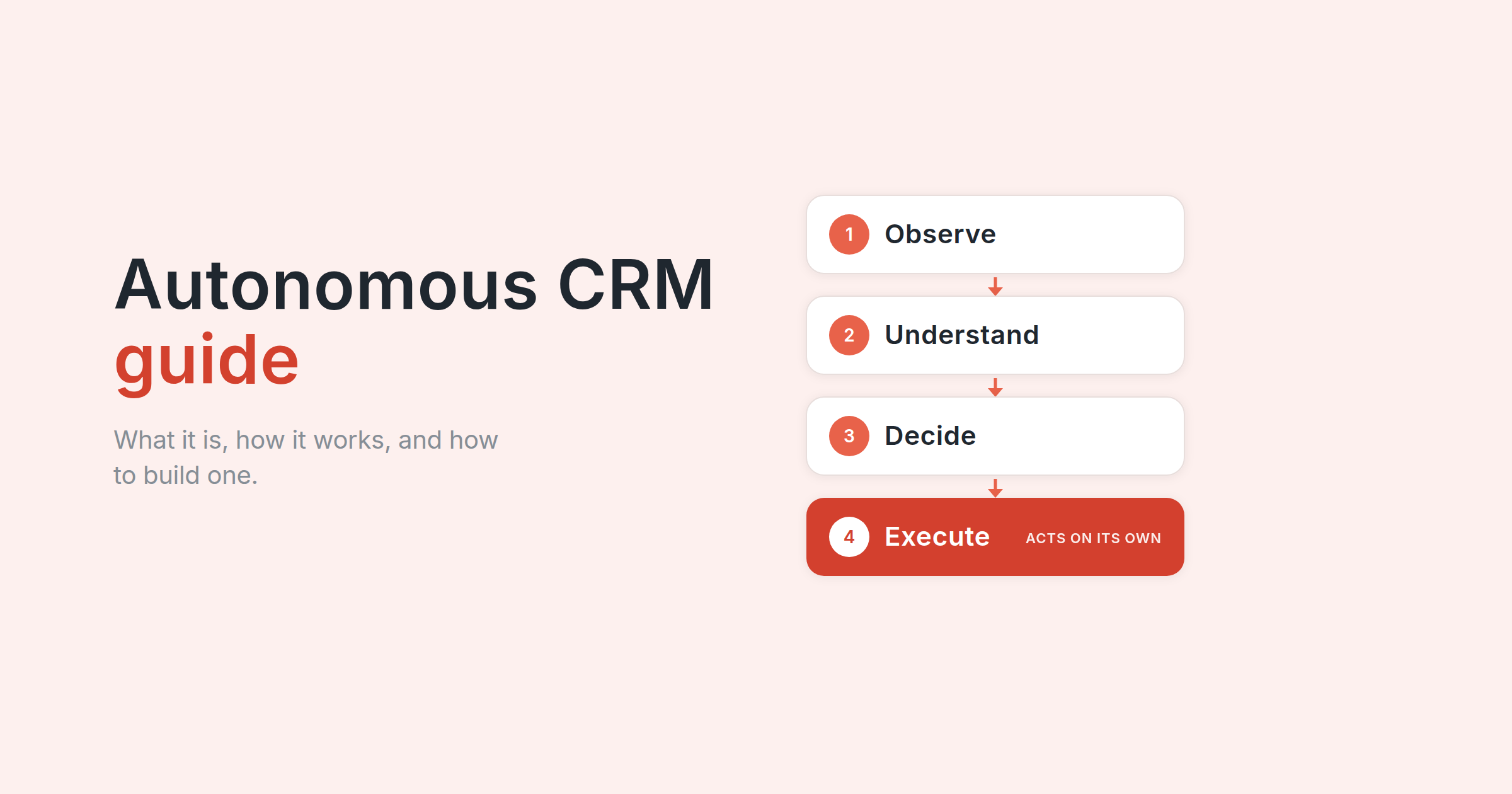
That model makes the CRM more useful while preserving its authority. Adding approved execution creates an autonomous CRM workflow, with permissions and human review defined by the action.
See how Avoma turns meetings, deals, and pipeline activity into source-backed intelligence while keeping CRM data current.
Frequently Asked Questions
A CRM can serve as the system of record for accounts, contacts, opportunities, and activities. An ERP may hold authoritative financial or inventory data, while an HRIS may hold employee data.
The system of record depends on which platform owns the accepted version of a specific data domain.
Yes. A system of intelligence can combine data from a CRM, ERP, support platform, product system, and other records.
It should preserve the authority of the source system, match identities across sources, and respect the permissions attached to the data.
No. Rules, analytics, and statistical models can interpret records and surface signals. Modern platforms use AI to analyze unstructured sources such as conversations and emails.
The capability qualifies as intelligence when it contributes context to a defined decision.
A system of reference consolidates and prepares data from source systems so people and applications can use it. A system of engagement provides the interface where people communicate or work.
A system of intelligence connects records and context to interpret what the information means for a decision.
It should retain the source evidence, follow the authority of the system of record for controlled fields, and surface the conflict for review.
A person should resolve material conflicts before the workflow writes an update back to the record.




What's stopping you from turning every conversation into actionable insights?


