
Agentic AI for sales: what it is and how to use it

Table of Contents:

Agentic AI for sales moves AI from answering requests to carrying execution on its own. Instead of waiting for a prompt to draft an email or summarize a call, an agent can take a goal, reason through the next step, act within defined guardrails, and keep working until it needs a person.
That changes where AI fits into the sales motion. It sits inside the work itself, monitoring deals and handling repeatable execution, while reps focus on judgment, relationships, and the conversations that move revenue.
- What agentic AI for sales actually means, and the goal, context, reason, act loop it runs on.
- What turns a normal sales process into an agentic one: a defined outcome, real context, decision boundaries, and a human handoff point.
- The four levels of agent autonomy, from recommend to execute autonomously, and how to pick the right one for an action.
- Where agents fit in your CRM and the rest of your sales stack, including the context that never makes it into a CRM field.
- How specialized agents hand work to each other, what Avoma calls a Revenue AI Workforce.
- How to pick your first sales process to hand over, define its goal and boundaries, and set an agent on it.
Like what you read? Add us as a preferred source.
What is agentic AI for sales?
Agentic AI for sales is AI that can pursue a sales goal, use revenue context to decide what to do next, take action, and adjust based on what happens. The simplest way to think about it is: goal → context → reason → act → learn or escalate.
Say an AE finishes a discovery call. An agent can pull the commitments and next steps from the conversation, update the opportunity, create follow-up tasks, draft the recap, and monitor whether the buyer completes their agreed action.
The goal gives the agent direction. Context from CRM records, conversations, emails, and buyer activity helps it reason about the situation. Guardrails determine which actions it can take on its own and which ones need the rep's approval.
That's where AI agents fit into agentic AI. An AI agent handles a defined job or workflow, while agentic AI describes the broader way these systems reason and act toward an outcome. We've covered the mechanics and individual sales jobs in this breakdown of AI sales agents.
The more useful question for a sales team is where that model fits into the actual revenue cycle.
What makes a sales process agentic?
A sales process becomes agentic when AI has a defined outcome to work toward, a clear trigger for when it should act, enough context to make decisions, permission to take specific actions, and a clear point where a person takes over.
Think about a stalled opportunity. A normal workflow can alert the AE after 14 days of inactivity. An agentic workflow can inspect the deal, check recent conversations and activity, work out why progress has stalled, and decide which permitted action makes sense based on what it finds.
That requires a few pieces to work together:
| Part of the process | What it means in sales |
|---|---|
| Goal | Give the agent a clear outcome, such as keeping opportunity data current or getting a qualified lead to the right rep. |
| Trigger | Define what starts the agent's work: a schedule, an event such as a meeting ending or a deal changing stage, or a condition becoming true, such as an overdue next step. |
| Context | Give it access to the CRM record, conversations, emails, meeting history, and other signals required to understand the situation. |
| Decision boundary | Define what the agent is allowed to decide and which decisions belong to the rep, manager, or RevOps team. |
| Action | Give it permission to do the work, such as updating a field, creating a task, routing a lead, or alerting an AE. |
| Feedback | Let the agent see what happened after its action so the workflow can continue, stop, or escalate. |
This is also a useful way to decide which sales processes are ready for agentic AI. Start with work that has a clear outcome, a reliable trigger, happens frequently, has enough reliable context behind it, and has an obvious escalation path when judgment is required.
For example, "manage this enterprise deal" is far too open-ended. "Monitor this opportunity for missing next steps and alert the AE with the supporting evidence" gives an agent a job it can finish.
We've gone deeper into the individual AI sales agent jobs, and into CRM-specific agent workflows. Here, the useful unit to think about is the process: where an agent starts, what it can decide, what it can do, and where a human takes over.
Once those boundaries are clear, you can start deciding where agentic AI belongs in your sales process.
What's the difference between agentic AI for sales and AI sales agents?
Agentic AI for sales is the broader concept: AI systems that can pursue a sales goal by planning, deciding what to do next, using tools, and carrying out multi-step workflows with some autonomy.
AI sales agents are specific applications of that technology. Each one is an individual AI "worker" built to do a particular sales role or set of tasks.
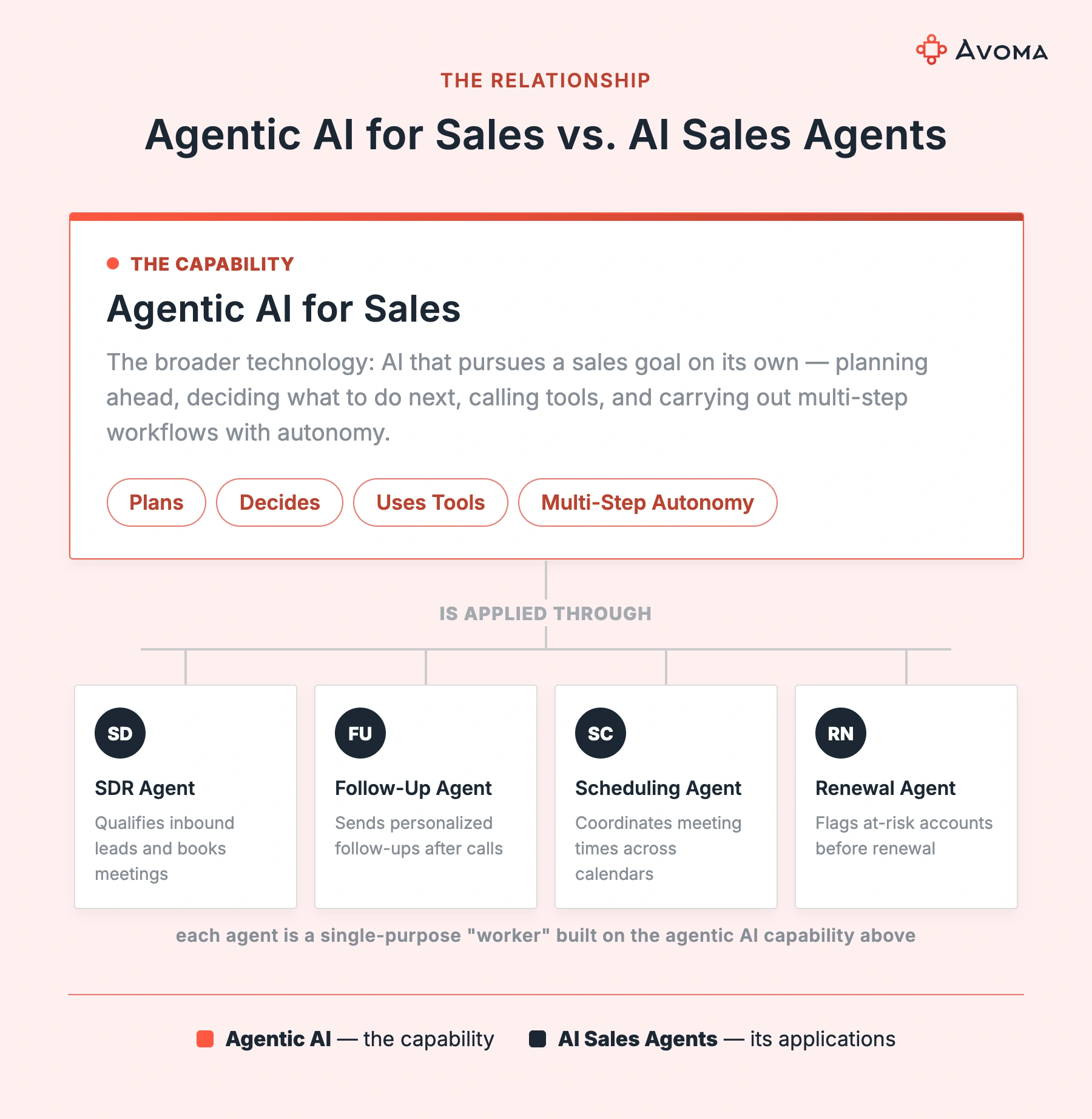
Say the goal is "generate more qualified meetings."
| Agentic AI for sales | AI sales agent | |
|---|---|---|
| What it is | An AI approach for automating sales workflows | A specific AI agent performing sales work |
| Scope | Broad, often spanning multiple stages and systems | Narrower, focused on one role or task |
| Example | Identifies target accounts → researches them → selects contacts → drafts personalized outreach → updates the CRM → follows up based on responses | An AI SDR that researches prospects, sends outreach, and follows up |
| Autonomy | Can coordinate multiple actions, tools, rules, and other agents | Acts on its own within its assigned role |
| Analogy | The operating model for an autonomous sales system | A digital salesperson within that system |
A useful way to think about it:
Traditional sales AI: "Here's a draft email for this prospect."
AI sales agent: "I researched this prospect, created a personalized email, sent it, and will handle the follow-up according to the rules you gave me."
Agentic AI for sales: "Here's the sales objective. I'll determine which accounts to prioritize, coordinate prospect research and outreach, react to engagement, route qualified prospects, update the CRM, and escalate situations that require a human."
An AI sales agent can be part of an agentic AI sales system. But "agentic AI for sales" describes the broader capability and architecture, not one particular agent.
There's some marketing ambiguity here: vendors often use "AI sales agent," "agentic sales AI," and "AI SDR" interchangeably, even when their products offer different levels of autonomy.
How do you build an agentic AI workflow for sales?
Building an agentic AI workflow for sales starts with a specific goal and a clear trigger for when the agent should get to work. Then define the context it can use, the instructions it should follow, the actions it can take, and where a person needs to step in.
A useful structure is goal → trigger → context → instructions → actions → human handoff.
Here's how that can work in Avoma.
Say a sales leader wants to catch stalled deals before they sit untouched for another week. They can create a scheduled prompt in Avoma that reviews open opportunities at the end of each day.
| Setup | Example in Avoma |
|---|---|
| Goal | Find open deals that have stalled and alert the deal owner. |
| Trigger | Run at the end of every day. |
| Context | Review open opportunities, recent customer conversations, next steps, and deal activity. |
| Instructions | Identify deals with no meaningful buyer activity or confirmed next step. Review recent conversations to determine what's holding up the deal. |
| Actions | Create a short report with the likely blocker and supporting evidence, post it in #sales-alerts, and tag the deal owner. |
| Human handoff | The AE reviews the evidence and decides how to re-engage the buyer. |
So the AE might get an alert like this:
Maple Systems | Deal stalled
No buyer activity in 12 days and no next meeting is scheduled. In the last call, the champion said they needed security approval before involving procurement. No security follow-up has been recorded since.
Owner: Jamie Carter
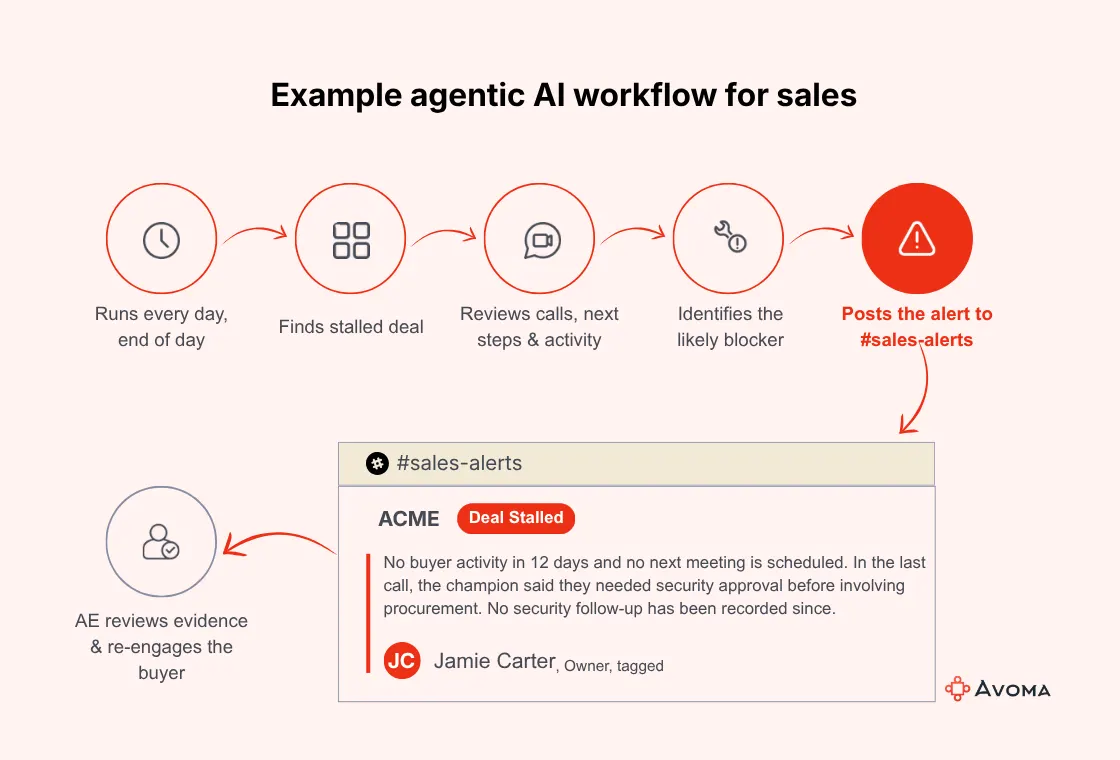
The trigger doesn't always need to be a schedule. It can just as easily be an event, like a meeting ending, or a condition becoming true, like an overdue next step.
Once triggered, the agent has a job to complete. In this example, it checks the state of the deal, reads recent customer context, works out the likely blocker, and brings the evidence to the person who owns the next move.
The AE owns the decision about how to re-engage Maple Systems. Avoma handles the monitoring and investigation that gets the problem in front of them sooner.
The same structure can be applied to qualification gaps, next-step compliance, stage validation, and forecast inspection. Define the goal, decide what wakes the agent up, give it the right context and instructions, then set its actions and human handoff.
Where does agentic AI sit in your sales stack?
Agentic AI can run inside a CRM or work across the tools your sales team already uses. Where an agent sits matters less than whether it can access the context and actions required to finish its job.
The CRM is an obvious starting point, functioning as the system of record for the deal. It holds the account, contact, opportunity, stage, owner, amount, and activity history that many sales workflows depend on. CRM agents can use that information to maintain records, inspect opportunities, prepare reps, and trigger work based on changes in the pipeline.
This guide to AI agents for CRM goes deeper into how agents reason over CRM and conversation data, which CRM jobs they can take on, where human approval still matters, and how to deploy your first CRM agent.
But plenty of sales context sits outside CRM fields. A buyer raises a security concern on a call. A champion commits to introducing procurement. An economic buyer stops attending meetings. The next step agreed during discovery never gets scheduled. That kind of context matters most in complex, multi-stakeholder deals, covered in our guide to enterprise sales.
An agent working across the revenue stack can use that conversation and activity context alongside the CRM record, then take action in the system where the work needs to happen.
The CRM you use also shapes what's possible. If your team runs on HubSpot, this look at HubSpot AI agents covers how agents fit into HubSpot workflows, including where Avoma's HubSpot integration feeds them conversation context. Salesforce teams can go deeper in our guide to Salesforce AI agents.
For RevOps, the practical test is simple: Where does the agent need to read, reason, and act to complete the job you've given it? That tells you which systems need to be part of the workflow.
How much autonomy should sales agents have?
Sales agents should get more autonomy when the action is easy to verify and easy to reverse. As the cost of a wrong decision rises, human approval should move closer to the action.
Why guardrails matter: three-quarters of enterprises have already rolled back or shut down a customer-facing AI agent after deployment, and that rate climbs to 81% among organizations with mature governance frameworks. The leading causes were customer data exposure, hallucinated or brand-risky responses, and an inability to trace what went wrong, according to a 2026 Sinch survey reported by CX Dive. The levels below exist to keep a deal-monitoring agent out of that statistic.
| Level | What the agent can do | Sales example |
|---|---|---|
| Recommend | Analyze the situation and suggest an action | Flag that a committed deal has weak evidence behind the forecast |
| Prepare | Complete the work and leave it ready for review | Draft a follow-up email based on commitments from the call |
| Execute with approval | Ask a person to approve an action before completing it | Prepare a change to the opportunity stage or close date for the AE to approve |
| Execute autonomously | Complete a permitted action without waiting for approval | Create an internal task or post a deal-risk alert in Slack |
The right level can change within the same workflow.
Take the stalled-deal workflow above. Avoma can monitor the opportunity, investigate recent activity, and post the evidence to Slack without asking the AE each time. The decision to contact the buyer, change the deal strategy, offer different commercial terms, or pull another executive into the conversation stays with the seller.
Your permissions should follow the same logic. Define which data an agent can read, which systems it can write to, which actions require approval, and which conditions force a handoff.
That gives RevOps a more useful question when setting up an agent: What's the highest level of authority this job requires?
What happens when sales agents work together?
Sales agents become more useful when one agent's work can become context for the next. That lets a sales process continue across systems and stages without every handoff depending on a rep to restart the work.
Take a discovery call. One agent can capture the buyer's requirements and commitments. Another can use that information to update permitted CRM fields. A deal agent can keep watching those commitments, while a pipeline agent can use the same evidence when inspecting deal risk.
Each agent has a narrow job. They share enough context to work on the same revenue outcome.
This is where an agentic sales system starts to take shape. Instead of building one agent with broad authority, you can give specialized agents clear responsibilities and let them coordinate when a workflow crosses those boundaries.
For a sales team, that could mean:
Meeting agent → CRM agent → deal agent → pipeline agent
A meeting ends. The CRM gets updated. The agreed next step becomes something the deal agent watches. If that next step slips and changes the deal's risk, the pipeline agent can surface it for the manager.
Avoma calls this model a Revenue AI Workforce: specialized AI agents working across shared customer and revenue context, with people stepping in where judgment or buyer interaction is required.
The quality of those handoffs determines whether you have a collection of AI features or an agentic sales process that can keep work moving.
Where is agentic AI for sales headed?
Agentic AI for sales is moving toward persistent execution. Agents will keep track of work across calls, CRM changes, buyer activity, and internal handoffs, then pick up the next permitted action as the situation changes.
That changes the role of sales software. A CRM records that an opportunity moved to negotiation. An agent can watch whether procurement gets involved, whether the economic buyer shows up, whether the agreed next meeting happens, and whether the evidence still supports the forecast.
For reps, more of the background work can run without a prompt: monitoring commitments, keeping records current, researching changes, and bringing exceptions to their attention. Reps stay closest to the work where context alone isn't enough, including discovery, negotiation, relationship building, and judgment calls inside complex deals.
Sales managers get a similar shift. Instead of inspecting every opportunity by hand before a pipeline review, they can spend more time on the deals and reps where the evidence says their attention is needed.
And RevOps gets a new operating problem to solve: deciding what agents can access, which actions they can take, how agents hand work to each other, and where people need to stay in the loop.
That's the direction behind a Revenue AI Workforce. Sales teams can assign repeatable execution to specialized agents while keeping people responsible for the decisions and buyer relationships that carry real commercial consequences.
Agentic sales starts with a job worth handing over
The strongest agentic sales processes have a clear owner on both sides. The agent knows what it's responsible for, what information it can use, what actions it can take, and when the work belongs back with a person.
Start with one sales process your team keeps having to chase. A stalled deal that gets noticed too late. A next step that disappears after discovery. A CRM field that stays stale until pipeline review.
Give an agent that job. Set the boundaries. Then measure whether the work gets done earlier, with fewer gaps, and with enough evidence for your team to trust the result.
As those processes connect, agents can carry more of the monitoring and repeatable execution that sits between customer conversations. Your sellers get to spend their attention where it has the highest commercial value: understanding buyers, navigating complex deals, and deciding what to do when the answer isn't obvious.
Put agentic AI to work without taking sellers out of the loop
Avoma helps revenue teams build agentic workflows around real customer and deal context, with clear human handoffs for decisions that need seller judgment.
Let AI monitor, investigate, and act within the guardrails you set. Bring your reps and managers in when their judgment matters.
Frequently Asked Questions
An example of agentic AI in sales is an agent that monitors open deals, detects when one has stalled, investigates recent customer conversations and activity, and alerts the deal owner with the likely blocker. The agent keeps watch over the process and brings in the AE when the situation requires a seller's judgment.
Agentic AI describes how an AI system works toward a goal by reasoning, acting, checking results, and handing work to a person when required. An AI sales agent is a specific application of that approach, such as an agent responsible for prospect research, CRM updates, deal monitoring, or follow-up.
Agentic AI can read CRM records, combine them with relevant sales context, decide what action a workflow requires, and write permitted changes back to the CRM. Our guide to AI agents for CRM covers CRM agent jobs, the data they use, human approval, and how to deploy them.
Yes. Agentic AI can use HubSpot data and take permitted actions as part of sales workflows, depending on the agent and its access. Read our guide to HubSpot AI agents for the HubSpot-specific options and workflows.
Yes. Agentic AI can use Salesforce records as context and perform permitted actions around leads, opportunities, accounts, and other sales workflows. The exact capabilities depend on the agent, its Salesforce access, and the workflow your team has configured.
Good candidates have a specific goal, enough context for the agent to make a decision, repeatable actions, and a clear human handoff. Stalled-deal monitoring, next-step compliance, CRM hygiene, qualification checks, stage validation, and pipeline inspection fit that pattern well.
An AI sales agent should have enough autonomy to complete low-risk, verifiable actions without creating unnecessary approval steps. Actions with meaningful commercial consequences, such as changing pricing, negotiating terms, or deciding how to handle a sensitive buyer conversation, should stay with the seller or require explicit approval.


Dive into Our Latest
Avoma Insights.


What's stopping you from turning every conversation into actionable insights?


