
Can Claude or ChatGPT replace purpose-built AI software for revenue teams?

Table of Contents:

A sales leader wants to build call coaching workflows in Claude. Another company plans to recreate revenue intelligence with HubSpot and AI agents. A third asks why it needs specialized meeting software when Microsoft Copilot is already in its stack.
These are real buyer conversations.
In an internal review of about 55 Avoma prospect calls, 21 accounts discussed building their own AI capabilities, 14 asked whether bundled AI was sufficient, and 17 described using Claude or ChatGPT to analyze conversations by hand.
If you run RevOps or lead a sales team, you've heard the same question: if Claude, ChatGPT, or Copilot can do much of what specialized software does, why pay for another application?
Use a 4-part test for what changes at team scale and a build, buy, or combine framework to answer it for your team.
TL;DR
- Claude, ChatGPT, and Copilot can summarize calls, score them, flag deal risks, and draft CRM updates when they can reach the right data.
- That's often enough for one person, or a small workflow someone reviews.
- The 4C scale test (Context, Consistency, Control, Continuity) shows where a personal AI workflow breaks once a team depends on it.
- Custom AI workflows are cheap to prototype and expensive to operate.
- Many teams pick a hybrid: purpose-built software for shared conversation data, plus their own AI tools connected through MCP.
Can general-purpose AI replace revenue intelligence software?
General-purpose AI (Claude, ChatGPT, Microsoft Copilot) can replace parts of revenue intelligence software for individuals and small, well-defined workflows.
Purpose-built software captures meetings, links them to CRM records, and runs recurring workflows like call scoring and deal inspection for a whole team. Replacing that across an organization takes building work and ongoing maintenance.
The right choice depends on what you need to accomplish, how many people depend on it, and what you're willing to build and maintain.
Why revenue teams are reconsidering specialized AI software
3 shifts are changing how companies evaluate AI software for sales and customer success.
1. Teams can build more with general-purpose AI
With Claude, ChatGPT, APIs, and AI agents, teams can create workflows that used to need a dedicated application.
A sales manager can evaluate calls against MEDDICC. RevOps can scan CRM data for qualification gaps. Customer success can pull recurring complaints out of transcripts.
Some buyers now ask vendors for the underlying data so they can build the analysis themselves.
2. Many companies already pay for AI
Microsoft 365, Google Workspace, Zoom, and HubSpot plans may already include AI meeting notes and summaries.
If a team needs summaries and the occasional follow-up draft, those tools are probably enough.
The evaluation changes when it needs consistent coaching, analysis across meetings, CRM workflows, or revenue reporting.
3. Employees already use AI on their own
Reps paste transcripts into ChatGPT to write follow-ups. Managers upload recordings to Claude for coaching. Others keep custom GPTs for analyzing calls.
These workflows save time.
But when everyone works in a separate AI environment, the organization loses sight of what employees learn from customers.
The shadow AI section below covers what that costs.
What Claude, ChatGPT, and Copilot can already do
General-purpose AI can handle these revenue workflows when it can reach the right data.
| Revenue workflow | What general-purpose AI can do |
|---|---|
| Meeting follow-ups | Summarize transcripts, draft emails, extract commitments |
| Sales coaching | Evaluate calls against a framework and recommend improvements |
| Deal inspection | Identify missing stakeholders, objections, and qualification gaps |
| CRM automation | Draft updates, create tasks, and take permitted actions through integrations |
| Forecast preparation | Analyze pipeline information and flag inconsistencies |
| Win-loss analysis | Categorize reasons for wins and losses across conversations |
| Customer success | Spot concerns, feature requests, and expansion signals |
A sales manager reviewing 5 calls can get everything they need from a well-written Claude prompt.
The case for general-purpose AI gets stronger when the requirement is specific, the data is accessible, and someone reviews the results.
Pro Tip: Run the workflow in Claude or ChatGPT with a small group for 2 weeks before you buy or build. Write down every step you repeat by hand, like pasting transcripts or copying results into the CRM. That list becomes your requirements doc.
Purpose-built software starts to matter once a workflow leaves one person's laptop, which is what the next test measures.
The 4C scale test: what changes when AI works across a whole team
The 4C scale test checks whether a personal AI workflow can support a team across 4 areas: Context, Consistency, Control, and Continuity.
Here's how the spread happens. A sales manager writes a Claude prompt that checks whether reps identified the economic buyer, explored business pain, and agreed on next steps.
It works, so other team leads adopt it. Soon 50 reps depend on it, and the organization has 4 questions to answer.
Context: Where does the AI get the full deal story?
The latest call may sound positive while earlier ones show unresolved objections, missing stakeholders, or a close date that keeps moving.
General-purpose AI can pull that history through connectors, APIs, and MCP servers. Someone on your team has to configure the connections, match records, and manage permissions.
Avoma, for example, links meeting conversations to supported CRM records, so each opportunity carries its conversation history.

Consistency: Is every manager scoring calls the same way?
One manager's prompt weights qualification. Another's focuses on objection handling. A third changes the criteria mid-quarter.
Each gets useful feedback, and leadership loses the ability to compare reps across teams.
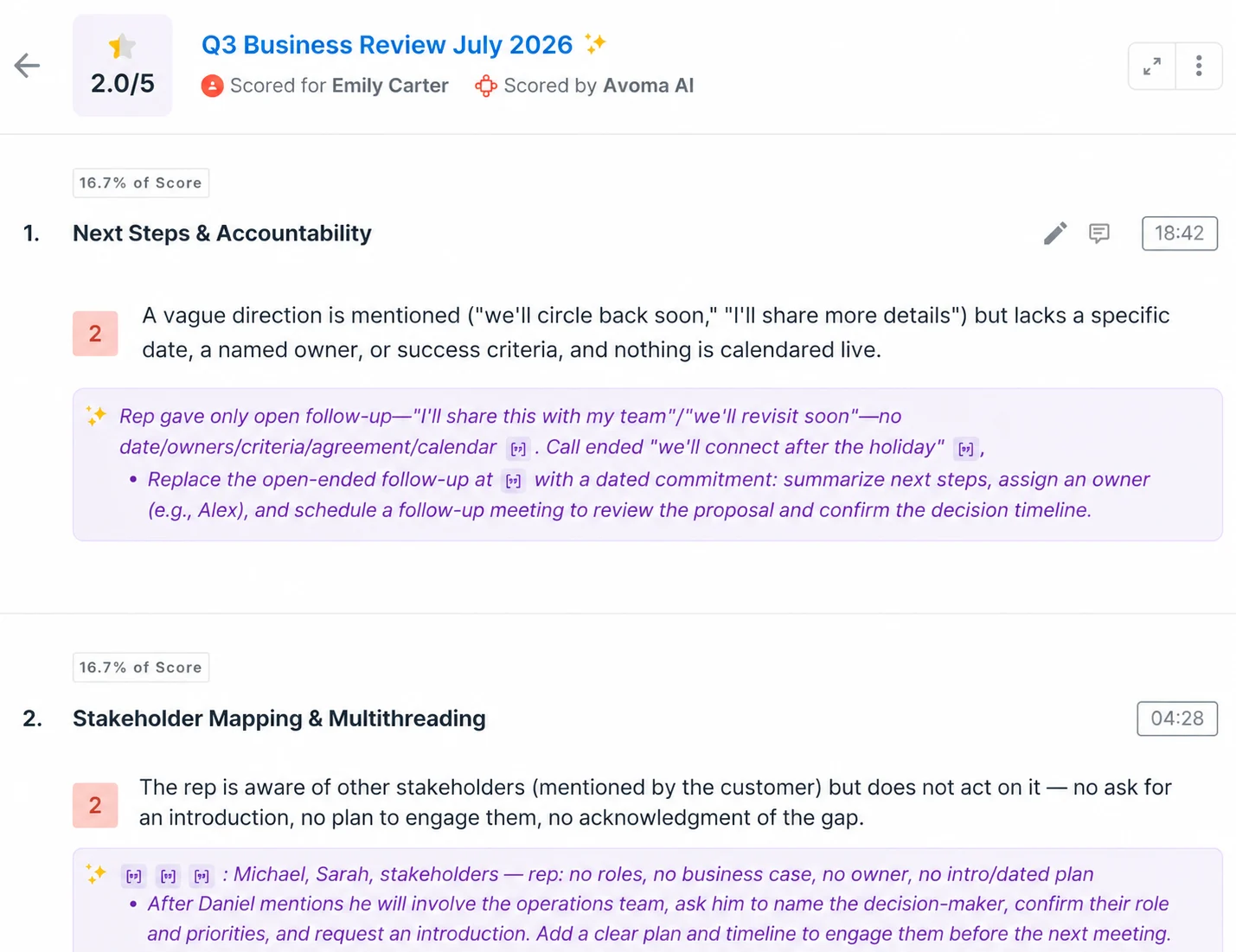
Avoma offers custom scorecards with weighted criteria. Its automated scoring evaluates every call, returning scores with reasoning and timestamps tied to call moments.
Control: Where do findings and actions go?
An AI agent flags that a $150,000 opportunity may slip because procurement hasn't started.
The AE has to act, the manager needs to see it in pipeline review, and the CRM may need an update.
A custom agent can handle these steps once someone writes rules for permissions, record matching, approvals, and failed actions.
Purpose-built software ships established workflows for supported activities, so your team writes less orchestration.
Continuity: Can leadership see patterns over time?
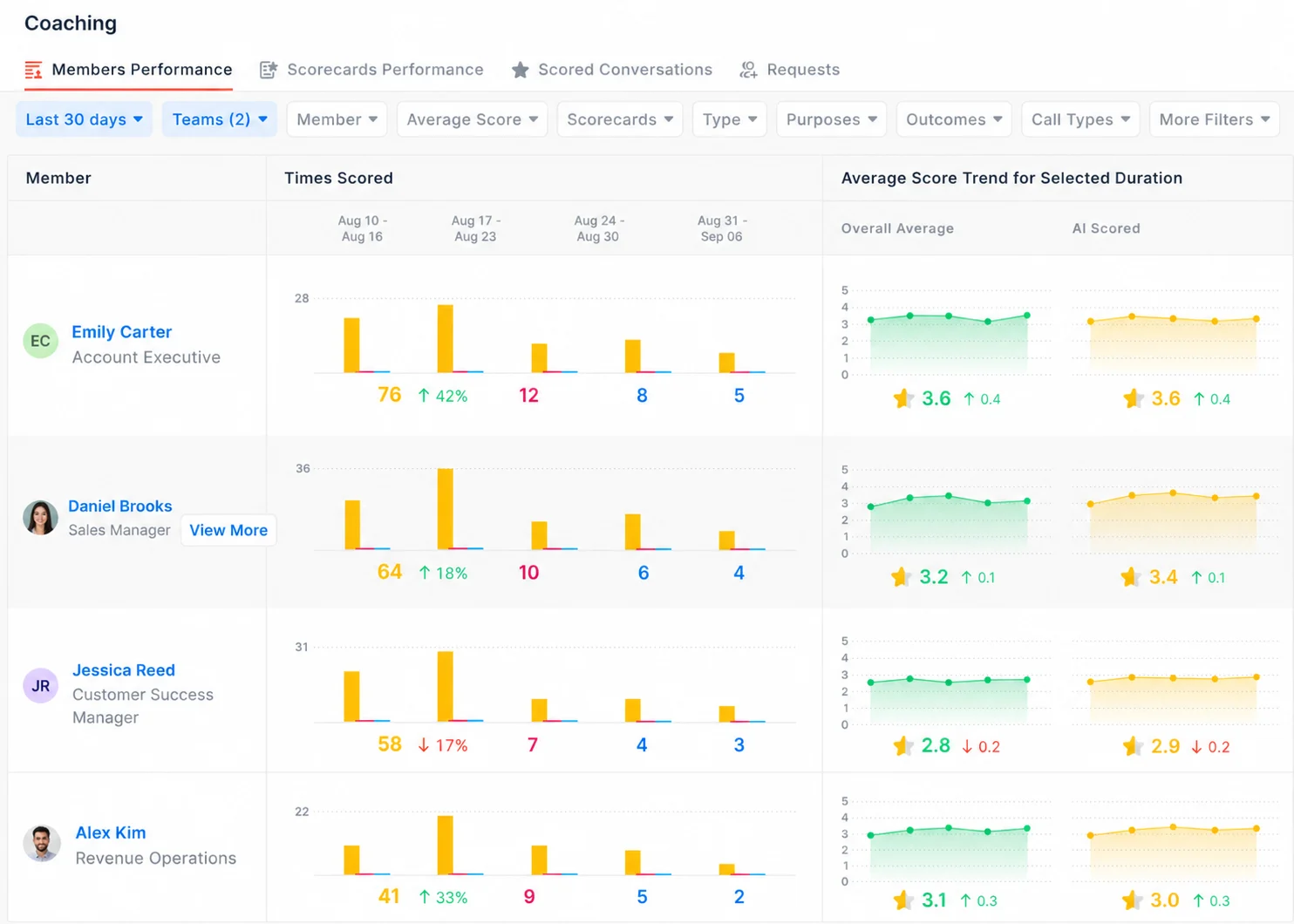
Sales leaders need answers that no single call analysis gives them: which qualification gaps come up most, whether coaching scores are improving, and why deals are lost.
That takes historical data, consistent definitions, and reporting. You can build it on a data platform, and then you maintain it for as long as you need the answers.
| 4C test | Question to ask | Personal AI workflow | What team scale needs |
|---|---|---|---|
| Context | Does the AI see the full deal history? | One pasted transcript | Meetings linked to CRM, account, and prior commitments |
| Consistency | Is everyone scored on the same criteria? | Each manager's own prompt | Shared scorecards and definitions |
| Control | Where do findings and actions land? | A chat window | Permissions, record matching, approvals, error handling |
| Continuity | Can leaders see trends? | Nothing beyond the chat | Stored results and reporting across quarters |
Key Takeaway: A workflow that fails 1 of these tests can still serve an individual. Treat 2 or more failures as a sign you've started building a product, with everything a product needs to keep running.
The hidden costs of running AI workflows yourself
Building an AI workflow takes less time than building traditional software. Operating it for months or years is a different job.
A company that builds call analysis with recordings, Claude, and its CRM will need to maintain:
- Meeting and CRM integrations
- Authentication and user permissions
- Prompts, evaluation rules, and agent instructions
- Data storage and historical reporting
- Workflow triggers and error handling
- Testing when models or APIs change
- Monitoring, support, and security controls
Then add AI usage, infrastructure, and engineering time.
These costs came up in Avoma's prospect conversations.
One company said maintaining integrations had become a problem for its internal AI platform. Another dropped plans to build with Claude because of the time and money involved. A third hit accuracy issues analyzing recordings through an AI integration.
These cases show that a prototype and an operating business process carry 2 separate costs, and your budget needs both.
For a small workflow, building can make financial sense. For a process hundreds of employees use, maintenance becomes a standing commitment.
Common Mistake: Teams budget for the build and leave out the run. Before approving a custom workflow, name who will fix it when a model update changes its output or a CRM field gets renamed.
Shadow AI: when individual productivity stays individual
Shadow AI is the use of AI tools, accounts, or workflows outside an organization's approved oversight. It creates 2 problems for revenue teams.
Data Point: In an August 2025 Cybernews survey of 1,003 employed US adults, 59% said they use AI tools for work that their employer hasn't approved. About three-quarters of that group said they may have shared sensitive information, such as customer data or internal documents, with those tools.
The first problem is data exposure.
A rep who uploads a transcript to a personal AI account may be sharing pricing or contract terms.
The organization needs to know where that data went, which controls apply, and whether the workflow meets its policies.
The risk sits with unapproved services, personal accounts, and ad hoc data sharing. Company-approved Claude, ChatGPT, or Copilot accounts with usage rules count as sanctioned AI.
The second problem is lost knowledge.
A rep spots a recurring objection in ChatGPT. A CSM finds a feature request in Claude. A manager sees a coaching gap in Copilot.
If those findings stay in private chats, other teams never benefit.
Employees can become more productive with AI while the organization keeps losing customer knowledge across disconnected workflows.
A shared source of conversation data closes that gap by giving authorized employees the same customer history to work from.
Once an external AI tool processes that data, the provider's terms and your agreement with it govern retention and use.
Build, buy, or bring your own AI?
Revenue teams have 3 reasonable approaches, and each shifts different responsibilities onto your team.
| Approach | Choose it if | You own |
|---|---|---|
| Build with general-purpose AI | You have specialized requirements, want to experiment, or have staff to maintain custom workflows | Instructions, integrations, business logic, and every operational responsibility |
| Buy purpose-built software | You need established workflows across many employees: meeting capture, coaching, CRM sync, deal inspection, forecasting, reporting | Configuration, adoption, and governance, while the vendor maintains the product |
| Bring your own AI to purpose-built software | You want shared data and recurring workflows, plus custom analysis in your preferred AI tool | Custom prompts on a shared data layer, and governance of the AI tools you connect |
The hybrid gives teams control over specialized workflows without rebuilding every underlying capability.
How Avoma supports built-in AI and bring your own AI
Avoma records and transcribes customer meetings, scores calls against your scorecards, syncs notes to the CRM, and surfaces deal risk from conversation data.
Ask Avoma, the built-in AI copilot, answers questions about meetings and deals inside the product.
For teams that prefer their own AI tool, Avoma has an MCP connector for Claude and ChatGPT.
MCP (Model Context Protocol) is an open standard that lets an AI assistant read data from, and act in, other applications.
Through the connector, an AI client can read Avoma meetings, transcripts, notes, scorecard evaluations, team usage metrics, and CRM deal stages. It can also update a meeting's outcome, purpose, or privacy setting.
Access follows each user's Avoma permissions.
Per Avoma's help center, the Claude connector requires an Avoma Organization or Enterprise plan, or the API Access add-on.
Example: A RevOps manager asks Claude, through the Avoma MCP connector, to review last month's discovery calls for 10 open opportunities and list which have no economic buyer identified. Claude pulls the meeting notes and transcripts from Avoma, with nothing downloaded or pasted by hand.

Sales leaders and CS teams can run custom deal risk or feedback analysis the same way.
Your organization stays responsible for governing how the external AI tool handles that data.
How should your team decide?
Start with the business process you want AI to support, then answer 7 questions:
- Is this a one-time task or a recurring workflow?
- What information does the AI need, and where is it stored?
- How many people will use the workflow?
- Do managers need consistent evaluations and historical reporting?
- Where will findings and actions be recorded?
- What data governance requirements apply?
- Who will maintain the workflow over time?
Then match your answers to an approach:
- Your existing AI tools meet the requirement: You have little reason to add another application.
- You need custom analysis for one team: Building may be the right call.
- You need shared conversation history, consistent workflows, and cross-team reporting: Purpose-built software is worth evaluating.
- You need all 3: Pair purpose-built software with your preferred AI tools.
Each answer comes back to where your team's conversation data lives: in one governed place, or in dozens of private chats.
Avoma records your customer conversations, scores them, links them to deals, and makes them available in Avoma and in Claude or ChatGPT through MCP.
Explore Avoma's revenue intelligence to see how built-in workflows and your own AI tools can work from the same conversation data.
Frequently Asked Questions
Bundled AI is often enough for meeting summaries and follow-up drafts.
Sales coaching tends to need more: a shared scorecard applied to every call, scores managers can compare across reps, and history that shows whether a rep improves. Teams should check whether their bundled tool supports custom evaluation criteria and stores results for reporting before relying on it for coaching.
An MCP connector is an integration built on the Model Context Protocol, an open standard that lets AI assistants such as Claude and ChatGPT read data from and take actions in other applications.
For revenue teams, an MCP connector to a conversation intelligence platform lets an AI assistant query meeting transcripts, notes, and scorecards without users downloading and uploading files by hand.
It depends on the account and the organization's policies. A company-approved business or enterprise account with agreed data terms differs from a personal account outside company controls.
Sales transcripts often contain pricing, contract terms, and customer details, so teams should confirm which AI tools are approved, which account types employees may use, and what the provider's data retention terms say before sharing call content.
A small team can often cover its needs with Claude or ChatGPT if one person reviews calls, the workflow is limited in scope, and trend reporting isn't required.
The trade-off grows with headcount. Once several managers coach reps, or leadership wants call quality and deal risk trends over time, the team needs shared criteria, stored results, and someone to maintain the workflow.
According to Avoma's help center, the Avoma account needs an Organization or Enterprise plan, or the API Access add-on.
The Claude workspace needs a paid plan that supports custom connectors, and the person adding the connector needs the Owner role in the Claude organization. Requirements can change, so teams should confirm current details in Avoma's help center before setup.




What's stopping you from turning every conversation into actionable insights?


