
The sales role play handbook for managers and reps

Table of Contents:
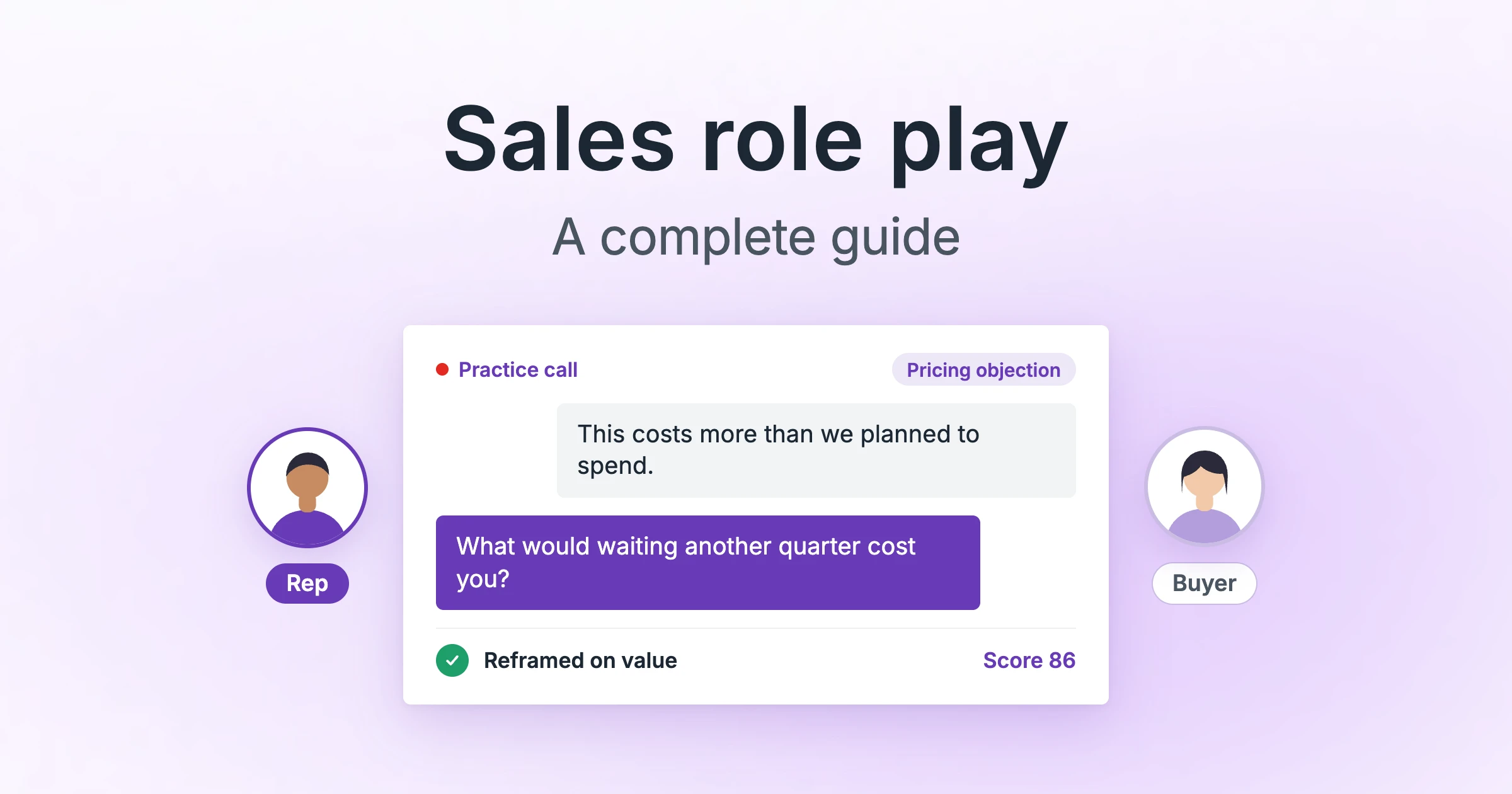
Sales role play is how sales teams practice the conversations that decide deals before a real buyer is on the line.
This guide covers what it is, the main formats, how it compares with other practice methods, how to run a session, how to choose a tool, and how to measure results.
TL;DR
- Sales role play is practice of one part of a sales conversation, with a colleague or an AI tool playing the buyer from a written brief, followed by scored feedback and a rerun.
- Common formats include standard 1:1 sessions, hot seat, role reversal, rapid-fire, tag team, call replay, mock calls and AI role play. Pick by the skill you're practicing and the manager time you have.
- Role play builds repetition. Shadowing teaches call structure, and live call coaching builds judgment with real buyers. New reps benefit from them in that order.
- A session takes 30-40 minutes: one moment pulled from real calls, a private buyer brief, a 10-12 minute round, a rep-first debrief and one rerun.
- Measure it on live calls. Score a baseline, practice, then rescore new calls on the same rubric.
What is sales role play?
Sales role play is a practice session where a rep runs one part of a sales conversation, such as a cold call opener or a price objection, while a colleague or an AI tool plays the buyer from a written brief. An observer scores the attempt against a rubric, the rep gets feedback, and then the rep tries the same moment again.
Teams use it to rehearse the moments that decide deals before a real buyer is on the other end. A rep who fumbles a pricing question in practice costs nothing. The same fumble on a late-stage call can cost the deal.
Managers tend to reach for role play at four points:
- Onboarding: New hires practice the talk track before their first solo calls.
- Launches: Reps rehearse new messaging, pricing or a new product.
- Skill gaps: A manager keeps hearing the same mistake on recorded sales calls.
- High-stakes meetings: An AE preps for an executive demo or a negotiation.
You'll also see it called sales roleplay or sales training role play. They describe the same practice.
Once it's clear when role play helps, the next decision is which format fits what your team needs to practice.
Types of sales role play
Common sales role play formats include standard 1:1 sessions, hot seat, role reversal, rapid-fire, tag team, call replay, mock calls and AI role play. The right one depends on the skill being practiced and how much manager time you can give it.
- Standard 1:1: A rep, a buyer and an observer who scores.
- Hot seat: One rep stays on while the team takes turns raising objections.
- Role reversal: The rep plays the buyer, so they hear how pushback feels.
- Rapid-fire: Reps get 30 seconds per objection, then rotate.
- Tag team: Reps take turns continuing the same call.
- Call replay: A recording plays up to the moment the deal stalled, and a rep handles it live.
- Mock call: A manager plays the buyer for a full call, from opener to next step.
- AI role play: An AI persona plays the buyer and scores the attempt.
The scenario guide explains group size, timing and when to use the six exercise formats. Mock calls and AI role play get a fuller comparison in the practice methods section.
Common sales role play scenarios by sales stage
The scenarios worth practicing are the moments your reps lose at different stages of the deal. Pull them from recorded calls and lost-deal reviews, so the buyer's pushback sounds like your buyers.
- Prospecting: The cold call brush-off and "send me some information."
- Discovery: A buyer who gives short answers, or says what they have is good enough.
- Evaluation: "It's too expensive," a competitor comparison and a skeptical executive.
- Negotiation: A deal that slowed down and a procurement discount request.
- Renewal: A customer with low usage questioning the spend.
The scenario guide has 10 scripted role plays, each with a win condition and two rounds of pushback. For prospecting, the cold calling guide covers the full call, and these objection handling techniques cover the responses behind the evaluation-stage scenarios.
Who uses sales role play
Sales role play is used by SDRs, AEs, CSMs, new hires, sales managers and hiring teams. These groups use it for different moments in the sales cycle.
- SDRs and BDRs: Openers, brush-offs and booking the meeting.
- Account executives: Discovery, demos, multi-stakeholder calls and negotiation.
- Customer success managers: Renewals, expansion conversations and delivering bad news.
- New hires: Practice gates during a sales ramp plan, before they take calls on their own.
- Sales managers: Coaching a gap they've heard across several reps' calls.
- Hiring teams: Role-play interviews that test how a candidate sells, covered in the FAQ at the end of this guide.
Knowing who it's for makes the next question sharper: what does role play fix, and where does it fall short?
Benefits and limitations of sales role play
Sales role play gives reps safe repetition on the moments that decide deals. It's weaker at teaching judgment with real buyers, and it stalls when the scenario is invented, the buyer is played too soft or too hard, or nobody checks the next live calls.
Benefits
- Reps get repetition on a hard moment without risking a real deal.
- Teams practice the same messaging, so buyers hear a consistent story.
- Feedback arrives in minutes, while the attempt is still fresh.
- New reps walk into early calls having handled the objection before.
Limitations
- Reps often find it awkward in front of peers. Google's research on team effectiveness ranks psychological safety first among the dynamics of effective teams, and a gotcha-style debrief works against it.
- A peer playing the buyer can be unrealistic: too agreeable or too hostile.
- Live sessions need manager time, which caps how often they happen.
- Practice can fail to carry over to live calls, where the buyer and the stakes are real.
Common Mistake: Treating a strong practice score as proof the skill will show up on calls. A rep can handle a scripted objection well and still discount on a live call when the buyer has a real deadline. The proof is in the next set of recorded calls, and the measurement section shows how to check them.
Those limitations are why role play works best as one method among several, which the next comparison lays out.
How role play fits with other sales practice methods
Use shadowing to learn call structure, role play and mock calls to build repetition, and live call coaching to build judgment with real buyers. For new reps, the order matters: they learn structure by watching, build fluency through practice, then develop judgment on real calls.
The ramp guide's method comparison breaks this down by ramp stage, including manager time, call libraries and real-time guidance.
How to choose between them:
- Choose role play, in any of the formats covered earlier, when reps need many attempts at one moment and managers can't attend the sessions.
- Choose mock calls when you need to judge whether a rep is ready to run a full call alone.
- Choose live call coaching when reps know the talk track and the gap is judgment with real buyers. Real-time sales guidance can surface prompts during the call itself.
This 90-day ramp plan sequences these methods with readiness gates before reps sell alone.
What a sales role play session looks like
A session runs on three roles: a rep who practices the moment, a buyer who plays the customer from a private brief with set points to push back, and an observer who scores the attempt against a rubric. On small teams, the manager often observes.
Plan for 30-40 minutes. Pick one moment from a recorded call or the stage list above, run a 10-12 minute round, debrief rep-first, then have the rep rerun the same moment with one change. The session playbook walks through each step, including how to handle reps who resist.
Key Takeaway: Use the same rubric for role play that managers use to review live calls. A score of 3 should mean the same thing in practice and on a real call, or you can't tell whether practice moved anything.
How you set up the session decides whether reps take it seriously, which comes down to a handful of habits.
Sales role play best practices and mistakes to avoid
The sessions that change behavior share a few habits: scenarios from recorded calls, a buyer briefed to push back, one behavior per round, and the same scoring used on live calls.
| Do this | Instead of |
|---|---|
| Pull scenarios from recorded calls and lost deals | Writing scenarios from memory or a generic list |
| Give the buyer a private brief with set pushback points | Letting the buyer improvise, too agreeable or too hostile |
| Practice one behavior per round | Running a whole discovery call and scoring everything |
| Keep rounds to 10-12 minutes | Hour-long sessions that tire everyone out |
| Rotate who plays the buyer | Making the newest rep play the buyer by default |
| Debrief rep-first, with quotes from the round | Opening with the manager's critique |
| Score role play and live calls on one rubric | Using a separate practice scorecard |
| Check the next live calls for the same moment | Assuming the session worked because it went well |
The scenario guide also shows how to turn a recorded call into a written scenario, step by step.
Once sessions are running well, the next question is whether a tool can add more practice than managers can staff.
How to choose a sales role play tool
Run role play live when judgment and feedback quality matter most. Add an AI role-play tool when reps need more repetition than managers can staff. Look for a tool that lets you build buyer personas from your own calls and scores attempts against your own rubric.
Manual vs AI role play
Live role play gives reps feedback from someone who has sold the product. AI role play gives reps attempts on demand, without booking a colleague.
- Choose live role play for judgment-heavy moments (negotiation, executive conversations) and for calibrating what "good" sounds like.
- Add AI role play for repetition on common objections and openers, for remote teams across time zones, and for new hires who need volume before their first calls.
- Use both when reps need volume on a moment and a manager's read on whether it's ready for live calls.
What to look for in an AI role-play tool:
- Buyer personas you can customize by role, industry and objection
- Scenarios you can build from your own call recordings or transcripts
- Scoring against your rubric or sales methodology, such as MEDDICC or SPIN
- Voice practice, since reps sell out loud
- Manager review of attempts, with scores and recordings in one place
- Integrations with your CRM or learning platform
- A pricing model you can predict, whether per seat or by usage (check vendor pages and ask how practice time is counted)
AI role play covers the practice side. Avoma covers the real calls on either side of it. Avoma records and analyzes sales conversations, tracks objections and topics with Smart Topics, scores calls against MEDDICC, SPIN or your own framework with AI Scorecards, and collects clips of strong handling into playlists. Teams use it to pick the moments worth practicing and to check whether those moments improve on live calls, which is what the next section covers.
How to measure whether sales role play is working
Measure sales role play on live calls. Track leading indicators first, such as rubric scores on the practiced moment in role play and in the next live calls. Then track lagging ones, such as stage conversion, win rate on deals where that moment came up, and ramp time.
| Metric | Type | Where to get it |
|---|---|---|
| Rubric score on the practiced moment in role play | Leading | Observer scorecards |
| Rubric score on the same moment in live calls | Leading | Call reviews or AI call scoring |
| Practice sessions per rep per month | Leading | Session log |
| Stage conversion where the moment comes up (for example, proposal to close for price objections) | Lagging | CRM |
| Win rate on deals where the objection was raised | Lagging | CRM plus call data |
| Ramp time to first solo deal or first full-quota month | Lagging | Ramp plan |
To check practice against live calls, the training guide's 3-Score Check scores a live-call baseline on 5-10 calls per rep, logs practice scores through a 2-3 week cycle, then rescores 5-10 new live calls on the same behaviors. If the live score moved, retire the behavior and spot-check it monthly. If it didn't, keep it in the rotation.
Scoring 10-20 calls per rep by hand is where measurement tends to stall. Avoma's AI Scorecards score recorded calls against the same rubric you set up for practice, and Smart Topics flag which calls contain the objection you practiced, so managers go straight to the calls that matter.
Key Takeaway: Leading indicators tell you within weeks whether practice is carrying over. Lagging indicators like win rate take a full sales cycle to move, so don't judge a role-play program on them alone.
Key takeaways and next steps
- Sales role play works when the scenario comes from a real call and the result gets checked on real calls.
- Pick the format by the skill and the manager time available. Call replay and AI role play add practice without adding manager hours.
- Run short sessions on one moment, with a briefed buyer, an observer, a rep-first debrief and one rerun.
- Score practice and live calls on the same rubric, and judge the program on the live-call score first.
Where to go next:
- To run a program: The training program guide has the session plan, rubric and calibration steps.
- To practice specific moments: The scenario library covers 10 moments across the sales cycle.
- To ramp new hires: The four-stage ramp plan sequences role play, mock calls and live coaching.
If your team wants to stop guessing which moments to practice, Avoma shows you. It records and scores your team's calls, flags the objections reps keep losing, and supports sales coaching on the live calls that follow practice, without managers sitting in on them. Try Avoma free and score your next round of calls against the rubric your team practices with.
Frequently Asked Questions
A short weekly session is a practical starting cadence for many sales teams. Weekly practice keeps a skill fresh between live calls without taking a large share of selling time. Teams onboarding new hires or launching new messaging often add sessions during that period, then return to a weekly rhythm once live-call scores on the practiced moment hold steady.
The best AI tool for sales role play depends on what a team needs to practice. Useful criteria include customizable buyer personas, scenarios built from the team's own calls, scoring against the team's rubric or methodology, voice practice, and manager review of attempts. Teams with complex deals tend to weight custom personas and methodology scoring higher, while teams focused on outbound weight voice practice and volume.
A sales role-play interview is passed by selling the way a strong rep sells on a real call. Candidates should ask discovery questions before pitching, tie the product to the problem the interviewer describes, handle at least one objection by isolating it before answering, and close by asking for a specific next step with a date. Interviewers often care more about how the candidate runs the conversation than about the pitch itself.
A mock sales call interview is a hiring exercise where a candidate runs a short simulated sales call, often a discovery call or a "sell me this" pitch, with the hiring manager playing the buyer. For example, a candidate might get 10 minutes to prepare, then run a 15-minute discovery call with a buyer who hides their real problem until asked the right follow-up question.



What's stopping you from turning every conversation into actionable insights?


