
6 signs your revenue team has outgrown a standalone AI notetaker

Table of Contents:
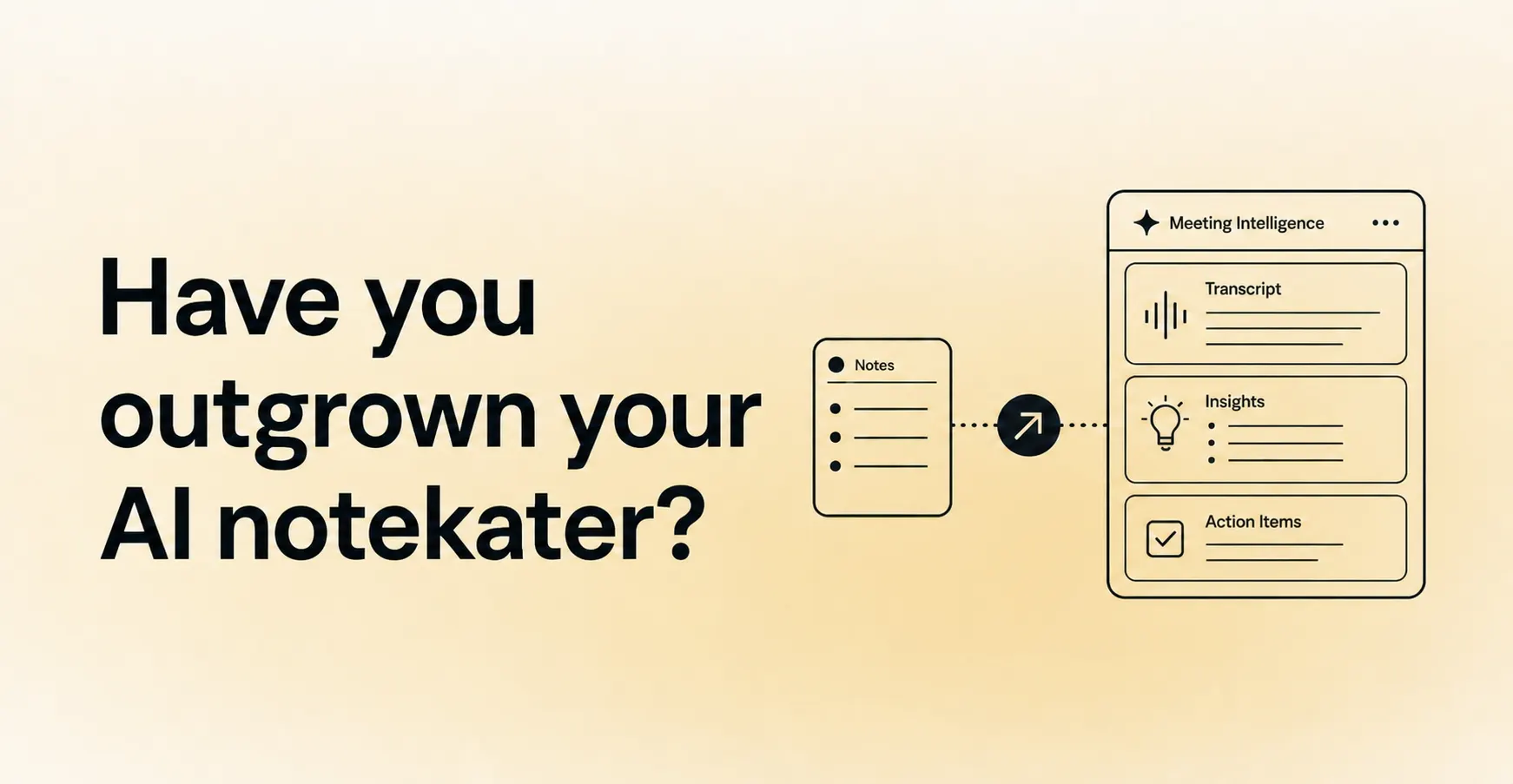
AI notetakers are good at capturing meetings, generating transcripts, and summarizing conversations.
The challenge starts after the meeting. As revenue teams rely more on conversation data, reps still update CRM fields, managers build separate coaching workflows, teams move transcripts into ChatGPT or Claude, and customer context gets spread across tools.
One recurring pattern stands out in our customer and prospect conversations from the beginning of 2026: the notetaker often keeps doing its original job, while the workaround becomes harder to manage.
We found six signs that show when a standalone AI notetaker may no longer be enough for your revenue team.
TL;DR
- Standalone AI notetakers work for meeting capture. They handle recordings, transcripts, summaries, action items, and searchable notes.
- Teams start outgrowing them when customer conversations feed broader revenue workflows. CRM updates, coaching, deal intelligence, and questions across customer conversations create work outside the notetaker.
- Avoma brings those workflows into one platform. Teams can record, transcribe, and analyze calls, use the data for coaching and reviewing deals.
What to look for after outgrowing an AI notetaker
The six signs point to capabilities that become important as customer conversation data starts supporting more revenue work.
1. Manual CRM updates slow reps down
AI-generated notes save reps from writing meeting notes during calls. That value drops when reps spend time transferring qualification details, pain points, next steps, competitor mentions, and deal updates into the CRM after the call.
We saw this pattern in our customer and prospect conversations. In one case, meeting notes moved into shared storage before someone transferred the relevant information into the CRM. Structured CRM field updates and deeper CRM integration also came up in other evaluations. A Sales leader said during a demo call:
It doesn't mark the meeting as closed. It doesn't fill any properties. It does nothing. So after the call, the rep still has to go in and do all the manual stuff in Hubspot themselves, which is such a waste of their time, and reps are expensive. Time is expensive.
The limitation becomes clearer when pipeline reviews, forecasting, handoffs, and reporting depend on CRM data.
Avoma differentiator
Avoma connects conversation data with CRM workflows. Smart Topics can map information from calls to supported CRM properties, so reps spend less time on manual updates and teams get more value from their CRM integration.
2. Reps keep moving transcripts into ChatGPT or Claude
Using ChatGPT or Claude for an occasional transcript analysis can make sense. A stronger signal appears when exporting transcripts, pasting prompts, and moving the output into another system becomes part of the standard workflow.
Few frustrations from our prospects and customers:
Marketing tried pulling full transcripts and using Claude to analyze, but pulling transcripts from (a competitor notetaker) is hard and speaker separation is unclear. Not a feasible system for external insights.
For in-person I use (basic notetaker) but its prompts to pull info aren't great; I put their transcript into ChatGPT but it's messy.
Reps export the transcript, provide context, reuse prompts, review the answer, and move the result to the system where the team needs it.
The gap grows when the answer depends on information outside one call. A question about an account or deal may require several meetings, CRM records, emails, and previous interactions.
Avoma differentiator
Avoma records customer conversations, transcribes them, and creates structured AI meeting notes, so the context is already captured in one place.
Ask Avoma is Avoma's AI copilot that sits on top of that conversation data. Teams can ask questions about a call, account, deal, or a broader set of customer conversations and get answers from the underlying meeting and revenue context.
That means reps do not have to dig through recordings, scan notes, export transcripts, or rebuild the context in ChatGPT or Claude before they can get an answer.
3. Different teams use different AI notetakers
Different teams can choose different AI notetakers because their meetings and workflows vary.
We saw this in our research. One prospect described Sales capturing customer conversations in one tool while Customer Success used another. That setup made it harder to access information from Customer Success calls when other teams needed it.
They don't use (competitor notetaker), actually, like our customer success team. They use (another competitor notetaker) because they don't like the meeting recorder joining (competitor notetaker), which is a pain for me because it's annoying to get the data now from their calls.
Using separate AI notetakers makes it harder for these teams to work from the same customer conversations.
Avoma differentiator
Avoma gives revenue teams one AI-powered conversation intelligence platform for capturing, analyzing, and using customer conversations.
Sales, Customer Success, RevOps, Enablement, Marketing, and Product can work from the same conversation data while using it for different workflows.
Marketing teams can use conversation intelligence to study messaging, objections, competitor mentions, and product feedback. Customer Success teams can use conversation intelligence across onboarding, account management, renewals, and expansion.
4. Managers need a repeatable coaching system
Managers can review recordings and give feedback when call volume stays manageable. That process becomes harder as the number of reps, calls, managers, and coaching criteria grows.
Our customer and prospect research found demand for custom coaching frameworks, scorecards, call grading, and live guidance. One prospect had built an external AI workflow that pulled transcripts and created coaching output against the company’s framework.
A repeatable coaching system gives managers a consistent way to:
- score calls against defined criteria or a sales methodology
- identify calls and reps that need attention
- track coaching themes over time
- guide reps with battle cards, competitor positioning and messaging
Those workflows require a system that can turn conversation data into coaching data.
Avoma differentiator
Avoma offers AI sales coaching by scoring reps calls with AI scorecards. They score the reps based on sales methodologies and custom frameworks. Managers can use call scores to focus their review time on the conversations that need attention.
5. Leaders need deal intelligence
Revenue leaders need a clear view of deal progress, risk, engagement, qualification, and next steps.
That information develops throughout the deal. Calls, emails, CRM updates, stakeholder interactions, methodology criteria, and changes in engagement contribute to the picture.
Our research includes a customer who valued opening an account and reviewing its conversation and activity history as part of the deal workflow. Another prospect wanted revenue and forecasting intelligence beyond the capabilities available in its note-taking setup.
Conversation data becomes useful to leaders when it supports pipeline inspection, deal reviews, risk detection, methodology tracking, and forecasting.
Avoma differentiator
Avoma’s Revenue Intelligence gives leaders a deal-level view that brings conversation history and CRM context together.
They can track the deal progression across calls and updates, spot risks or missing methodology criteria, and use that same view during pipeline and forecast reviews.
Avoma also supports win-loss analysis, helping teams review what happened across closed deals.
6. Teams need answers across customer conversations
Searchable transcripts work when someone knows which meeting contains the information they need. The gap shows up when teams need answers that span across several customer conversations.
Our customer and prospect research found demand for questions such as:
How many times has my competitor's name come up on a demo?
How did we manage that objection?
These questions require looking across multiple calls. Teams may also want to understand which pain points keep coming up, which product requests repeat, or which risks appear across active accounts.
Opening individual transcripts and compiling those findings manually does not scale well.
Avoma differentiator
Ask Avoma lets teams ask questions across customer conversations instead of searching transcripts one at a time.
Teams can use it to find recurring competitor mentions, objections, or other patterns across calls, then trace the answer back to the source conversations. It also supports scheduled prompts for questions teams need to ask regularly. Teams can turn repeat research into an ongoing workflow without searching the conversation library from scratch.
When a standalone AI notetaker still fits
A standalone AI notetaker can be a good fit when the primary requirement is meeting capture.
Teams that mainly need transcripts, summaries, action items, and searchable notes may get enough value from a free or basic AI notetaker.
This can work well for individuals, smaller teams, or companies where customer conversations do not feed CRM updates, coaching, pipeline reviews, or analysis across calls. You can check our Otter AI alternatives guide if you need basic AI notetaker.
If you are a company who has a basic AI notetaker and are expanding teams, book a demo with us to see Avoma's all-in-one AI meeting assistant live in action.
Frequently Asked Questions
An AI notetaker focuses on meeting capture, including recording, transcription, summaries, notes, and action items.
Conversation intelligence uses those conversations for broader workflows such as call analysis, coaching, CRM updates, deal intelligence, and analysis across customer conversations.
Some AI notetakers connect with CRMs such as Salesforce or HubSpot, but the depth of the integration varies.
Avoma offers two-way CRM sync. Teams can bring supported CRM data into Avoma and map conversation data back to CRM fields, helping keep meeting context connected to the records used for pipeline, forecasting, handoffs, and reporting.
A basic AI notetaker can be enough when the main requirement is meeting recording, transcription, summaries, action items, and searchable notes.
Teams start outgrowing that setup when conversation data begins supporting CRM automation, coaching, deal intelligence, and analysis across customer conversations.




What's stopping you from turning every conversation into actionable insights?


