
Enterprise sales: How to win complex deals with multiple stakeholders

Table of Contents:
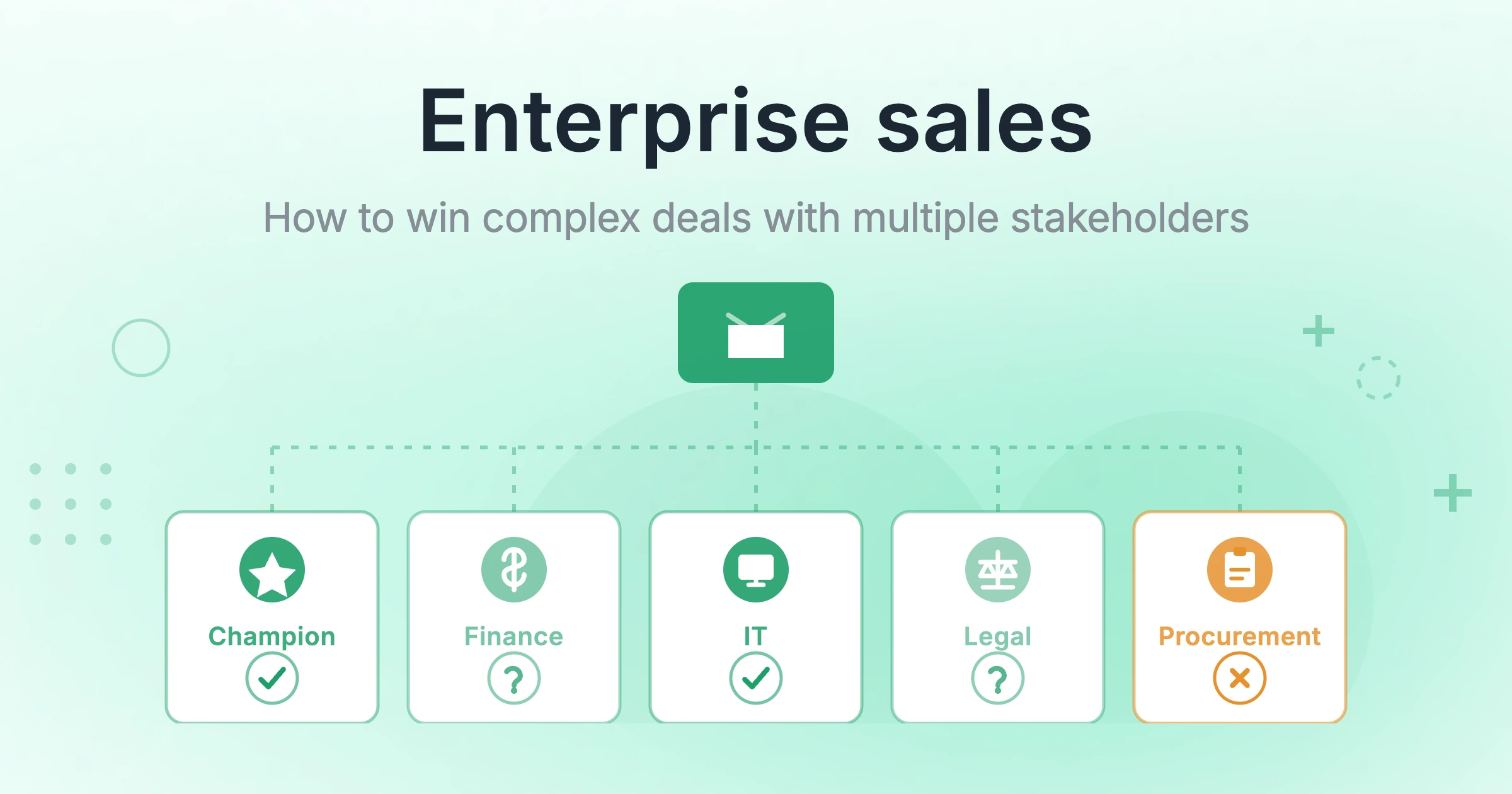
Moving from SMB to enterprise sales changes how the whole deal works.
You have more people in the room. Finance wants the ROI case. Security wants to know how you handle their data. IT cares about implementation. Procurement has a process you didn't know existed. And the person who loves your product may have very little power to get it approved.
Every one of those people gets a say.
That's what makes enterprise sales hard. You're helping a group of people with different priorities and concerns get comfortable with the same decision.
And that changes how you sell.
You need to know who has influence, who controls the budget, who can kill the deal, and what each person needs to move forward. You also need to know whether the buyer is actually making progress, because 6 calls, a good demo, and a finished POC can still leave you months away from a signature.
This guide covers how enterprise sales works, where complex deals tend to get stuck, and how to figure out what's actually happening inside the buying group. It's a useful companion to our guide to agentic AI for sales, since multi-stakeholder deals are exactly the kind of work that's hardest to hand off to an agent.
TL;DR
- Enterprise sales gets harder than SMB sales as more people, approvals, and competing priorities enter the buying process.
- Track buyer progress by what changes inside the account, not your CRM stage: new stakeholders engaged, budget confirmed, security cleared, decision criteria agreed.
- A strong champion helps, but enterprise deals need support beyond one person. Map the buying group early.
- Treat POCs, proposals, and meetings as evidence of activity. Look for buyer commitments before calling a deal healthy.
- Bring procurement, security, finance, and legal into the process early enough to plan around them — that's usually why deals stall.
What is enterprise sales?
Enterprise sales is the process of selling high-value, complex products or services to large organizations, where multiple stakeholders take part in the buying decision. These deals involve longer sales cycles, more organizational risk, and formal approval steps across functions like finance, procurement, legal, security, and IT.
Buying complexity is what makes a sale enterprise. Company size and contract value are useful signals, but they don't tell you how the customer will buy.
What makes a sale "enterprise"
A handful of traits show up together in most enterprise deals:
- Multiple stakeholders. More than one person has to say yes, and often more than one has to say yes in sequence.
- High business impact. The decision touches budgets, workflows, or strategy beyond a single team.
- Higher perceived risk. A wrong choice is expensive, visible internally, and hard to walk back.
- Formal approval requirements. Legal, security, procurement, and finance each get a say before the deal closes.
- Longer buying cycles. More people agreeing takes longer than one person deciding.
Enterprise, in other words, describes a buying motion as much as a company size. A 300-person company with a formal security review can behave like an enterprise buyer. A much bigger company with one decision-maker might not.
Once you know what makes a deal enterprise, the next question is what that changes about how you sell it, covered in the comparison below.
Enterprise sales vs SMB sales: What changes
An enterprise AE deals with a group that can span several functions, not a single relationship, and those people don't necessarily agree with each other. Gartner's B2B buying research found that buying groups now range from 5 to 16 people across as many as four functions, and 74% of buying teams show real conflict, not just disagreement, somewhere in the decision process.
| Factor | SMB sales | Enterprise sales |
|---|---|---|
| Buying group | One person, or a small team | Cross-functional, often 5 to 16 people |
| Decision authority | Concentrated in one role | Distributed across functions |
| Perceived risk | Lower | Higher, and politically visible |
| Sales cycle | Weeks | Months |
| Buying process | Linear | Nonlinear, set by the buyer |
| Procurement involvement | Minimal | Formal, often mandatory |
| Legal and security review | Light | Substantial |
| Seller's role | Persuade | Persuade, then orchestrate |
| Forecasting basis | Stated interest | Buyer-side signals across the group |
The table explains what changes. Here's why it takes longer.
In SMB sales, the VP wants the product, has budget, and can sign it off on the same call. In enterprise sales, the VP still wants the product, but finance has to approve the ROI case, security has to approve the risk, IT has to validate the implementation, procurement has to negotiate terms, and legal has to approve the contract. Every one of those is a separate yes.
More dependencies stand between interest and purchase in an enterprise deal, and each one adds time to the cycle.
Your CRM wasn't built to track dependencies like that. It tracks your process, not the buyer's, which is exactly where accurate sales forecasting starts to break down.
Why enterprise deals are harder than they look in your CRM
A CRM tracks your sales process. The buyer follows their own.
A deal can sit at "proposal sent" while the CFO hasn't approved the initiative internally. It can show "technical validation complete" while security hasn't opened a review.
| CRM says | Buyer reality |
|---|---|
| Proposal sent | Finance hasn't approved the initiative |
| Technical validation complete | Security review hasn't started |
| Negotiation | Economic buyer isn't engaged yet |
| 80% probability | Champion is still building internal consensus |
Key Takeaway: Instead of asking what a rep did since the last update, ask what changed inside the customer's organization since the last interaction. Did the economic buyer engage. Did a new stakeholder commit. Did security sign off. Did the buying group agree on decision criteria. If the honest answer is nothing, the deal hasn't moved, whatever the CRM stage says.
That question, what changed inside the organization, runs through the rest of this guide, from the process below to the Deal Consensus Score later on.
The enterprise sales process: Follow the buyer, not your pipeline
Enterprise deals don't move step by step from prospect to demo to proposal to close. They move when something changes inside the buyer's organization. Each step below is really a question about what needs to change next, not a task to check off.
1. Find a problem worth solving now
Enterprise buyers have a long list of real problems. That doesn't mean yours is worth acting on this quarter. Before anything else, understand the business impact, the cost of doing nothing, and where this sits on the buyer's current priority list.
A prospect can genuinely like your product and still rank the problem it solves twelfth out of twelve. Twelfth doesn't get budget.
Progress here means the problem becomes a stated priority, not just an acknowledged one.
2. Find a champion, then test their influence
A real champion believes change is necessary, has credibility inside their organization, shares information freely, and opens doors to other stakeholders. Someone who likes your product isn't automatically a champion.
Test it directly. Ask them to introduce you to their VP, or to walk you through everyone else who needs to sign off.
A real champion can answer both. Someone who can't hasn't earned the title yet, whatever they told you on the last call.
Example: Your champion has joined eight calls and answers every message the same day. Ask how their organization approves a purchase like this, and they admit they've never bought software at this level before.
Aditya Kothadiya, our CEO, gives our sales team a short non-negotiable list for this:
- Who's the decision maker
- Who's the champion
- What's the signature process
- What's the evaluation process
"You won't get all of those answers on the first call," he tells reps. "If not the first, cover them on the second. Thinking about it as a process, as a team, is also what uncovers the challenges our customers are actually going through."
3. Map and multithread the buying group
Good multithreading gives you a map of who cares about what, who has influence, and who can stop the deal.
Map every stakeholder to what they need to say yes, not just their title:
- The CFO cares about ROI.
- Security cares about risk.
- IT cares about implementation.
- End users care about workflow disruption.
- The executive sponsor cares about strategic fit.
- Procurement cares about commercial terms.
Multithread before your champion goes quiet, not after. By the time a single-threaded deal hits a problem, there's usually no other relationship left to work with.
Forrester's 2026 buyer insights put the typical buying decision at 13 internal stakeholders and nine external influencers, which is why mapping the group matters more than mapping one contact.
4. Build the business case your champion can sell without you
Most of the selling in an enterprise deal happens when you're not in the room. Help your champion answer: why change, why now, what does doing nothing cost, and why this vendor.
The business case is what your champion uses to sell the decision internally, in meetings you'll never sit in.
5. Validate without confusing validation with commitment
Set success criteria, an owner, a timeline, and what happens next, before you run a demo, pilot, or proof of concept.
A successful POC answers one question: does the product work for this use case? The buying group still has budget, risk, procurement, and approval questions to settle.
Everyone can sign off that the product works, and three weeks later Finance still asks why the company needs to make this change this year at all.
6. Bring procurement, security, and legal in early
A champion says "we're ready to go." Then the rep learns vendor security onboarding takes six weeks and hasn't started. The deal was never as close as it looked.
Ask about the security review, the procurement process, data processing agreements, and budget approval as soon as you know this is a real opportunity. Procurement showing up "unexpectedly" late in a deal is one of the most common reasons enterprise deals stall.
7. Build a mutual path to the decision
A mutual action plan lists milestones, owners, dates, and the approval steps still ahead, agreed with the buyer rather than handed to them. Built together, it makes the buying process visible to both sides, so slippage shows up before the forecast call does. A template for a mutual action plan helps if you're building one from scratch.
Knowing the steps is one thing. Knowing when a deal quietly falls out of them is another.
Why enterprise deals stall
Most stalled enterprise deals don't fail over price or a lost champion. They stall in a handful of predictable ways, the same ones top performers learn to spot early.
You're single-threaded
A rep says "my champion loves us." A manager should hear "we have one relationship." If that person leaves, gets reassigned, or loses political capital, the deal loses its only advocate. Multithread before that happens, not after.
Even seasoned sales leaders get caught by this. One of our own sales leaders described a demo call where his team was the leading vendor, until the buyer brought in another leader who wasn't on the original invite.
"I wasn't prepared for it," he said. "I was scrambling to figure out what to ask and how to secure the next meeting. It made me realize I hadn't walked into that meeting with a clear goal for what I wanted to get out of it, and that's why I struggled live on the call."
Single-threading is one of the common deal risks enterprise pipelines carry silently.
You're confusing activity with progress
Demos, calls, and meetings feel like momentum. They aren't, unless something changed inside the buyer's organization: a new stakeholder engaged, budget confirmed, a decision criterion agreed.
Count buyer actions, not seller activity, the same distinction covered under busy vs productive reps, just playing out at the deal level instead of the rep level.
There's no compelling reason to change
The product can be genuinely good and still lose to doing nothing, if staying with the status quo costs the buyer less than the effort of switching. Put a number on what inaction costs them, not just what your product saves them.
Procurement and approvals show up "unexpectedly"
If enterprise procurement was a surprise, discovery missed a step. Ask about the buyer's approval process in the first month of a deal, not the last.
Deal context lives in five different heads
The AE remembers one conversation. The SE remembers another. The manager heard a third version. The CRM has a fourth.
None of these people is necessarily wrong. They're just working from an incomplete record, which is why deal reviews built on memory keep missing what the buyer said. That fragmentation is exactly the problem conversation intelligence is built to close, covered later in this guide.
A stalled deal often looks like a pricing problem. The real blocker usually sits somewhere in the buying group, not in what you're charging.
Knowing why deals stall matters less than catching it early.
What top enterprise sellers do differently
They multithread before they need to
Not after their only champion goes dark. By then, there's no relationship left to lean on.
They separate interest from commitment
Interest sounds like "this looks good." Commitment sounds like "I'll bring our CFO into Thursday's meeting." Track the second one when you're judging where a deal really stands, not the first.
Recap every call in writing, even a one-line email. It turns a vague "sounds good" into a specific, checkable commitment with a date attached.
They coach their champion for meetings they'll never sit in
Most of a champion's internal advocacy happens with no rep in the room. Give them the numbers, the objection handling, and the language to make the case on their own.
They diagnose organizational risk, not just product fit
Alongside "what problem are we solving," ask "what could stop this organization from acting, even if they genuinely want to."
They make next steps mutual
A real next step names what both sides commit to, and by when, not a placeholder like "let's follow up next week."
How to tell if an enterprise deal is healthy
Most forecast calls ask what the rep did. A better set of questions asks what's true inside the buyer's organization right now. The Deal Consensus Score is a 5-point check for that: Problem, Power, Consensus, Process, and Momentum.
- Problem: Is this important enough for the organization to act on now, not eventually?
- Power: Are you connected to people who can authorize the purchase, not just recommend it?
- Consensus: Do the stakeholders who matter agree on the problem and the approach, or are they still negotiating with each other?
- Process: Do you know how this organization makes and formalizes a decision, including who signs last?
- Momentum: Is the buyer taking real action, scheduling their own meetings, sharing information, introducing you to people, or are you the only one pushing?
Treat this as a qualitative check, not a formula. A weak answer on any single point is a real risk, not a detail to revisit later.
Key Takeaway: A deal can pass four of these checkpoints and still be at real risk. Power without consensus usually just means one senior person likes you. It doesn't mean the organization is ready to buy.
This is close to how Avoma's own deal health scoring works: it flags risk from real engagement and process signals in the conversation and CRM data, instead of a rep's self-reported status.
Where technology helps
The harder an account gets, the more scattered the picture becomes.
One AE hears the CFO's objection. Procurement changes the timeline in an email nobody else sees.
Your team needs those signals in one place, which is what revenue intelligence tools solve for.
Your CRM gives you the account record, the system of record for the deal. Conversation and deal intelligence tools add what buyers said across calls: objections, commitments, and risks that would otherwise sit in someone's notes or memory.
AI makes that record easier to search and review, a shift explored further in AI in sales. A manager can see which stakeholders have engaged and whether the buyer has committed to a next step, without replaying several calls before a forecast meeting. Specialized AI sales agents and AI agents for CRM, including HubSpot and Salesforce implementations, are increasingly built to catch these same stakeholder and risk signals automatically.
The technology gives your team a better view of the account. The seller still has to get the people inside it to make a decision.
Enterprise sales isn't finished when one person says yes
The AE's champion loving the product was never the same thing as the deal being 80% closed. Enterprise selling finishes when enough of the organization decides together.
Before you call any deal healthy, ask what changed inside the customer's organization since the last call. That question matters more than any stage in your CRM.
Avoma's conversation and deal intelligence surfaces that change automatically, so your deal reviews are grounded in what buyers said, not what a rep remembers from three weeks ago. Book an Avoma demo to see it against your own pipeline.
Frequently Asked Questions


Dive into Our Latest
Avoma Insights.


What's stopping you from turning every conversation into actionable insights?


