
AI sales agents aren't just AI SDRs: 7 jobs agents can take off your sales team's plate

Table of Contents:
Ask most sales leaders what an AI sales agent does, and you'll get the same answer: it prospects. It finds leads, sends outreach, and books meetings, basically an AI SDR with a better vocabulary.
That answer is 6 jobs too small.
Sales teams already running AI agents use them for CRM upkeep, pipeline inspection, deal-risk alerts, forecasting, coaching, and follow-up, not just prospecting. Salesforce's 2026 State of Sales research backs this up: 87% of sales organizations now deploy AI agents somewhere across the full sales cycle, not just the front end.
This guide covers what an AI sales agent is, how it differs from a copilot or plain automation, and the 7 jobs agents are already taking on inside revenue teams. You'll leave knowing which jobs are worth handing off first, and what to keep for your reps.
In this guide:
- An AI sales agent is software that plans and completes a multi-step sales task on its own, not a rule-based automation or a copilot that waits for approval.
- Prospecting agents (AI SDRs) got the early spotlight, but only 36% of teams running AI agents use them for coaching, per Salesforce's 2026 State of Sales report.
- 7 recurring sales jobs are now agent territory: prospecting, CRM maintenance, pipeline inspection, deal-risk monitoring, forecast validation, coaching, and follow-up execution.
- The bigger shift is a Revenue AI workforce: multiple agents sharing the same CRM, call, and pipeline context, working alongside sales, CS, RevOps, and enablement.
- Relationships, negotiation, and judgment calls stay with people. Agents are built for recurring, well-defined work, not the exceptions.
What is an AI sales agent?
An AI sales agent is software that uses AI to plan and carry out a multi-step sales task on its own, drawing on live CRM, call, and pipeline data, then reports what it did. That's different from a chatbot running a script or a dashboard waiting for someone to read it.
The definition matters because "AI sales agent" gets used loosely. A lot of what's marketed as an agent today is a smarter automation rule or a copilot that still needs a person to approve every step. A real agent finishes the job and only loops a human in when the outcome needs a judgment call.
Most of the market's attention has gone to one version of this: the AI SDR that prospects, qualifies, and books meetings. That's a real and useful job. It's also one job in a list of at least 7, covered below.
AI sales agents vs AI copilots vs sales automation
These three terms get used as if they're interchangeable. The difference decides how much work you can hand off.
Automation follows a fixed rule: if X happens, do Y, and it breaks the moment the situation falls outside that rule. A copilot looks at context and suggests something, but a person still decides and executes. An agent plans a sequence of steps toward a goal, executes them using live context, and stops to ask only when the situation calls for judgment.
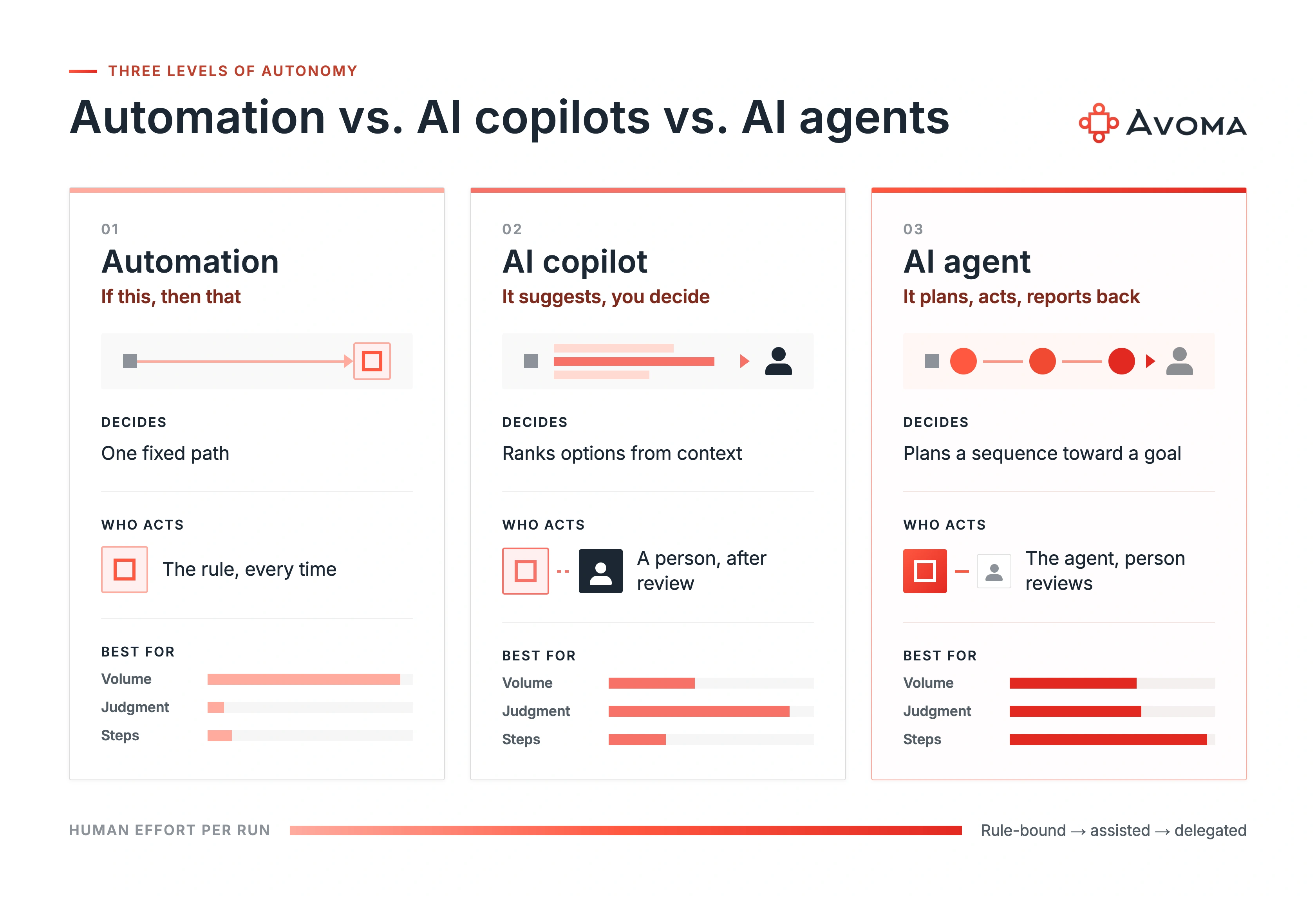
| Dimension | Automation | AI copilot | AI agent |
|---|---|---|---|
| How it decides | Follows a fixed rule | Suggests an option based on context | Plans a sequence of steps toward a goal |
| Who acts | The rule, every time | A person, after reviewing the suggestion | The agent, with a person reviewing the outcome |
| Best for | High-volume, low-variance steps | Judgment calls that still need a human | Recurring multi-step jobs with a clear finish line |
| Example in sales | Auto-assign a lead by territory | Draft a follow-up email for a rep to review | Update the CRM record and flag deal risk after every call, unprompted |
The test for a real agent: does it finish the workflow, or stop and wait for a person at every step? Most of what gets marketed as agentic AI for sales today is still the middle column. Stack several genuine agents together and the picture changes, covered later.
Why the first AI sales agents looked like SDRs
Prospecting was the obvious place to start. It's repetitive, high-volume, and painful enough that sales leaders were willing to try software before they trusted it anywhere else. Sending 100 personalized emails a day was never going to happen with a human alone, so an agent doing it 24 hours a day was an easy sell.
It also helped that prospecting has a clean success metric: meetings booked. That's easier to build and market against than something like deal-risk detection, where success looks like a problem that never showed up.
Data Point: Salesforce's 2026 State of Sales report found 87% of sales organizations now deploy AI agents somewhere across the full sales cycle, but only 36% use them for coaching, and the top listed use cases skew toward order fulfillment and quoting, not the deal-in-motion work sales leaders lose sleep over.
That gap is the opportunity. The rest of this guide walks through the 6 jobs beyond prospecting that agents already handle, starting with the one most teams overlook first: keeping the CRM honest.
7 jobs AI sales agents can take on
Each of these is a recurring, well-defined job that used to need a person, and now runs on an agent with access to CRM records, call transcripts, and pipeline data.
1. Prospecting and research
This is the job most people mean when they say "AI sales agent." An agent scores leads against intent signals, pulls together account research, and drafts or sends personalized outreach.
Salesforce's own Agentforce Sales page lists this alongside meeting booking and objection handling on website chat. It's the most crowded corner of the market, and the easiest job to buy off the shelf.
2. CRM maintenance
Reps hate data entry, and it shows. Fields go stale, deals sit in the wrong stage, and by the time a manager pulls a report, it's already wrong.
An agent that sits on every call can log the outcome, update the deal stage, and fill in fields straight from the conversation instead of a rep's memory of it, extending the productivity tools reps already use to shrink non-selling work. Our guide to AI agents for CRM goes deeper into this specific job.
3. Pipeline inspection
Pipeline reviews traditionally mean a manager scrolling a CRM report and asking reps to talk through every deal. An agent can do the first pass: flag deals with no next meeting booked, no multi-threaded contact, or no activity in 2 weeks, before the review starts.
That turns a pipeline review that confirms gut feel into one that surfaces real problems, checking the same pipeline metrics and risk signals that predict deal outcomes automatically instead of once a quarter.
4. Deal-risk monitoring
A deal can look healthy in the CRM and still be dying in the conversations. An agent that reads call transcripts can catch a competitor mention, a stalled decision-maker, or a budget objection the moment it happens, not 3 weeks later when the deal slips.
Example: A deal shows "commit" in the forecast, but the last 2 calls both mention a new stakeholder who hasn't joined a meeting yet. An agent flags that gap the same day, instead of a rep finding out after the deal stalls.
5. Forecast validation
Most forecasts are built on what a rep says about a deal, not what's happening in it. An agent can cross-check a rep's forecast category against real signals: has the economic buyer joined a call, has a next step been committed to, has the deal moved stages in the last 2 weeks.
That turns a forecast roll-up into conversation-grounded forecasting instead of rep optimism.
6. Sales coaching
Coaching depends on a manager having time to listen to calls, and there's never enough of it. An agent can score every call against a rubric (MEDDIC, SPICED, or a custom one), flag talk-ratio and objection-handling patterns, and generate coaching notes without a manager touching a recording.
That's a coaching loop that doesn't run on a manager's calendar: coverage goes from a handful of spot-checked calls to every call, every rep.
7. Next-step and follow-up execution
The follow-up email after a call is important, repetitive, and always the first thing to slip when a rep is busy. An agent can draft or send it right after the call, pulling in what was discussed instead of a generic template.
Done well, this closes the loop between what happened on a call and what the buyer sees next, instead of a 2-day lag while it sits in a rep's task list.
| Job | What it replaces | What breaks without it |
|---|---|---|
| Prospecting and research | Manual list-building and cold outreach | Slow, inconsistent top-of-funnel volume |
| CRM maintenance | Rep-entered notes and field updates | Stale, unreliable pipeline data |
| Pipeline inspection | Manual deal-by-deal review prep | Reviews that confirm gut feel instead of catching risk |
| Deal-risk monitoring | A manager noticing a deal has gone quiet | Risk surfaces only after the deal slips |
| Forecast validation | Rep self-reported forecast categories | Forecasts built on opinion, not evidence |
| Sales coaching | Manager call-listening and spot checks | Coaching reaches a handful of reps, not the team |
| Next-step and follow-up execution | Rep-written follow-up emails | Slower response times, dropped commitments |
Each of these jobs gets meaningfully better once an agent has access to the same context a rep would have: the call, the CRM record, and the deal history together, not any one of them alone. That's the subject of the next section.
What changes when agents have revenue context?
An agent that only sees CRM fields can update a record. An agent that also sees the call transcript, the email thread, and the pipeline history can tell you why the deal is stuck, not just that it is.
That's the real shift behind the move from systems of record to systems of action: a CRM was built to store what happened. An agent with revenue context is built to act on it, in the moment, without waiting for a rep to translate a conversation into a form field first.
Key Takeaway: The value of an agent scales with how much of the deal it can see. A prospecting agent working off a contact list alone stays more limited than one that also knows what happened on the last 3 calls with that account.
That's also why a single-purpose point tool tends to plateau. A prospecting-only agent never sees what happens after the meeting gets booked, while an agent connected to the full meeting, CRM, and pipeline picture can follow a deal from first call to renewal.
From AI sales agents to a Revenue AI workforce
Once agents are working across prospecting, CRM, pipeline, forecasting, coaching, and follow-up, that's a small team of them, each doing one job well, pulling from the same underlying data.
That's the real category shift: a Revenue AI workforce, a set of agents covering the recurring work across the whole revenue motion instead of one slice of it.
This lines up with how RevOps teams already think about their stack. Instead of a separate tool for scheduling, notes, CRM sync, and coaching, the RevOps tech stack they're already consolidating becomes the shared layer a Revenue AI workforce needs: one source of meeting, deal, and pipeline data feeding every agent, instead of 5 disconnected ones.
Best Practice: Before adding another single-purpose agent, check whether it can see the same CRM, call, and pipeline data your other agents already use. An agent that can't share context with the rest of your stack becomes another silo, just an automated one.
Avoma's own approach reflects this: Ask Avoma already works as an AI copilot across meetings, deals, accounts, and pipeline activity, the same data foundation a CRM agent, a pipeline agent, or a coaching agent needs to do its job. A Revenue AI workforce is what happens when the agents you already have start sharing the same source of truth. None of that replaces the judgment calls a person still has to make, covered next.
What should humans still own?
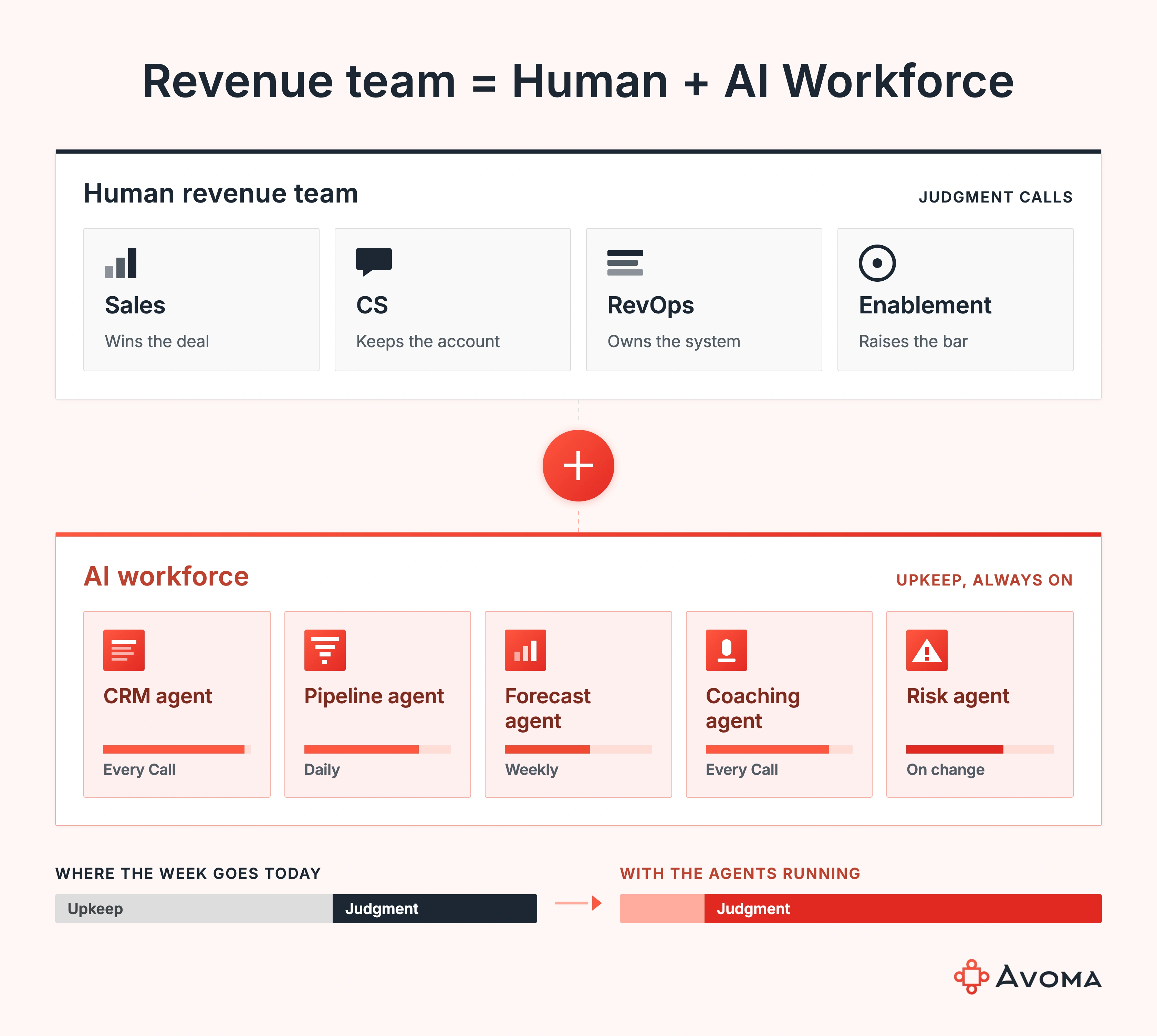
Agents are good at recurring, well-defined work with a clear finish line. They're not built for the parts of selling that depend on reading a room, building trust over time, or making a judgment call with incomplete information.
Negotiation is a good example. An agent can tell you a deal has stalled and why. Deciding how much to concede, when to walk away from a discount request, or how to read a buyer's hesitation in a live conversation still needs a person. That kind of stakeholder-by-stakeholder judgment is exactly what makes enterprise deals hard to hand off entirely.
The same goes for relationships that outlast any single deal, executive sponsorship, and the exceptions that don't fit a rubric. Those are exactly the effectiveness metrics that still come down to human judgment: win rate on strategic accounts, expansion conversations, and the calls a rep makes that a scorecard can't fully capture.
Common Mistake: Treating agent coverage as a reason to cut coaching or 1:1 time. Agents remove the busywork around a deal, and a manager or rep still has to apply judgment to it. That's the lens worth applying when evaluating a vendor, too.
What should you look for in an AI sales agent?
The market has more agents than jobs worth automating right now, so it helps to have a short list of what matters before you buy one.
- Does it finish the job, or hand it back to a person halfway through? A "sales agent" that still needs someone to approve every output is a copilot with better marketing.
- Can it see the same context a rep would? An agent limited to CRM fields alone will always miss what happened on the call.
- Does it work across more than 1 job, or lock you into a point solution? A prospecting-only agent solves 1 of the 7 jobs covered above. Check whether it can extend into CRM, pipeline, or coaching later.
- Can you see why it did what it did? An agent that updates a CRM field or flags a risk should point back to the call or email that triggered it. Without that, adoption stalls the first time someone doesn't trust the output.
- What happens when it's wrong? Every agent misjudges a signal eventually. The real question is whether there's an easy way to review, correct, and have that correction improve the next call.
The practical test is whether each new agent you add shares data with the ones you already have, instead of becoming 1 more disconnected tool in the stack. That matters more than which single vendor you pick for any one job.
If your team is already fielding a Revenue AI workforce across CRM, pipeline, forecasting, and coaching, Avoma's revenue intelligence is built around that same shared context: one platform where meeting data, CRM records, and pipeline activity feed every agent instead of 5 separate ones.
Frequently Asked Questions
AI sales agents are software programs that use AI to plan and complete multi-step sales tasks on their own, drawing on data such as CRM records, call transcripts, and pipeline activity. They differ from simple automation, which follows a fixed rule, and from copilots, which suggest an action but leave execution to a person.
AI sales agents handle recurring sales work such as prospecting and outreach, CRM record updates, pipeline inspection, deal-risk monitoring, forecast validation, call coaching, and follow-up email drafting or sending. The specific jobs an agent performs depend on what data it has access to and how it's configured.
No. An AI SDR is one type of AI sales agent, focused specifically on prospecting, lead qualification, and meeting booking. AI sales agents as a category cover a wider range of jobs, including CRM maintenance, pipeline inspection, forecasting, and coaching, that have nothing to do with outbound prospecting.
Sales automation follows a fixed rule (if X happens, do Y) and has no ability to adapt when a situation falls outside that rule. An AI sales agent plans a sequence of steps toward a goal, using live context such as a CRM record or call transcript, and adjusts its actions based on what it finds rather than following one fixed path.
Yes. This is one of the more established uses of AI sales agents. An agent with access to call transcripts and meeting notes can update deal stages, log call outcomes, and fill in CRM fields directly from a conversation, instead of relying on a rep to enter that data manually after the fact. See how this looks in practice in our guides to HubSpot AI agents and Salesforce AI agents.
AI sales agents are built to take on recurring, well-defined tasks such as CRM upkeep, pipeline checks, and follow-up drafting. They aren't built for the parts of selling that depend on judgment, negotiation, and relationship-building over time. Most sales organizations currently deploying agents use them alongside reps, not as a replacement for them.
Agentic AI for sales refers to AI systems, often called AI sales agents, that can plan and execute multi-step sales workflows autonomously rather than performing a single scripted action. The term distinguishes this category from simpler chatbots or rule-based automation, which cannot adapt their actions based on new context partway through a task.


Dive into Our Latest
Avoma Insights.


What's stopping you from turning every conversation into actionable insights?


