
What is BANT in sales and when should you use it?

Table of Contents:
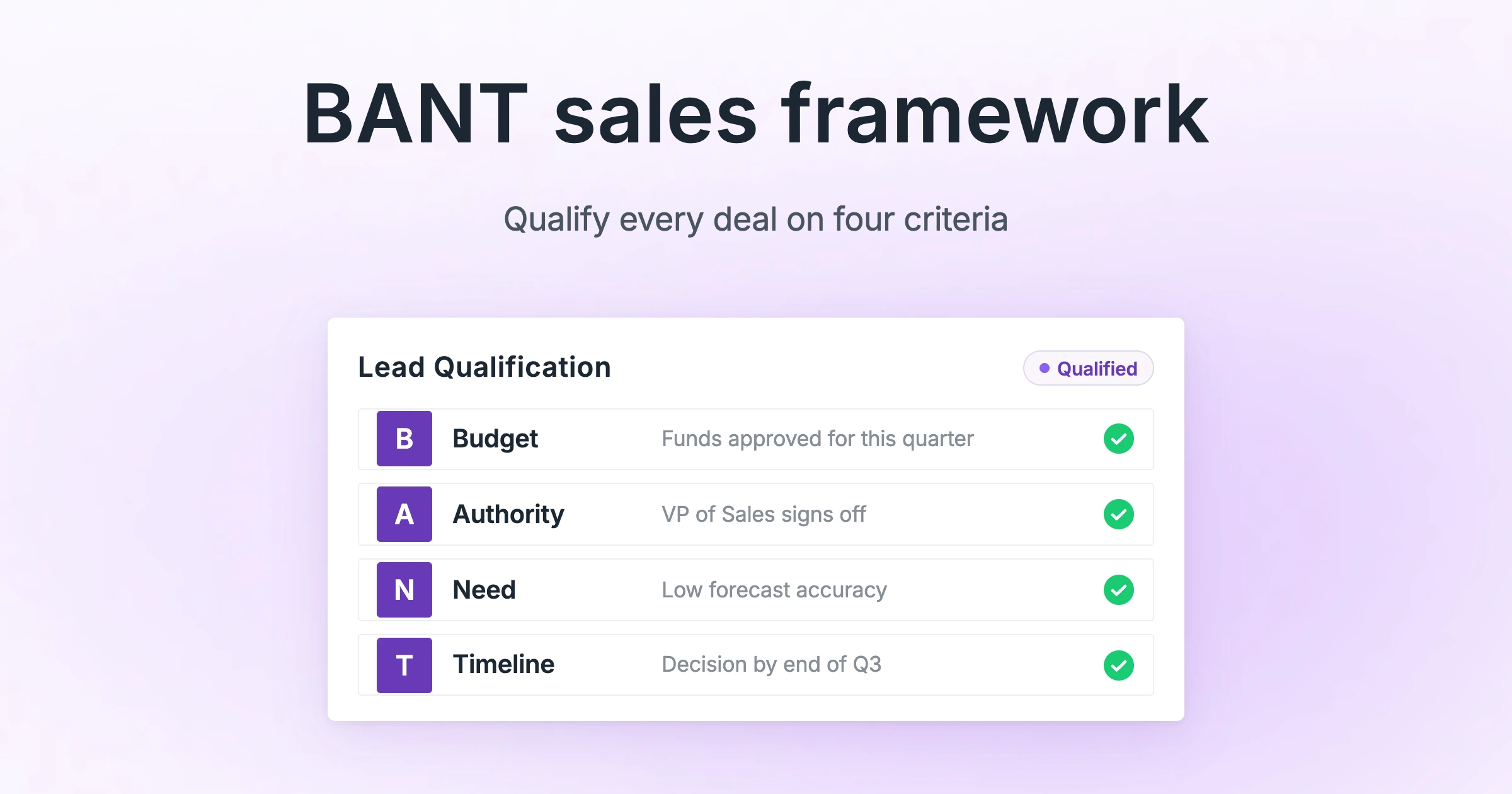
BANT in sales is a qualification framework, also called the BANT methodology or BANT model.
The acronym stands for Budget, Authority, Need, and Timeline, and it helps reps decide whether a lead is worth pursuing. Reps check whether the buyer can pay, who signs off, what problem they need solved, and when they plan to buy.
BANT qualifies deals. It is not a forecasting method.
In sales, it's important to quickly determine whether a prospect is a good fit and worth investing more time in.
The BANT sales framework is one of the fastest ways to qualify leads. It's a structured approach that allows you to gauge a prospect's potential for conversion so you can spend your time and focus working on those deals.
In this blog post, we'll look at:
- What BANT stands for and where it came from
- How to use each BANT component strategically
- What BANT looks like in real Avoma discovery calls
- 25+ BANT questions
- Pros and limitations and BANT vs MEDDIC, CHAMP, and SPIN
- Is BANT still as effective in 2026?
- A BANT scoring model
- How to build BANT into your CRM and how AI automates it
What is BANT? Meaning and acronym explained
BANT is an acronym that stands for:
- Budget: Can the buyer fund this purchase, or reallocate spend from a tool they already pay for?
- Authority: Who decides, who influences, and who can block the deal (IT, security, legal)?
- Need: What problem are they trying to solve, and what does it cost them today?
- Timeline: When do they need a solution in place, and what event is driving that date?

Already know the basics? Jump to the question bank or the scoring model.
Where did the BANT framework come from?
Most sources say BANT originated at IBM, which used it to help its sellers qualify opportunities.
Many sources date it to the 1950s or 1960s. We could not confirm the exact year from an IBM primary source, so treat the date as approximate.
Is BANT a qualification framework or a forecasting methodology?
The BANT qualification framework tells you whether a lead deserves a rep's time. Forecasting predicts which deals will close and when.
BANT feeds forecasting: A deal with a confirmed Timeline and Authority is easier to forecast. But BANT alone won't give you a commit number.
For that, see how teams run sales forecasting on top of qualification data.
To turn BANT signals into a number, use the scoring model below.
How to use the BANT sales methodology to qualify leads
BANT is a relatively simple and straightforward sales methodology to use, compared to the likes of MEDDIC, MEDDPICC, or SPICED.
But it was built for one-time license sales and a single decision-maker. Here's how each letter changes for modern B2B buying:
| Letter | Original assumption | Modern approach |
|---|---|---|
| Budget | A fixed, upfront license fee | Current spend, consolidation, and expected ROI |
| Authority | One person signs | A buying committee, including IT and security |
| Need | Match pains to product features | Quantify the business impact |
| Timeline | "When will you decide?" | A critical event, like a contract renewal |
1. Go beyond the prospect's 'budget'
Subscription pricing makes upfront budget less of a gate. Most B2B SaaS companies offer pricing plans from $10 to potentially $1000 per month, so budget isn't a serious roadblock as it used to be before.
What our calls show (123 discovery and demo calls):
- 11% named a budget figure. Only 3% had budget already allocated.
- 36% were replacing a tool they already paid for.
- 51% raised price sensitivity.
"I'm not saying I wanna spend less. I just wanna use the dollar wisely."
-IT and ops lead, 100+ seat media company
How to qualify budget today:
- Ask what they spend on the tools you'd replace or consolidate.
- Ask about your prospect's expected ROI and understand how your solution capabilities align with their expectations.
- Disqualify if expected ROI and available spend are far apart.
Go deeper with the Budget questions.
2. Identify the 'authority' involved in making the final decision
Today, an average of 5 decision-makers are involved in the sales process, as per the 2024 Sales Trend Report by HubSpot.
In our calls, 67% of prospects needed someone else to decide, and only 32% identified the final decision-maker.
| Stakeholder | Role | What to find out |
|---|---|---|
| Champion | Internal advocate who sees the value and persuades decision-makers | Can they get you access to the decision-maker? |
| Leadership team | Has a say but can't sign | Which outcome matters most to them? |
| Legal, IT & compliance | Handles legal, security, and compliance reviews | Does a review need to clear before the trial? (Came up in 43% of calls.) |
| Decision-maker | Holds final authority to sign or veto | Cost and expected impact |
A clean SDR to AE handoff carries this stakeholder map forward. Go deeper with the Authority questions.
3. Pinpoint the business 'needs' and challenges
Reps often match a need to a feature and stop there. Reps can take the leaf out of the 'I' component of the SPICED methodology here, which stands for Impact. Dig through three layers:
- Problem: What's broken today?
- Impact: What does it cost in revenue, time, or churn?
- Consequence: What happens if nothing changes?
In our calls, 99% of prospects described a need, but only 34% tied it to a metric like conversion or revenue. Go deeper with the Need questions.
4. Identify the 'timeline' of making the decision
Asking your prospect questions such as "When do you need to make a decision?" may not result in a helpful response but rather an arbitrary one. Instead, find the critical event (the 'CE' in SPICED) that's driving the change.
Critical events in our calls:
- Trial end date was the next deadline: 32% of calls
- Current tool's contract renewal drove timing: 15%
- Quarter or fiscal year-end: 13%
One buyer's contract renewed in February with 60 days' notice, so they planned a November trial to switch by year-end.
Ask when the current contract renews and how much notice it needs. Go deeper with the Timeline questions, and track renewal dates in your CRM.
BANT in real sales calls: What Avoma discovery calls show
We reviewed 123 discovery and demo calls with new prospects, recorded in Avoma. We coded each call from its AI meeting notes for how Budget, Authority, Need, and Timeline showed up.
If the notes didn't capture something, we counted it as not mentioned, so treat these figures as a floor. This is a sample of buyers evaluating sales software, not an industry benchmark.
| BANT element | What we saw (123 calls) | What it means for reps |
|---|---|---|
| Budget | 11% named a budget figure. 3% had budget allocated. 36% were replacing a tool they already paid for. 51% raised price sensitivity. | Ask about current spend and consolidation, not "What's your budget?" |
| Authority | 67% needed someone else to decide. Only 32% of calls identified the final decision-maker. Security, IT, or compliance came up in 43%. | Map the buying committee and IT/security on call one. |
| Need | 99% described a need. 34% tied it to a success metric like conversion or revenue. | Quantify the need in a metric the buyer already reports on. |
| Timeline | 74% gave some timing. The trial was the next deadline in 32%. Renewal of the current tool drove timing in 15%. Quarter or fiscal year-end came up in 13%. | Ask when the current contract renews and what notice it needs. |
| Frameworks | 10% named a qualification framework (MEDDIC/MEDDPICC, SPICED, BANT, or SPIN). | Most buyers won't speak in frameworks. Build BANT into your questions, not your vocabulary. |
Want to turn these signals into a number? Jump to the scoring model.
Teams also don't treat BANT as all-or-nothing. A head of global sales at an IT services company, whose team blends MEDDIC and BANT, told us: "If we don't get budget, if we know there is a need and if there is a timeline and that person… has the authority, we would go ahead on the first call."
By the second discovery call, though, they expect all four: "It's good from a sales manager perspective to have all the 4 needs covered. So that should be a benchmark."
Some teams want BANT precisely because it's light. A RevOps director at an automotive tech company told us: "I feel like a simplified methodology to basically qualify, like, deal readiness would be more impactful than something more in depth like MEDDPIC."
25+ BANT questions to ask on discovery calls
Use these as prompts, not a script. Pick two or three per letter based on what you already know from research.
For a longer list, see our discovery call playbook with 90 questions.
Budget questions
- What are you spending today on tools that solve this problem?
- Which of those tools would this replace or consolidate?
- What outcomes would justify this investment for you?
- Is budget already set aside for this, or does it need to be approved?
- Who owns the budget line this would come from?
- How many people need this, and how many aren't using what you have today?
Authority questions
- Who decided that you should be investing in our solution?
- What does your buying committee look like?
- If you like our solution, what would be the next steps?
- Who is the final decision-maker in the company?
- Who else needs to see this before you move forward?
- Does IT or security need to review this before a trial?
- How does the handoff work from your BD team, and what does the sales process look like after that?
Need questions
- How are the [specific] issues affecting your team, customers, or business outcomes?
- What would happen if these challenges were unresolved?
- Can you estimate the financial or operational impact of these challenges?
- In what way is this impacting customer retention and satisfaction?
- What impact do you expect this to create? Which metrics should improve?
- Do you follow a methodology like MEDDIC or BANT today? How do you check that reps apply it?
- What have you already tried, and why didn't it work?
Timeline questions
- When does your current contract renew, and how much notice does it need?
- What happens if nothing changes by then?
- Is there an event driving this, such as a new hire class, a funding round, or a new quarter's targets?
- When would you want a trial running, and what would make it a success?
- What steps sit between a successful trial and a signed contract?
- Who needs to sign off, and how long does that usually take?
Pros and limitations of BANT
Pros
- Simple to learn. New SDRs can use it in their first week.
- Fast. It works on a 15-minute qualification call.
- Easy to put in a CRM as four fields and a score.
- Works as a first-call gate before heavier frameworks like MEDDIC.
Limitations
- Budget is rarely stated up front. In our call sample, only 11% of prospects gave a figure.
- It assumes one decision-maker. Most B2B deals involve a committee.
- It qualifies the lead but says little about decision criteria, competition, or the paper process.
- Used as a checklist, it feels like an interrogation and buyers disengage.
- It is often checked once on the first call and never updated across the deal.
A sales leader at a sports-wearables company summed up the checklist problem: "There's no intelligence in the BANT scorecard other than, like, hey, did you qualify what the budget is? ... It's one layer, and it doesn't go deeper."
BANT vs MEDDIC vs CHAMP vs SPIN
BANT is the lightest of the common qualification frameworks. Here's how it compares.
For a deeper look at each, see our guide to sales methodologies.
| Framework | Stands for | Best for | Main difference from BANT |
|---|---|---|---|
| BANT | Budget, Authority, Need, Timeline | High-volume, shorter cycles, SDR qualification | — |
| MEDDIC | Metrics, Economic buyer, Decision criteria, Decision process, Identify pain, Champion | Complex, multi-stakeholder enterprise deals | Adds decision criteria, process, and a champion |
| MEDDPICC | MEDDIC + Paper process, Competition | Enterprise deals with procurement and competitors | Adds paper process and competition |
| CHAMP | Challenges, Authority, Money, Prioritization | Teams that lead with the buyer's problem | Starts with Need (Challenges), not Budget |
| SPICED | Situation, Pain, Impact, Critical Event, Decision | Recurring-revenue, customer-centric sales | Focuses on impact and a critical event |
| SPIN | Situation, Problem, Implication, Need-payoff | Structuring discovery questions | A questioning technique, not a qualification checklist |
Many teams blend them. One prospect we spoke with runs a mix of MEDDIC and BANT: BANT on the first call, MEDDIC as the deal matures.
Is the BANT sales methodology still useful in 2026?
Yes. BANT works best as a first-call gate, tracked and updated across the whole deal.
It fails when reps make one of three mistakes:
| Mistake | Fix |
|---|---|
| Treating BANT as a static list of questions | Use it as a guide to the information you need |
| Box-ticking: "What is your budget?" "Are you the final decision-maker?" | Ask layered questions about current spend, impact, and what's driving the change |
| Checking it once on the first call | Update the score as the deal moves |
"It should be across the entire deal as well, not just on the first call."
-Head of global sales, IT services company
How to score BANT: A simple scoring model
A BANT score turns qualification into a number your team can compare across deals.
Score each letter from 1 to 5, the same range Avoma's rating-scale scorecard questions use. Then add them up for a total between 4 and 20.
This is how BANT lead qualification works in practice: Every lead gets the same four checks before it moves to the next stage of your BANT sales process.
| Score | Budget | Authority | Need | Timeline |
|---|---|---|---|---|
| 1 | No information | Unknown who decides | No clear problem | No date or driver |
| 2 | Price sensitivity only | Talking to a user only | Problem named, no impact | "Sometime this year" |
| 3 | Current spend identified | Champion engaged | Problem with a stated impact | Rough target date |
| 4 | Budget being requested or consolidation discussed | Decision-maker named and engaged | Impact described in business terms | Target date with a reason |
| 5 | Budget allocated or consolidation agreed | Decision-maker and IT/security engaged | Impact quantified in a metric the buyer tracks | Critical event confirmed, e.g. renewal date |
- 16–20: Sales-ready. Move to demo or trial.
- 10–15: Keep working. Fill the gaps on the next call.
- 4–9: Nurture or disqualify.
Want Avoma to score every call on this scale for you? See how to automatically score sales calls against BANT criteria.
BANT example: A qualified deal vs an unqualified deal
| BANT element | Qualified (score 18/20) | Not yet qualified (score 8/20) |
|---|---|---|
| Budget | Spends on a note-taker today and wants to consolidate it with coaching (4) | "We'll see what it costs" (2) |
| Authority | RevOps lead on the call; CRO joins the demo; IT reviewing the DPA (5) | An SDR exploring tools on their own (2) |
| Need | CRM fields are 40% empty and forecast calls run on gut feel (5) | "Notes would be nice" (2) |
| Timeline | Current tool renews in 90 days with 60 days' notice (4) | "Maybe next year" (2) |
The first deal goes to a trial. The second gets a follow-up to find the real owner and a problem with a cost attached.
How to build BANT into your CRM
- Create four fields on the deal or opportunity: Budget, Authority, Need, Timeline. Use a pick-list (1–5) plus a notes field for each.
- Add a formula field for the total BANT score.
- Make a minimum score an entry rule for your qualified stage. See how to set pipeline stage entry and exit rules.
- Add a renewal-date field for the buyer's current tool. It is often your best Timeline signal.
- Review BANT fields in pipeline reviews, not just at handoff.
How AI automates the BANT sales qualification process
AI can handle four parts of BANT: Call prep, notes, call scoring, and CRM updates.
1. Automate account research
Before the discovery call, AI can pull company size, funding, products, and key stakeholders, so you walk in with sharper questions. Pair it with a short pre-call routine.
2. Extract buyer insights & generate follow-up emails
AI can record and analyze sales conversations to generate notes based on the BANT (Budget, Authority, Need, and Timeline) framework.
Avoma also drafts the follow-up email and action items.
Forgot a detail? Ask Avoma, the built-in AI chatbot, and it finds the answer in seconds.

3. How to automatically score sales calls against BANT criteria
Managers rarely know whether reps actually cover BANT on calls. AI-powered BANT scorecards score every call against each letter, so reps and managers see what was asked, touched on, or missed.
Read more on how teams track methodology adherence with AI.

To set it up in Avoma:
- Add one question per BANT letter. Use Rating scale (1 to a maximum of 5) for how well a letter was covered, matching the scoring model. Use Yes / No for whether something happened, e.g. "Did the rep ask when the current contract renews?"
- For a Rating scale question, click the empty question field and enter your question.
- Review the examples of valid questions shown on the right for guidance.
- Click Generate answers with AI to create answers and scoring, then review and edit them as needed.
- Review low-scoring calls weekly and coach to the missed letter.
4. Auto-fill BANT fields in your CRM
Manual BANT fields go stale because reps update them after the call, if at all. Avoma fills them from the conversation instead:
- Set up custom BANT fields in your CRM (see the setup steps). Avoma integrates with Salesforce, HubSpot, Pipedrive, Copper, Zendesk Sell, and Zoho CRM.
- Avoma generates AI notes in a BANT structure and automatically maps them to the matching fields.
- Edits to the notes sync back to the CRM in real time.

Master the BANT sales methodology with Avoma
Avoma covers every step above in one place: BANT-structured notes, automatic CRM field updates, and call scoring against your BANT scorecard. Reps spend less time on admin, and managers can see which BANT letters each rep misses.

Interested in knowing how you can automate and successfully implement the BANT framework?
Talk to our product experts. Check out additional features of Avoma here.
Frequently Asked Questions
BANT stands for Budget, Authority, Need, and Timeline. Reps use it to check whether a lead can buy, who decides, what problem they have, and when they plan to act.
BANT qualification is the process of checking a lead's Budget, Authority, Need, and Timeline before a rep invests more time. It usually starts on the first discovery call and should be updated as the deal moves.
BANT is widely attributed to IBM, which used it to qualify sales opportunities. The exact year is not confirmed by an IBM primary source.
BANT is a qualification framework. Its signals, especially Authority and Timeline, feed into forecasting, but it doesn't predict close dates on its own.
A BANT score rates each of the four elements from 1 to 5 and adds them up, for a total between 4 and 20. A total of 16 or more usually signals a sales-ready deal. See the scoring model.
Yes, as a first-call qualification gate. It works best when budget is framed as value or current spend, authority covers the full buying committee, and the score is updated across the deal.
BANT is faster and suits shorter cycles and SDR qualification. MEDDIC suits complex, multi-stakeholder deals. Many teams use BANT first and MEDDIC as deals mature.
Start with "What are you spending today on tools that solve this?", "Who else needs to see this?", "What does this problem cost you?", and "When does your current contract renew?" See the full list of 25+ questions.





What's stopping you from turning every conversation into actionable insights?


