
System of action vs system of record: What's the difference?

Table of Contents:
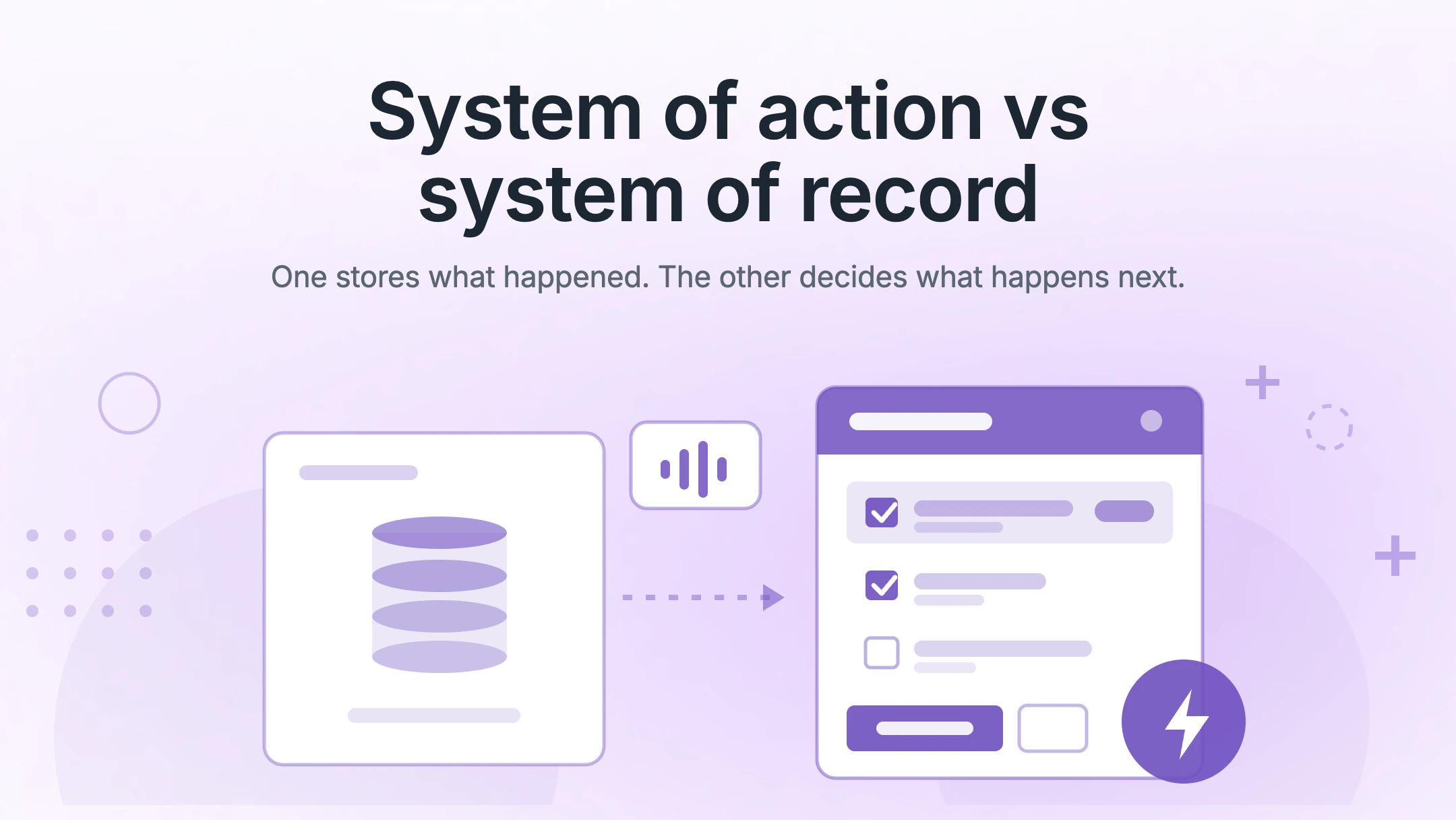
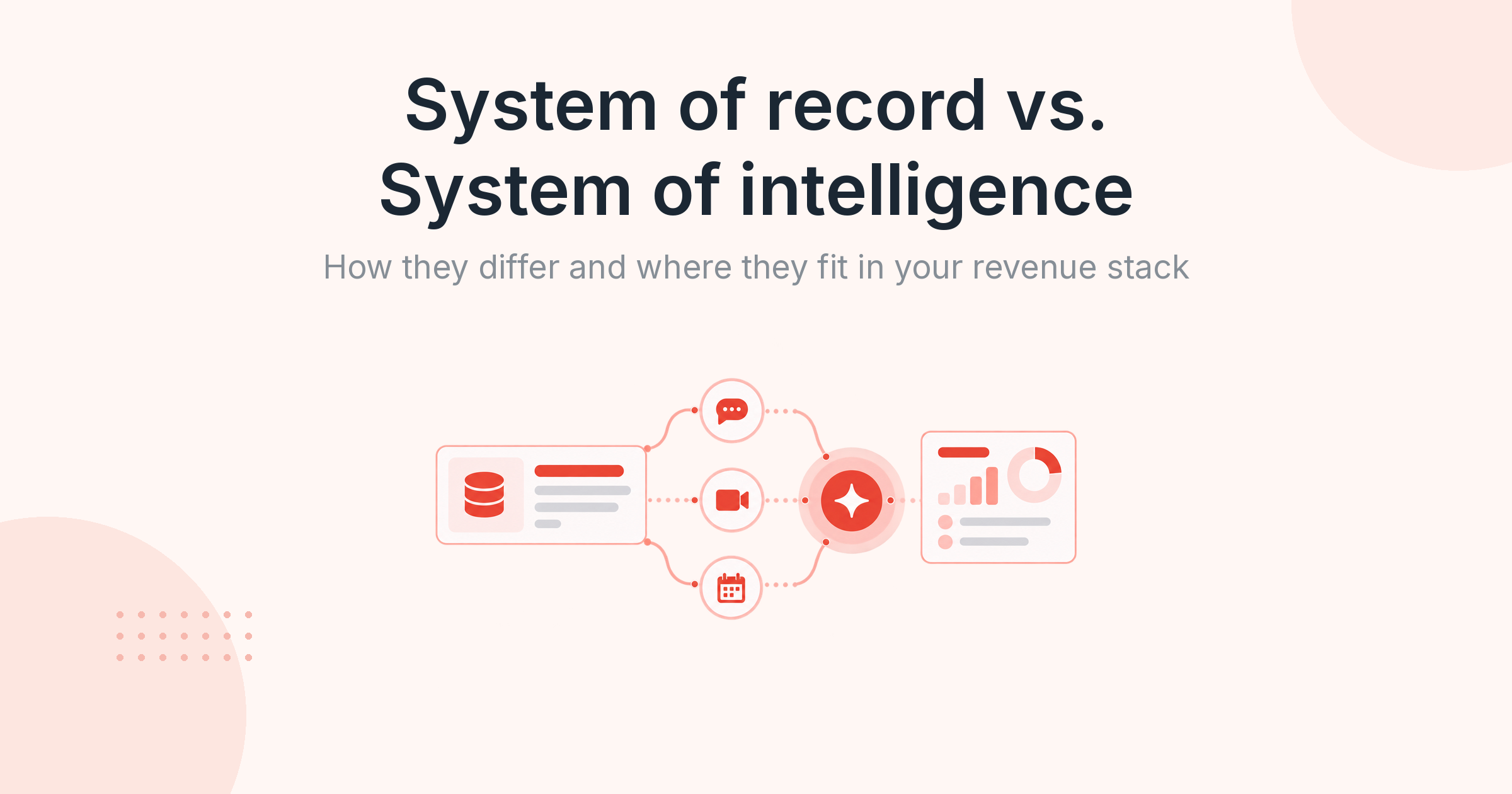
A system of record stores the data your business trusts. A system of action uses that data, along with signals from calls, emails, and workflows, to decide what should happen next and trigger or execute the action.
Consider a $120,000 deal marked healthy in Salesforce. The CRM says it's in negotiation and on track to close this month. But the latest call reveals that legal is stuck, procurement wants different pricing, the economic buyer isn't involved, and there's no next meeting. This kind of gap shows up constantly in complex, multi-stakeholder deals, covered in our guide to enterprise sales.
The CRM isn't wrong. It's missing what happened since the last update.
A system of action closes that gap. It turns those signals into alerts, tasks, recommendations, or CRM updates, then writes the outcome back to the system of record.
The two work together: One maintains the source of truth; the other turns that truth into action.
The harder question is what actually qualifies as a system of action, especially now that almost every product claims to be AI-powered. That's what this guide examines.
TL;DR
- A system of record stores authoritative data (CRM, ERP, HRIS). A system of action turns that data into tasks, alerts, recommendations, or executed changes.
- These aren't rival categories, side by side at a glance. Most real systems combine both jobs, and a system of action still depends on a reliable record to work from.
- The test for a real system of action: record → understand → act → write back. Skip the writeback step and the CRM never learns what happened.
- Not every AI copilot qualifies, see how to tell the difference. If a human still has to interpret the output and do the work by hand, most of the loop is still manual.
- Autonomy is a spectrum, not a toggle. The strongest systems know when to execute, when to ask first, and when to leave a decision alone.
System of action vs system of record at a glance
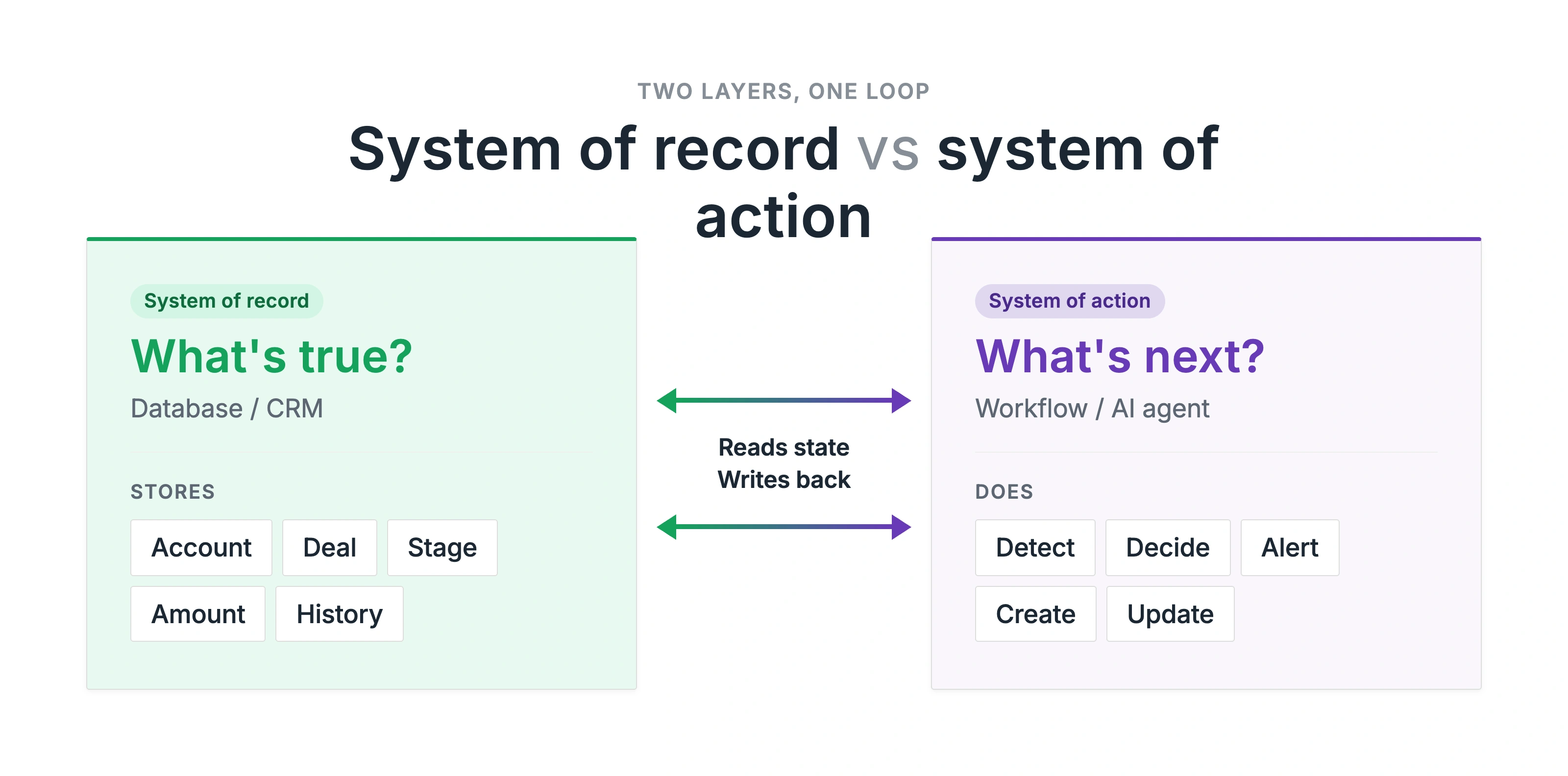
Before going deeper, here's how the two categories divide the work.
| Factor | System of record | System of action |
|---|---|---|
| Primary job | Maintain authoritative data | Turn information into action |
| Answers | What is true? | What should happen next? |
| Typical inputs | Structured business data | Records, events, signals, context |
| Typical output | Updated records | Tasks, workflows, recommendations, executed actions |
| Human involvement | Data entry and management | Ranges from human approval to autonomous execution |
| Examples | CRM, ERP, HRIS | Workflow platforms, automation systems, AI agents |
| Success looks like | Accurate, reliable data | The right action, at the right time |
These aren't two product categories competing for the same budget. A single platform can carry system-of-record and system-of-action capabilities at once, and a growing number do.
The distinction works better as a lens than a shopping list. For any tool in your stack, ask what it's responsible for in a given workflow: is it the thing everyone trusts as the source of truth, or the thing that notices something and moves it forward? The label on the pricing page rarely tells you which.
What is a system of record?
A system of record is the authoritative source for one type of business data. When two systems disagree about a fact, the system of record wins, because it's the one everyone has agreed to trust.
Common examples:
- Salesforce or HubSpot, for customer and opportunity data
- An ERP, for financial, inventory, or operational data
- An HRIS, for employee data
- A support platform, for tickets and case history
What a system of record is good at
A system of record exists to do a specific set of jobs well: keep one consistent version of a record, preserve history, enforce permissions, support reporting, hold up under an audit, and give every team the same numbers to work from.
None of that requires intelligence. It requires discipline: one place, one format, and one owner per field.
Where systems of record struggle
The CRM's real weakness is that someone still has to notice what changed, decide what it means, and manually update the record before that change becomes useful to anyone else.
During a single call, a rep might learn that legal approval stalled, that the economic buyer never joined, that the timeline slipped, or that a competitor showed up in the deal. None of that becomes fact in Salesforce until a person translates it: conversation, then interpretation, then a CRM update, then a next action.
A system of record was never built to notice and act on every change happening around it. That's the job a system of action handles, covered next.
Key Takeaway: A system of record's job is to be trusted, not to be smart. Expecting it to notice and act on everything happening around it asks it to do work it wasn't designed for.
What is a system of action?
A system of action uses data, events, and context to determine that something needs to happen, then triggers, recommends, or executes it.
Action is the word that defines this category, whether or not AI is involved. A tool can run on the latest model and still fail the test if nothing downstream changes when it speaks up.
What does a system of action do?
A system moves toward being a system of action when it can do five things:
- Detect a meaningful event or signal
- Understand what that signal means
- Determine the appropriate next step
- Trigger, recommend, or execute that action
- Capture the resulting outcome
Example: A customer mentions on a call that legal review is holding up the deal. A system of action flags the legal and procurement risk, decides a follow-up task is needed, creates or recommends it, alerts the account owner, and updates the deal record once the work is done.
System of action examples across the business
- Revenue: an opportunity has no confirmed next step, so the system flags it and creates a follow-up.
- Customer success: a customer raises the same adoption problem on three calls in a row, so the system surfaces a churn risk and assigns the CSM an action, the kind of pattern worth catching before the next QBR turns into a surprise.
- IT: a service starts failing, so the system kicks off the remediation runbook without waiting for a ticket.
- Finance: an invoice crosses an approval threshold, so the system routes it to the right approver.
- Operations: inventory drops below a set level, so the system opens a replenishment order.
That last example is worth sitting with. Inventory-triggered replenishment has run this way in ERP systems for decades, long before anyone called it AI. Whether AI changes any of that, and how much, is worth untangling directly, covered next.
The missing layer: System of intelligence vs system of action
There's a layer sitting between the record and the action, and skipping over it is where most "AI system of action" claims fall apart: a system of intelligence.
Picture the same deal from the intro. The CRM holds:
Deal amount: $120K, stage: negotiation, close date: August 31.
Conversation context adds:
No next meeting scheduled, legal approval outstanding, and the champion hasn't looped in the CFO.
A system of intelligence looks at all of that, weighing it against the metrics and signals that predict deal risk, and concludes: this deal is at risk. That's a genuinely useful conclusion. Nothing has happened yet.
A system of action answers "What should happen next?"
Extend the same example. The action layer can alert the rep, recommend looping in the CFO, create a legal follow-up task, flag the risk ahead of pipeline review, and update the relevant CRM fields once that work is done.
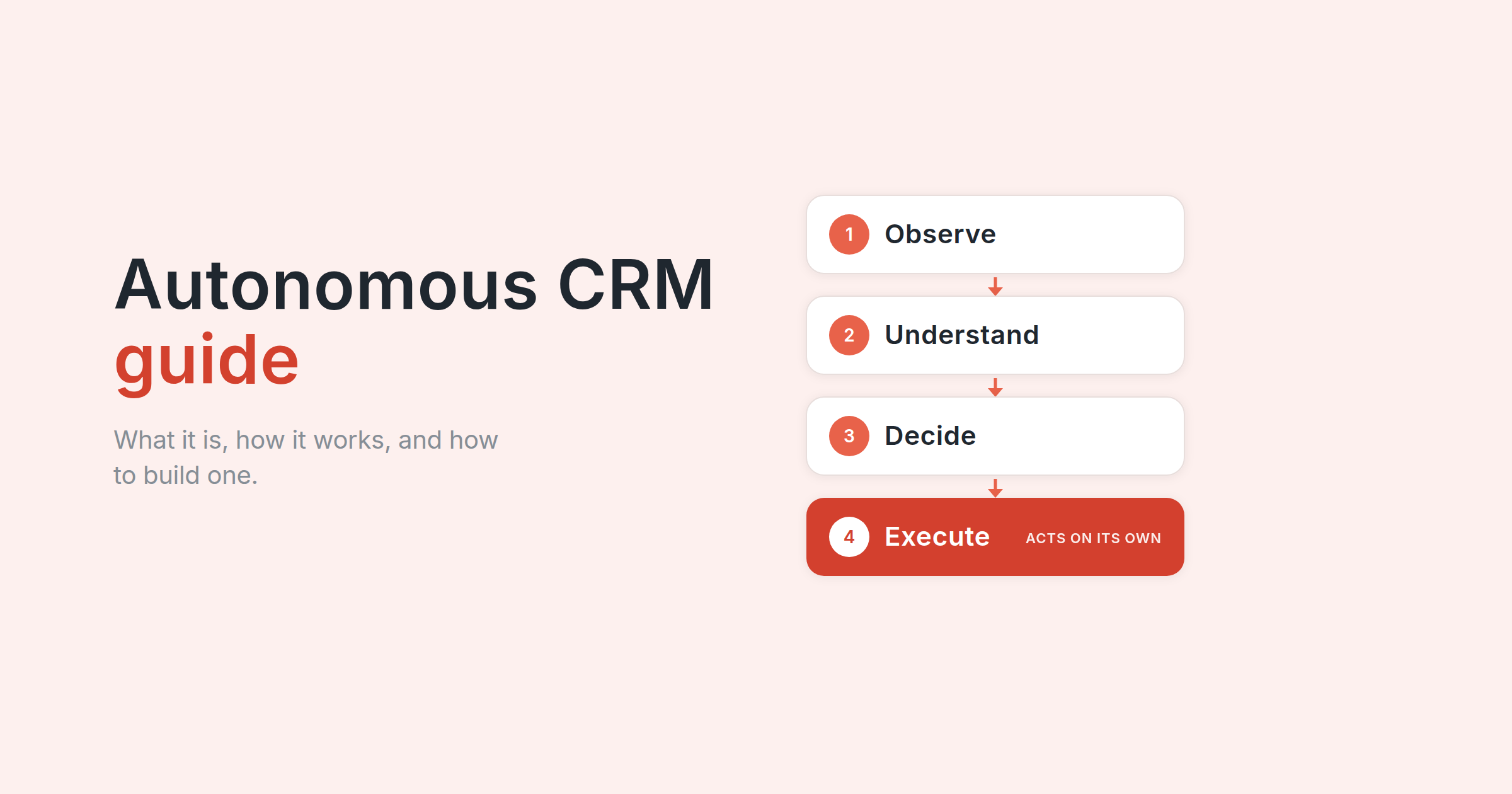
That four-stage sequence is worth naming, because it's the real test for telling a system of action apart from a tool that just talks about the record. Call it the action loop: record, understand, act, write back.
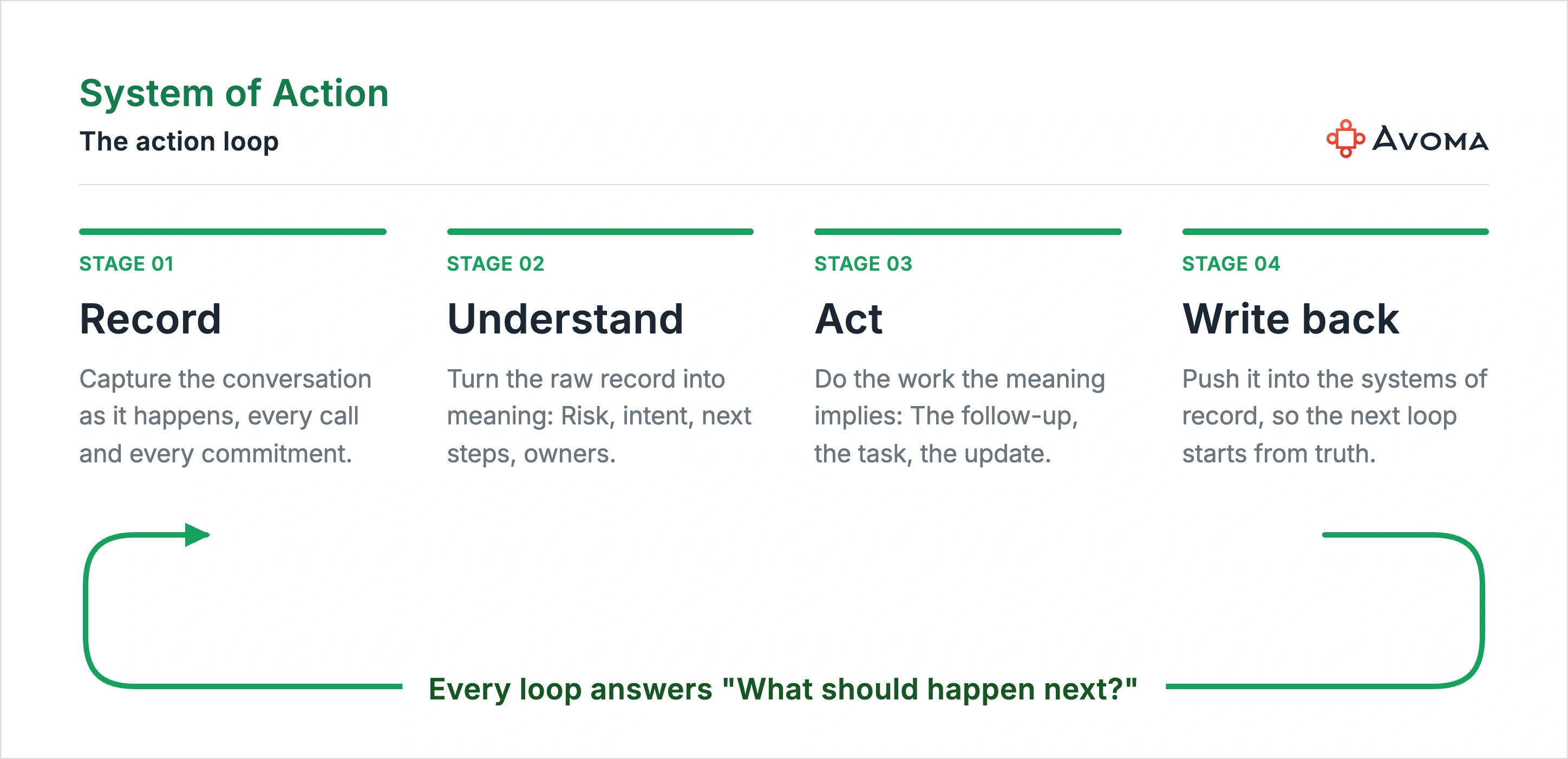
- Record: "This opportunity is worth $120K and closes August 31."
- Understand: "The deal is at risk. Legal review is blocked and there's no confirmed next meeting."
- Act: create the legal follow-up, alert the account owner, recommend the next step.
- Write back: the resulting task, alert, and updated fields become part of the record again.
Producing an insight is a different job than acting on it. A tool that tells a rep what happened, and leaves the interpreting, the doing, and the CRM update to a human, has only closed the first half of the loop.
That's also the practical test the next section applies to something a lot older than any AI product: rule-based automation.
AI didn't invent systems of action
Traditional software has taken action for decades, with no AI involved. If lead score is above a threshold, assign the lead to sales. If an invoice is above a set amount, route it for approval. If inventory falls below a set level, create a replenishment request.
Those are systems of action. Rule-based and mostly invisible, but each one detects a condition and does something about it without a human in the loop.
So what does agentic AI change?
The difference shows up in how the trigger gets decided, not in whether action happens at all. A traditional workflow fires a predefined action off a known trigger. An agentic workflow interprets several signals together, determines the appropriate response, and executes it or escalates to a person. That shift, and what it takes to hand a whole sales process to one, is covered in full in our guide to agentic AI for sales.
A revenue comparison makes it concrete. Traditional automation: an opportunity has had no activity for 14 days, so the system sends an alert. Context-driven action: the last three conversations show unresolved legal concerns, no engagement from the economic buyer, and no agreed next step, so the system flags deal risk and recommends a specific intervention instead of a generic nudge.
Rules are often the better choice when a process is predictable and doesn't change much. AI earns its place when the decision depends on something that resists a fixed trigger, like a conversation or an email thread. Neither approach is inherently better. The right one depends on how structured the input is.
Data Point: "System of action" isn't a standardized label. Companies across revenue tech, HR tech, and IT software have all started describing AI products this way, and no two use it to mean exactly the same thing. Treat a vendor's claim to be "the system of action" for a category as marketing language first, and check the behavior against the questions covered later in this guide.
Does a system of action replace your CRM?
Usually not, and the reason is structural: a system of action needs reliable context to act on, and the CRM is where most of the reliable account and deal context already lives. Most teams end up layering AI on top of the CRM they already run rather than swapping it out.
The loop runs like this:
- The CRM supplies account, contact, opportunity, and history data.
- Other sources (calls, emails, support tickets) add more signals.
- A system of intelligence figures out what those signals mean.
- A system of action triggers the appropriate response.
- The outcome gets written back.
- The CRM reflects the latest state, ready for the next cycle.
What happens when the loop doesn't close
An AI assistant flags that a deal is at risk. The rep gets the alert and deals with the problem, but nobody updates Salesforce.
The insight surfaced and the rep acted on it, but the system of record never found out, so next week's forecast still runs on numbers that are already stale, the same drift that shows up whenever CRM data and revenue predictions fall out of sync. That's why writeback deserves more attention than it usually gets in an "agentic CRM" pitch.
Common Mistake: Treating writeback as optional. A system of action that never updates the record just moves the manual-update problem downstream instead of solving it.
What this looks like inside a normal week for a revenue team, not just as architecture, is worth walking through next, starting before the call even happens.
What a system of action looks like for a revenue team
Zoom in from the architecture to a single week on a rep's calendar.
Before the customer call
The system already knows the account history, the opportunity stage, the stakeholders, prior conversations, open risks, and the last agreed next step.
The useful action here is surfacing the handful of things the rep needs to walk in with, ahead of the call.
During and after the call
The customer says: "Procurement won't approve the current pricing structure."
A system of action flags that as a pricing objection, connects it to the opportunity, logs it, drafts a follow-up, and notifies whoever owns pricing approvals internally, all without the rep stopping to write any of it down.
Most of that signal, the objection, the missing next meeting, the stalled legal review, showed up first in the conversation itself, not in a CRM field. That's the specific layer Avoma's Risk Alerts and CRM automations are built to catch: they flag deal risk directly from call and email context, then write the result back into Salesforce or HubSpot without a rep touching a form. See how Avoma turns conversations into CRM action.
Before pipeline review
The CRM says the deal is Commit. The conversation evidence says pricing is unresolved, the economic buyer is absent, and there's no meeting scheduled.
The useful action is flagging that inconsistency before the manager finds it the hard way, in front of the whole team, during what should be a tight pipeline review, not a fact-finding exercise.
Key Takeaway: The value here is shortening the distance from customer signal, to business context, to decision, to action, well before pipeline review turns into a scramble.
Closing that distance is one thing when every action is low-stakes. It gets more complicated once a system can also draft a customer email or change a forecast on its own, which is where autonomy needs real boundaries.
Not every action should be autonomous
The goal is appropriate autonomy: matching how much a system can do on its own to the risk and reversibility of the action itself.
Actions that can often happen automatically
Lower-risk, reversible work is a reasonable default for automatic execution:
- Update CRM fields
- Classify conversation topics
- Create internal tasks
- Route information to the right person
- Enrich records with missing detail
- Surface alerts
Actions that usually need a human's approval
Judgment calls and anything customer-facing usually deserve a person in the loop first:
- Sending customer-facing communication
- Changing pricing
- Modifying a forecast
- Escalating an account
- Making a contractual commitment
Actions that should stay human-owned
Organizational policy, risk tolerance, and the relationship at stake decide this boundary, and it moves by company. A regulated industry draws the line differently than an early-stage startup does. There's no universal list, only a principle: the higher the cost of getting it wrong, the more a human belongs in the loop.
Best Practice: A mature system of action needs to know when to act, when to ask, and when to stay out of the way. Autonomy that can't recognize its own limits becomes a liability the first time it acts on the wrong deal.
Judging where that line sits for a specific tool is hard from a demo alone, which is what the evaluation questions below are built to help with.
How to evaluate a system of action
Turn the concept into questions you can use in a vendor evaluation. Skip "does this have AI agents." Every vendor will say yes.
1. What signals can it understand?
Some tools only read structured fields. Others interpret conversations, emails, CRM records, and support tickets together. The wider the range, the more of the real picture the system can act on.
2. Does it reason across context, or only fire on a trigger?
A rule that fires when one field changes isn't the same as a system weighing several signals before deciding what to do. Ask for an example where the input wasn't a single, obvious trigger.
3. What can it do?
Separate surfacing an insight, recommending an action, requesting approval, and executing automatically. A vendor's "AI-generated recommendation" is not the same claim as autonomous action, and a good demo makes the difference obvious.
4. Does it write outcomes back to the system of record?
This is the question most evaluations skip, and it may be the most important one here. An action that logs its results somewhere separate from the CRM builds a new silo instead of improving the one that already exists.
5. What controls exist?
Look for permissions, approval rules, audit trails, data access limits, and a clearly defined boundary on what the system can touch on its own.
6. What happens when it's uncertain?
A system forced to act on every signal will eventually act on the wrong one. Whether it can say "I'm not sure, here's what I'd flag for a person" matters more than how autonomous the vendor claims the product to be.
System of action vs system of record: You probably need both
A useful revenue architecture runs all four layers in sequence: the system of record holds the trusted state, a system of intelligence figures out what's changing and why, a system of action decides and executes the response, and the outcome flows back into the record. Most GTM stacks, built up layer by layer over time, already have pieces of this. The gap usually sits in the handoffs, not inside any single layer, the same handoffs RevOps exists to close in the first place.
The real shift is from software that waits for a person to notice, interpret, act, and remember to update the record, to software that helps close that loop on its own, with a human still setting the boundaries on what it can do without asking.
For revenue teams, a lot of the signals that matter never start as CRM fields. They start in a conversation, an email thread, or a meeting, and a system of action earns its name once it can turn those signals into something the business can act on, then hand the result back to the record everyone still relies on.
See how Avoma helps revenue teams capture customer context, surface what needs attention, and keep CRM records up to date.
Frequently Asked Questions
A system of record stores and maintains authoritative business data, such as customer, financial, or employee records. A system of action uses that data, along with events and context, to trigger, recommend, or execute what should happen next. The system of record answers what is true, while the system of action answers what should happen next. Most GTM stacks need both, since a system of action depends on reliable data from a system of record to act on.
A common revenue example is a customer mentioning during a call that legal approval is blocking a deal. A system of action detects that signal, determines a legal follow-up is needed, creates or recommends the task, notifies the account owner, and updates the CRM once the work is done. Outside revenue, an ERP that detects low inventory and automatically starts a replenishment workflow is also a system of action. This pattern predates AI and exists in many rule-based systems.
Usually not, since a system of action needs reliable account, contact, and opportunity data to act on, and a CRM is typically where that data lives. Rather than replacing the CRM, a system of action adds a layer on top of it: it interprets signals, decides what should happen, executes or recommends the action, and writes the outcome back into the CRM. Without that writeback step, the CRM stops reflecting reality even when the underlying action gets taken.
Salesforce functions primarily as a system of record: it stores and maintains authoritative customer and opportunity data. Features and connected AI tools layered on top of it can add system-of-action capabilities, such as automated tasks, alerts, or recommendations tied to CRM records. Our guide to Salesforce AI agents covers what those look like. Whether a specific Salesforce deployment behaves as a system of action depends on which of those capabilities are configured and what they're allowed to execute on their own.
A system of intelligence sits between a system of record and a system of action. It takes the data held in a record, along with other signals like conversations or emails, and interprets what that data means, for example concluding that a deal is at risk. A system of intelligence answers what a set of signals means, while a system of action answers what should happen next as a result. A tool that only summarizes or recommends, without triggering or executing anything, is functioning as a system of intelligence rather than a complete system of action.
An AI agent can function as a system of action if it detects a signal, decides what should happen, triggers or executes a response, and writes the outcome back to the source system. Not every tool marketed as an AI agent clears that bar. Some only summarize information or generate a recommendation, leaving a person to interpret it, do the work, and update the record by hand. In that case, most of the action loop is still manual, regardless of what the tool is called. Our guides to AI sales agents and AI agents for CRM go deeper into which jobs actually clear it.
Yes, a single platform can maintain authoritative data as a system of record and use that same data to trigger, recommend, or execute workflows as a system of action, at the same time. The distinction describes what a piece of software is responsible for in a given workflow, not a fixed category every product has to fall into. Many GTM platforms are adding system-of-action capabilities on top of the system-of-record function they have always had.


Dive into Our Latest
Avoma Insights.


What's stopping you from turning every conversation into actionable insights?


